Facts
The petitioner joined the respondent no. 3 establishment in 1988.
Source reference: p. 4Following a termination in 1990, the 2nd Labour Court, Calcutta, awarded reinstatement with full back wages in 1999.
Source reference: p. 1-2, 8On March 26, 2002, a memorandum of settlement under Section 18(1) of the Industrial Disputes Act was executed, wherein the petitioner accepted ₹3,50,000 as full and final settlement of all claims and voluntarily left the service.
Source reference: p. 3, 8, 9Twenty-one years later, in 2023, the petitioner filed a representation and subsequently this writ petition seeking arrear Provident Fund (PF) and Pension dues from December 1990 to March 2002.
Source reference: p. 1, 4, 9The respondent no. 3 (employer) and respondent no. 2 (RPF Commissioner) are both located in Chennai, Tamil Nadu, and the petitioner’s service was rendered entirely in Chennai.
Source reference: p. 2, 9Issues
1. Whether the High Court at Calcutta has the territorial jurisdiction to entertain the writ petition under Article 226 of the Constitution when the establishment and the relevant authorities are located outside its territory.
Source reference: p. 2, 92. Whether the fact that an earlier award was passed by a Labour Court in Calcutta and a previous writ was entertained by this Court confers jurisdiction for the present claim for PF arrears.
Source reference: p. 6, 9Law Applied
Clause (2) of Article 226 of the Constitution of India, which mandates that a High Court can exercise jurisdiction only if the cause of action, wholly or in part, arises within its territorial limits.
Source reference: p. 11Definition of "cause of action" from Mulla's Code of Civil Procedure as a bundle of facts necessary for the plaintiff to prove his right to judgment.
Source reference: p. 10The principles established in Kusum Ingots and Alloys Ltd. v. Union of India and National Textile Corpn. Ltd. v. Haribox Swalram, that mere residence of a petitioner or receipt of correspondence does not constitute an integral part of the cause of action.
Source reference: p. 11-12The "integral facts" and "nexus" tests from State of Goa v. Summit Online Trade Solutions Private Limited, holding that facts not germane to the specific relief sought do not confer jurisdiction.
Source reference: p. 13-14Reasoning
The court reasoned that although a previous Labour Court award was passed in Calcutta, the current dispute pertains specifically to the non-payment of PF dues by an employer and a PF Authority both situated in Chennai.
Source reference: p. 6, 9-10The petitioner was appointed in Chennai, worked in Chennai, and submitted his 2023 representation to authorities in Chennai; additionally, the settlement of 2002 also took place in Chennai.
Source reference: p. 4, 15Applying the "integral part of cause of action" test, the court found that since the establishment has no branch in West Bengal and all records are maintained in Tamil Nadu, no part of the specific cause of action regarding the disbursement of PF arrears arose within the jurisdiction of the Calcutta High Court.
Source reference: p. 2, 15The court noted that territorial jurisdiction can be raised at any stage and the prior proceedings did not preclude the current challenge.
Source reference: p. 9Holding
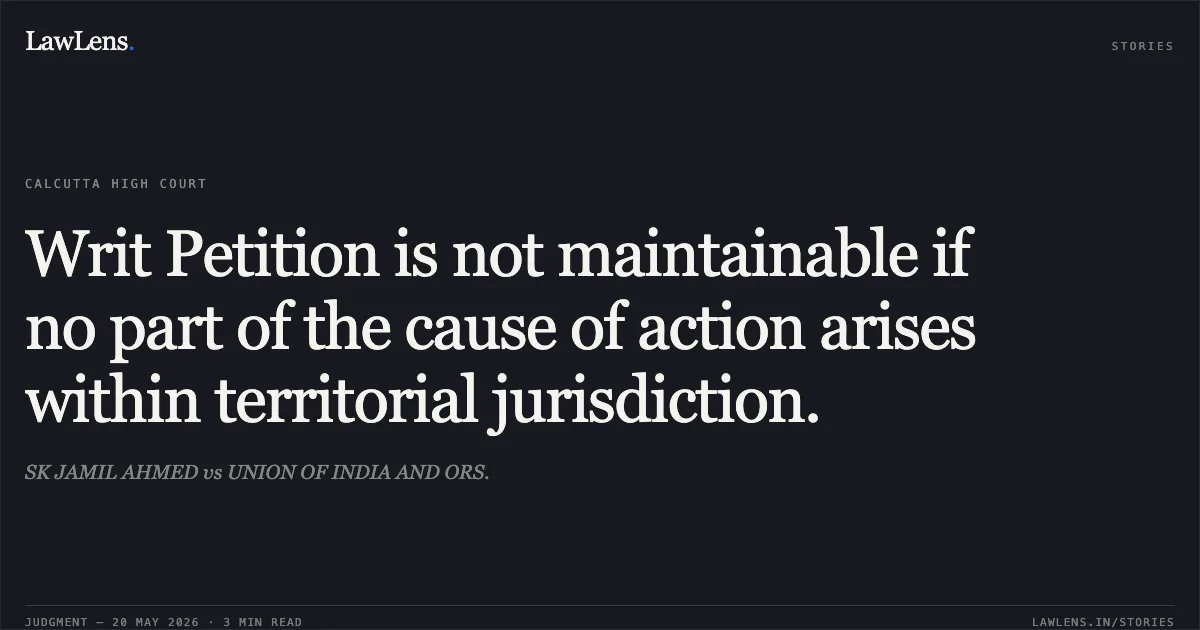
The court answered the primary issue in the negative, holding that it lacks territorial jurisdiction to decide the matter as the entire cause of action arose in Tamil Nadu.
The writ petition WPA 8712 of 2025 was dismissed for want of territorial jurisdiction, with liberty to pursue the case before the High Court at Madras, and all interim orders were vacated.
Source reference: p. 15-16Acts & Sections Cited
2 provisions across 2 statutes referred to in this judgment. Linked provisions open on LawLens.
Employees’ Provident Funds And Miscellaneous Provisions Act, 19521
the Act (alias, unresolved)1
Original Court PDF
SK JAMIL AHMEDvsUNION OF INDIA AND ORS.
Click to open original judgment
Original judgment, available to read, download and summarize on LawLens.in