Facts
The petitioner, an ex-serviceman, availed a financial facility of ₹25,00,000 and allegedly repaid ₹38,02,609.
Source reference: para. 2.1Claiming the secured creditor charged exorbitant interest, the petitioner filed a civil suit (EIOP No. 47/2025) under the Tamil Nadu Prohibition of Charging Exorbitant Interest Act, 2003, which is currently pending mediation.
Source reference: paras. 2.1, 3During the pendency of the suit, the first respondent, a private Asset Reconstruction Company (ARC), issued a pre-sale auction notice dated 17.03.2026 under the SARFAESI Act.
Source reference: para. 2.2The petitioner approached the High Court under Article 226 seeking a Writ of Mandamus to quash the auction notice and direct respondents to participate in the civil court proceedings.
Source reference: para. 1Issues
1. Whether a writ petition under Article 226 is maintainable against a private Asset Reconstruction Company (ARC) enforcing a security interest.
Source reference: para. 4 / para. 52. Whether the petitioner can seek to quash an auction notice via a Writ of Mandamus instead of Certiorari.
Source reference: para. 73. Whether the pendency of proceedings under a State Act (Tamil Nadu Prohibition of Charging Exorbitant Interest Act) overrides the statutory mechanism of the SARFAESI Act.
Source reference: para. 4 / para. 11Law Applied
Statement identifying Article 226 of the Constitution of India, noting that writs lie only against the "State" or entities performing public functions.
Source reference: para. 5Reliance on Phoenix ARC (P) Ltd. v. Vishwa Bharati Vidya Mandir, which held that a private ARC enforcing a debt is not performing a public function.
Source reference: para. 6Section 17, 34, and 35 of the SARFAESI Act, 2002; Section 17 provides an alternative remedy before the DRT, Section 34 bars civil court jurisdiction, and Section 35 mandates that the SARFAESI Act overrides inconsistent state laws.
Source reference: paras. 8, 11Citation of PHR Invent Educational Society v. UCO Bank regarding the refusal of writ jurisdiction where alternative statutory remedies exist.
Source reference: para. 9Reasoning
The Court reasoned that the first respondent is a private corporate entity and its enforcement of a security interest is a private contractual right, not a sovereign or public duty; thus, it is not "State" under Article 12, making the writ non-maintainable.
Source reference: paras. 5, 6Procedurally, the Court found the prayer defective as the petitioner sought a 'Mandamus' to 'quash' records, which is the province of 'Certiorari'.
Source reference: para. 7On merits, the Court observed that the SARFAESI Act is a self-contained code; since Section 17 provides a specific grievance redressal mechanism (DRT), the High Court should not exercise extraordinary jurisdiction.
Source reference: paras. 8, 9The Court held that under Section 35 of the SARFAESI Act, the Central Act prevails over the Tamil Nadu State Act. Therefore, the pending civil suit cannot stall the statutory recovery process.
Source reference: para. 11Holding
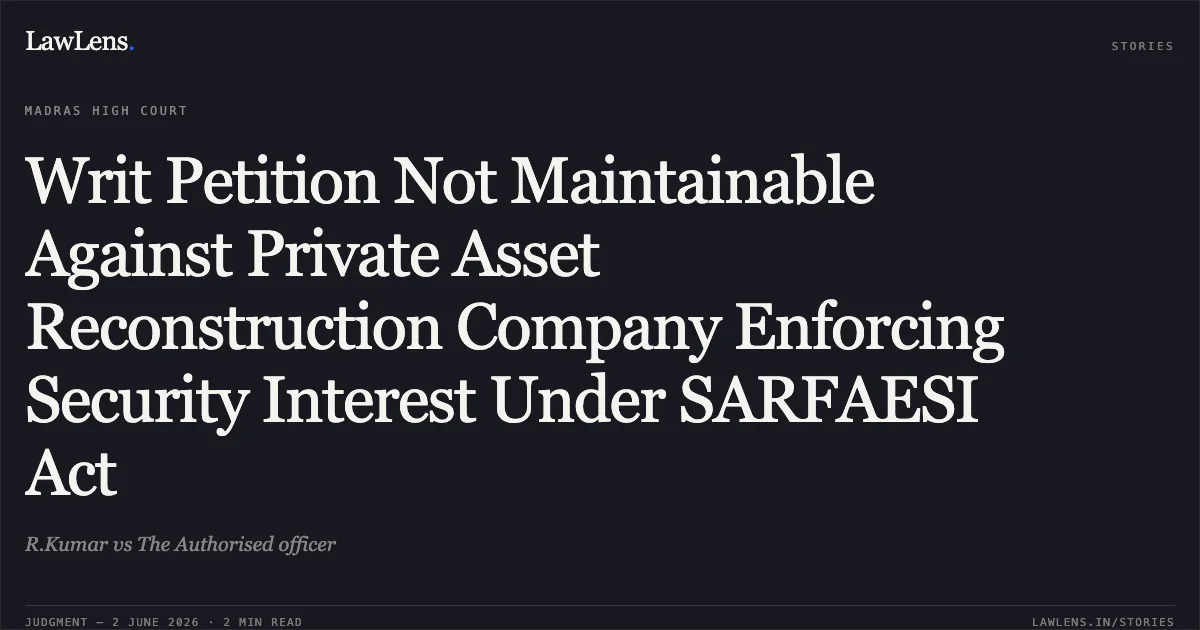
The Court held that no writ lies against a private ARC for commercial transactions and that the petitioner must approach the Debts Recovery Tribunal (DRT) under Section 17 of the SARFAESI Act for any grievances regarding interest calculations or auction proceedings.
The Court dismissed the writ petition as not maintainable. The interim application was closed, and no costs were awarded.
Source reference: para. 12Acts & Sections Cited
4 provisions across 1 statute referred to in this judgment. Each provision opens on LawLens.
Securitisation and Reconstruction of Financial Assets and Enforcement of Security Interest Act, 20024
Original Court PDF
R.KumarvsThe Authorised officer
Click to open original judgment
Original judgment, available to read, download and summarize on LawLens.in