Facts
The petitioner had availed a loan of ₹24,50,000 from Hinduja Housing Finance Limited and claimed to have paid ₹13,04,397 towards the loan, with instalments allegedly paid regularly until September 2025.
Source reference: pp. 2–3Following alleged default, the financial institution issued a demand notice dated 13 December 2025 under Section 13(2) of the SARFAESI Act, 2002.
Source reference: pp. 2–3The petitioner sought quashing or stay of the proceedings, consideration of his representation, supply of the loan sanction letter and payment-calculation statement, and permission to settle or repay the outstanding dues.
Source reference: pp. 2–3Instead of availing the statutory remedy under the SARFAESI Act, the petitioner directly approached the High Court under Article 226 of the Constitution.
Source reference: p. 3The respondent-Bank objected to the maintainability of the writ petition on the ground that an effective alternative remedy was available.
Source reference: p. 3Issues
1. Whether the High Court should entertain a writ petition challenging measures taken under the SARFAESI Act when the petitioner has an effective statutory alternative remedy available under that Act?
Source reference: pp. 3–52. Whether the petitioner should be permitted to approach the appropriate statutory forum, with the question of limitation left open for consideration by that forum?
Source reference: p. 53. Whether the respondent-Bank should supply the documents sought by the petitioner upon submission of a fresh application?
Source reference: p. 5Law Applied
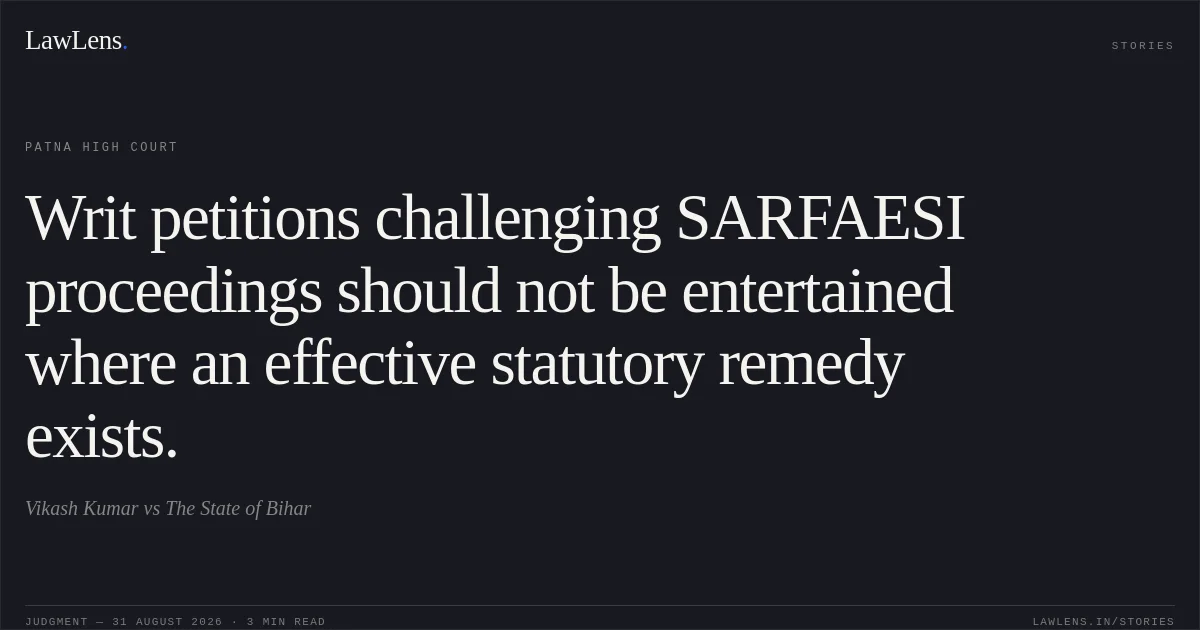
The Court applied the settled principle that the High Court ordinarily should not exercise its jurisdiction under Article 226 where an effective alternative statutory remedy is available, particularly in matters concerning recovery of public dues and dues owed to banks and financial institutions.
Source reference: p. 4Relying on United Bank of India v. Satyawati Tondon, (2010) 8 SCC 110, the Court held that statutory recovery enactments constitute a comprehensive remedial framework and that aggrieved parties should ordinarily exhaust the remedies provided under the relevant statute.
Source reference: p. 4The Court further relied on Celir LLP v. Bafna Motors (Mumbai) (P) Ltd., (2024) 2 SCC 1, and PHR Invent Educational Society v. UCO Bank, 2024 INSC 297, which reiterated that writ jurisdiction should not ordinarily be invoked where an effective remedy is available under the SARFAESI Act.
Source reference: p. 4Reasoning
The petitioner’s grievances directly concerned the demand notice and recovery proceedings initiated under the SARFAESI Act, as well as his request for restructuring or settlement of the loan account.
Source reference: pp. 2–3Since the SARFAESI framework provides an effective statutory mechanism for challenging measures taken by a secured creditor, the Court applied the alternative-remedy rule and declined to examine the merits of the petitioner’s objections in writ jurisdiction.
Source reference: pp. 3–5The Court found no basis to depart from the rule laid down in Satyawati Tondon and reaffirmed in Celir LLP and PHR Invent Educational Society.
Source reference: p. 5However, recognising the petitioner’s right to pursue the appropriate remedy, it granted liberty to approach the competent forum and directed that the issue of limitation be considered by that forum.
Source reference: p. 5The Court also recorded the Bank’s submission that the requested documents would be supplied within 15 days of a fresh application by the petitioner.
Source reference: p. 5Holding
The High Court held that the writ petition was not maintainable because the petitioner had an effective alternative remedy under the SARFAESI Act.
The petition was accordingly disposed of, without adjudication on the merits, with liberty to the petitioner to approach the appropriate statutory forum; the question of limitation was left open for consideration by that forum.
Source reference: p. 5The Court further recorded the Bank’s undertaking that, upon submission of an application seeking the relevant documents, it would supply them within 15 days.
Source reference: p. 5Acts & Sections Cited
1 provisions across 1 statute referred to in this judgment. Each provision opens on LawLens.
Securitisation and Reconstruction of Financial Assets and Enforcement of Security Interest Act, 20021
Original Court PDF
Vikash KumarvsThe State of Bihar
Click to open original judgment
Original judgment, available to read, download and summarize on LawLens.in