Facts
The petitioners, practicing advocates and trained mediators at the Patna High Court, challenged the validity of the Bihar Civil Procedure (Mediation) (Amendment) Rule, 2019, alleging it was enacted without legislative jurisdiction
Source reference: para. 2They sought reliefs including the payment of fee arrears, fee enhancement, and the quashing of office orders dated 11.10.2023, which renewed the tenure of 20 existing mediators and empanelled 40 new mediators under the 2019 Rules
Source reference: para. 2, 8During proceedings, the State argued that the newly appointed mediators must be impleaded as their rights would be affected
Source reference: para. 3The petitioners impleaded respondents 25 to 83 but initially claimed no relief against them to avoid the responsibility of serving notice
Source reference: para. 4Although the court ordered notice to be served via ordinary and registered post, the petitioners failed to file the necessary requisites and sought to serve via Dasti summons to save costs, which the court refused
Source reference: para. 5, 6Ultimately, the petitioners failed to comply with the court's direction to serve the newly added respondents
Source reference: para. 9Issues
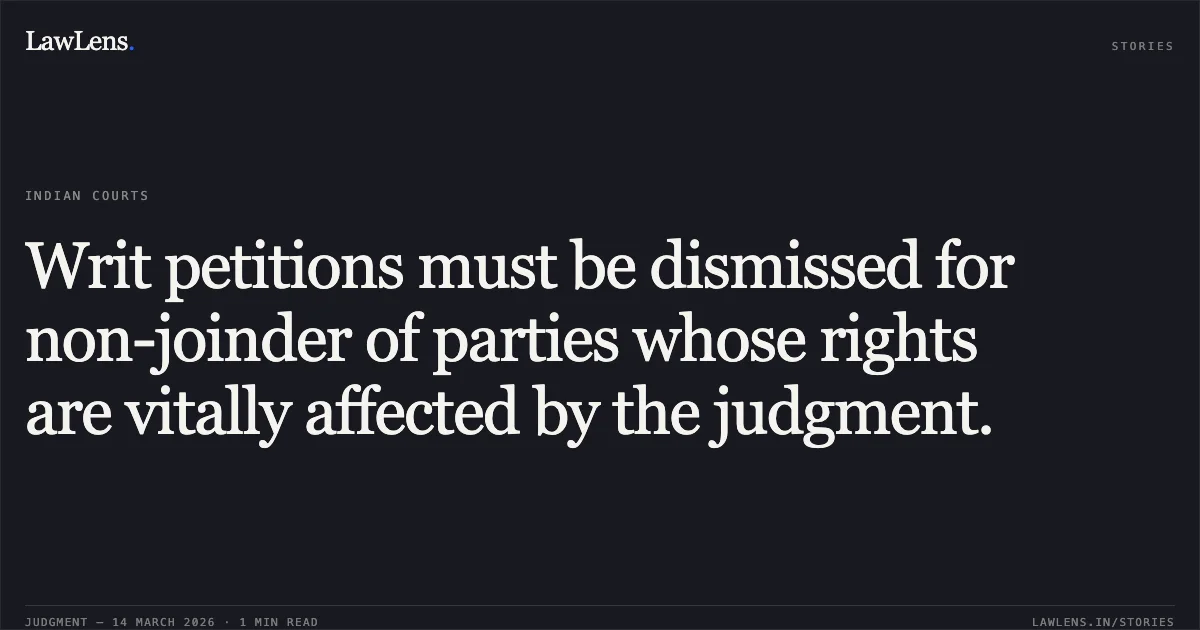
1. Whether the High Court can decide a writ petition under Article 226 in the absence of necessary parties who would be vitally affected by the judgment.
Source reference: para. 102. Whether the failure to serve notice upon newly impleaded respondents, whose appointments were under challenge, renders the writ petition liable for dismissal.
Source reference: para. 14-15Law Applied
The court applied the doctrine of "non-joinder of necessary parties" and the principles of natural justice.
Source reference: no citationIt relied on Ranjan Kumar & Ors. v. The State of Bihar & Ors. (2014) 16 SCC 187, which held that a writ petition is defective if appointees whose selection is challenged are not impleaded
Source reference: para. 11It further followed the precedent in Prabodh Verma and Others v. State of Uttar Pradesh and Others (1984) 4 SCC 251, which established that a High Court should not hear a writ petition without the presence of respondents whose interests are vitally concerned, or at least a representative capacity of such persons if their number is large
Source reference: para. 12Reasoning
The court observed that since the petitioners were challenging the very rules and recommendations under which respondents 25 to 83 were empanelled or renewed as mediators, any adverse judgment would directly imperil their appointments
Source reference: para. 4, 13The court noted that the petitioners had knowingly failed to deposit the requisites for service of notice, despite repeated orders
Source reference: para. 9, 14The court rejected the petitioners' contention that the matter could still be decided against the State (respondents 1 to 24) alone, reasoning that the validity of the 2019 Rules could not be adjudicated without hearing the parties whose livelihoods/positions depended on those rules
Source reference: para. 7, 14The defiance of court orders regarding service of notice was found to be a fatal procedural defect
Source reference: para. 14Holding
The court concluded that the continuation of the writ petition without the necessary parties being served was "wholly bad and illegal"
The court held that no adverse order can be passed against persons not properly brought before the litigation when their rights are at stake
Source reference: para. 11Due to the non-compliance with directions for service of notice upon necessary respondents (25 to 83), the High Court dismissed the writ petition in its entirety
Source reference: para. 15Original Court PDF
Jyoti PrakashvsThe State of Bihar
Click to open original judgment
Original judgment, available to read, download and summarize on LawLens.in


