Facts
The petitioner, the Management of Avenue Regent, challenged Ext. P14, a preliminary order passed by the Labour Court, Ernakulam in I.D. No. 22/2016.
Source reference: para. 1The Labour Court had dismissed the Management’s I.A. No. 131/2017, which sought an early determination of whether the employee, Antony Abu Franklin, was excluded from the definition of “workman” under Section 2(s) of the Industrial Disputes Act, 1947.
Source reference: para. 1The Labour Court held that the employee fell within the statutory definition of “workman”.
Source reference: para. 1The Management contended that the employee performed supervisory functions and received wages exceeding the prescribed statutory limit, thereby excluding him from Section 2(s).
Source reference: para. 4The Union raised a preliminary objection that the writ petition challenging the preliminary order was not maintainable.
Source reference: paras. 2, 5Issues
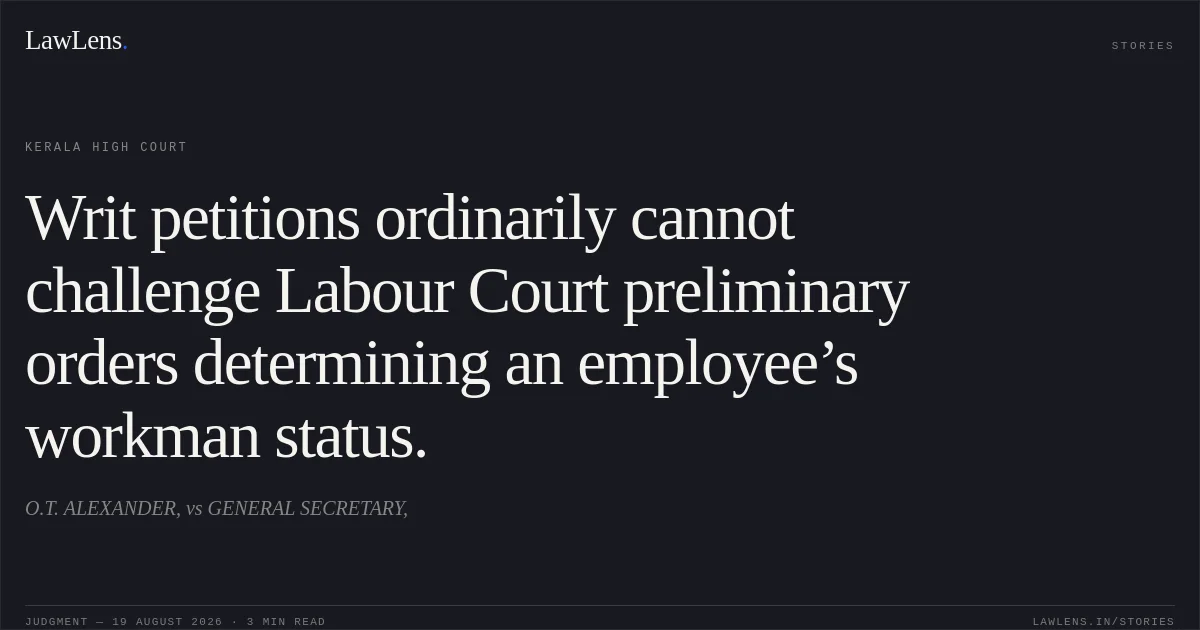
Whether a writ petition under Articles 226 and 227 of the Constitution is maintainable against a preliminary order of the Labour Court determining that an employee is a “workman” under Section 2(s) of the Industrial Disputes Act, 1947?
Source reference: para. 7Whether the alleged lack of jurisdiction arising from the employee’s asserted exclusion from the definition of “workman” justified interference by the High Court at the preliminary stage?
Source reference: paras. 4, 8–10Law Applied
Section 2(s) of the Industrial Disputes Act, 1947 defines “workman” and determines whether an employee falls within the Labour Court’s statutory jurisdiction.
Source reference: paras. 1, 7The Court applied the principle in D.P. Maheshwari v. Delhi Administration, (1983) 4 SCC 293, that Labour Courts and Industrial Tribunals should ordinarily decide all issues together rather than permit preliminary objections to delay adjudication, and that High Courts should not ordinarily interfere under Article 226 at the interlocutory stage.
Source reference: para. 8The Court also relied on Amrita Institute of Medical Sciences v. Labour Court, Ernakulam, 2017 (5) KHC 441, Shwas Homes Pvt. Ltd. v. Presiding Officer, Labour Court, 2021:KER:43423, affirmed in 2022:KER:35281, and Chelamattom Sree Krishna Swami Devaswom Trust v. State of Kerala, 2022 (4) KHC 215, which applied the same rule to challenges against preliminary orders concerning workman status or the validity of a reference.
Source reference: paras. 5, 9The exception recognised in St. Thomas Missions Hospital v. State of Kerala, 2007 (1) KHC 583, permits interference in appropriate cases where a preliminary order effectively terminates the proceedings or reflects a wholly misconceived exercise of jurisdiction.
Source reference: paras. 8–9Reasoning
The Court held that the Management’s objection regarding the employee’s status under Section 2(s) was a matter to be adjudicated in the pending industrial dispute and did not, at this stage, warrant writ interference.
Source reference: para. 14Although the Management characterised the issue as one of jurisdiction, the impugned order merely rejected its preliminary objection and allowed the industrial adjudication to continue.
Source reference: para. 14The Court found that the Management had reserved its right to conduct a de novo enquiry if the existing enquiry were found defective; consequently, the exceptional principle in St. Thomas Missions Hospital—where interference was justified because the preliminary order effectively concluded the proceedings—did not apply.
Source reference: para. 14Following D.P. Maheshwari and the subsequent Kerala decisions, the Court prioritised expeditious resolution of the industrial dispute and held that the alleged error concerning “workman” status could be raised against the preliminary order at the appropriate stage, including along with the final award.
Source reference: paras. 8–9Holding
The writ petition challenging Ext. P14 was held not maintainable and was accordingly dismissed.
The Court left open all contentions of the Management concerning Ext. P14 to be raised at the appropriate stage of the proceedings.
Source reference: para. 10Since the industrial dispute dated back to 2016, the Labour Court was directed to dispose of I.D. No. 22/2016 within six months from receipt of a certified copy of the judgment.
Source reference: para. 10Acts & Sections Cited
1 provisions across 1 statute referred to in this judgment. Linked provisions open on LawLens.
Industrial Disputes Act, 19471
Original Court PDF
O.T. ALEXANDER,vsGENERAL SECRETARY,
Click to open original judgment
Original judgment, available to read, download and summarize on LawLens.in