Facts
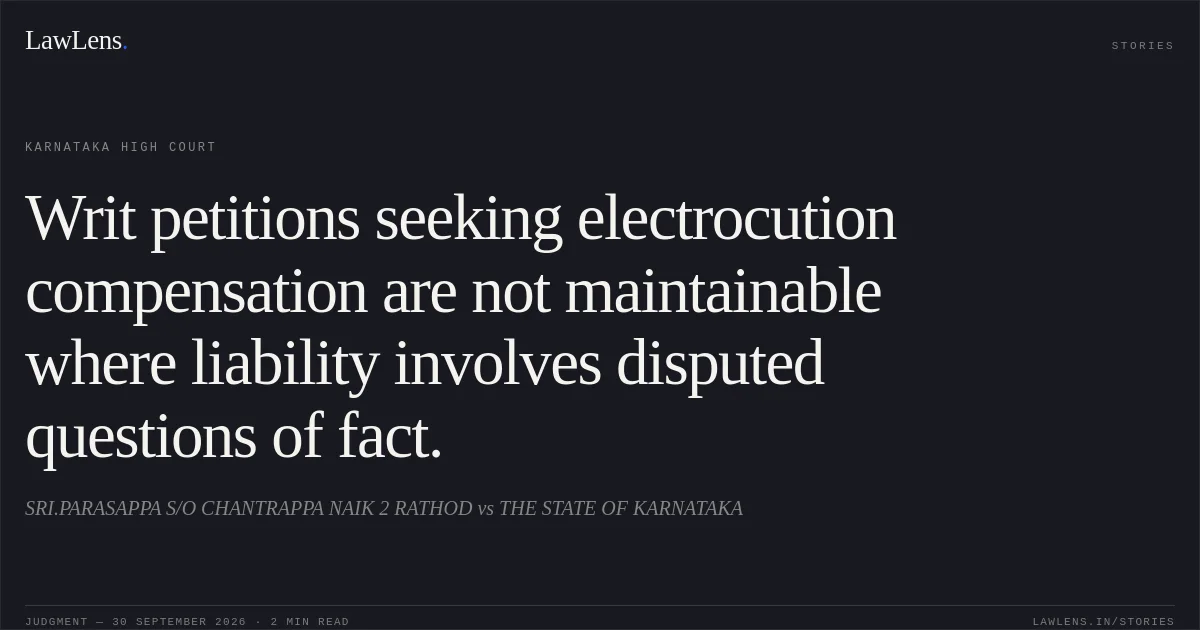
The petitioners, the husband and daughter of Smt. Danavva Naik, sought ₹10,68,000 with interest from the State and HESCOM, alleging that she died after coming into contact with a live electrical wire. The judgment records the incident date inconsistently: paragraph 1 states 8 January 2010, while the relief sought and subsequent references state 8 November 2010.
Source reference: pp. 3–4, paras. 1, 3, 6A criminal prosecution arising from the incident ended in acquittal on 6 June 2013.
Source reference: p. 3, para. 2After issuing notice in September 2015, the petitioners filed this writ petition in December 2015.
Source reference: p. 3, para. 3HESCOM opposed the petition, relying on the Supreme Court’s decision in Karnataka Power Transmission Corporation Ltd. v. Rekha and also raising limitation.
Source reference: pp. 4–5, paras. 5–6Issues
1. Whether a writ petition seeking compensation for death by electrocution is maintainable where disputed questions of fact arise and an alternative civil remedy is available?
Source reference: pp. 5–7, paras. 8–92. Whether the claim was barred by limitation?
Source reference: p. 5, para. 6Law Applied
In Karnataka Power Transmission Corporation Ltd. v. Rekha, the Supreme Court held that a writ petition seeking electrocution compensation is not maintainable where disputed questions of fact are involved; the claimant may pursue available remedies before the appropriate forum.
Source reference: pp. 5–7, para. 8It also held that the multiplier method used under the Motor Vehicles Act cannot be applied mutatis mutandis to electrocution claims; compensation must instead be just, reasonable and fair, having regard to the person’s income and related claims.
Source reference: pp. 6–7, para. 8Section 57 of the Electricity Act, 2003 addresses a licensee’s liability to pay compensation in specified circumstances but does not prescribe a method for calculating it.
Source reference: pp. 6–7, para. 8The Court also noted the respondents’ limitation objection, but did not decide it.
Source reference: p. 5, para. 6Reasoning
The petitioners relied on the High Court’s earlier decision in Rekha to support writ jurisdiction and calculation by the Sarla Verma multiplier method.
Source reference: pp. 4–5, paras. 4–5, 8–9The Court held that the Supreme Court had set aside the High Court decisions in Rekha and ruled that writ proceedings are not maintainable where factual disputes arise in an electrocution-compensation claim.
Source reference: pp. 4–5, paras. 4–5, 8–9That binding ruling defeated the petitioners’ request for compensation through a writ petition. Although limitation was raised, the Court dismissed the petition on maintainability and did not determine whether the claim was time-barred.
Source reference: pp. 5–7, paras. 6, 8–10Holding
The Court dismissed the writ petition as not maintainable.
The Court left the petitioners at liberty to pursue any remedy available and permissible under law.
Source reference: p. 7, paras. 9–10Acts & Sections Cited
1 provisions across 1 statute referred to in this judgment. Each provision opens on LawLens.
Electricity Act, 20031
Original Court PDF
SRI.PARASAPPA S/O CHANTRAPPA NAIK 2 RATHODvsTHE STATE OF KARNATAKA
Click to open original judgment
Original judgment, available to read, download and summarize on LawLens.in