01Facts
The petitioner, a rice mill, filed a writ petition under Article 226 against Karur Vysya Bank Ltd (R4 and R5), the Union of India (R1), the Ministry of MSME (R2), and the Reserve Bank of India (R3).
p. 1 · ¶ 1The petitioner challenged a bank communication dated 21.06.2019 and an order dated 09.10.2019 issued under Section 13(3A) of the SARFAESI Act.
p. 2, prayerIt sought a writ of certiorari quashing these, and a writ of mandamus directing the Bank to (i) implement RBI instructions dated 01.01.2019 and 11.02.2020, (ii) implement the MSME Credit and Rehabilitation Policy and the Bank's own Code of Commitment to Micro and Small Enterprises, (iii) one-time restructure its loans, (iv) disburse the balance OD working capital of ₹1 crore and a commodity loan, and (v) refrain from coercive recovery.
p. 2, prayer · ¶ 1The Bank was described as a private sector banking company, not "State" under Article 12.
p. 3 · ¶ 2A proposed sixth respondent, Edelweiss Asset Reconstruction Company, was sought to be impleaded through WMP No. 52973 of 2026.
p. 5 · ¶ 502Issues
i.1. Whether a writ petition under Article 226 is maintainable against a private sector bank (R4 and R5) that is neither "State" nor an instrumentality of the State under Article 12.
p. 3 · ¶ 2 · p. 4 · ¶ 3ii.2. Whether a writ of mandamus can compel a bank to restructure loans, sanction additional credit facilities, or alter contractual repayment terms.
p. 4 · ¶ 403Law Applied
The Court applied Article 226 of the Constitution, which holds that writ relief is primarily directed against the State or authorities discharging public functions or statutory public duties.
p. 4 · ¶ 3It relied on Article 12 for the test of "State" and instrumentality of the State.
p. 3 · ¶ 2It followed Federal Bank Ltd. v. Sagar Thomas, (2003) 10 SCC 733, which holds that a private banking company is not amenable to writ jurisdiction merely because it is subject to RBI regulation or must follow regulatory guidelines.
p. 4 · ¶ 3, fn. 1The Court also held that commercial lending, credit enhancement, and debt restructuring by a private bank arise from private contractual arrangements and commercial judgment, not sovereign or public functions.
p. 4 · ¶ 3Finally, it held that a writ court cannot rewrite or modify contractual repayment terms, and mandamus cannot compel restructuring or additional credit.
p. 4 · ¶ 404Reasoning
The Court first examined maintainability, the threshold question, and found that the Bank was a private entity.
p. 3 · ¶ 2It reasoned that the impugned acts (recovery under SARFAESI, refusal of additional credit, and restructuring) flow from a private contractual relationship and commercial banking judgment, not a public function.
p. 4 · ¶ 3RBI circulars and the Bank's internal policies did not alter that character, because regulatory compliance alone does not make a private bank amenable to writ jurisdiction, following Sagar Thomas.
p. 4 · ¶ 3Having found no maintainability, the Court held that the relief sought was independently impermissible, since mandamus cannot compel restructuring, sanction of credit, or modification of repayment terms, and a writ court cannot rewrite the contract.
p. 4 · ¶ 4The order does not separately analyse the merits of the RBI or MSME instructions, or the SARFAESI challenge, and does not separately discuss the maintainability of the writ against R1 to R3.
p. 5 · ¶ 505Holding
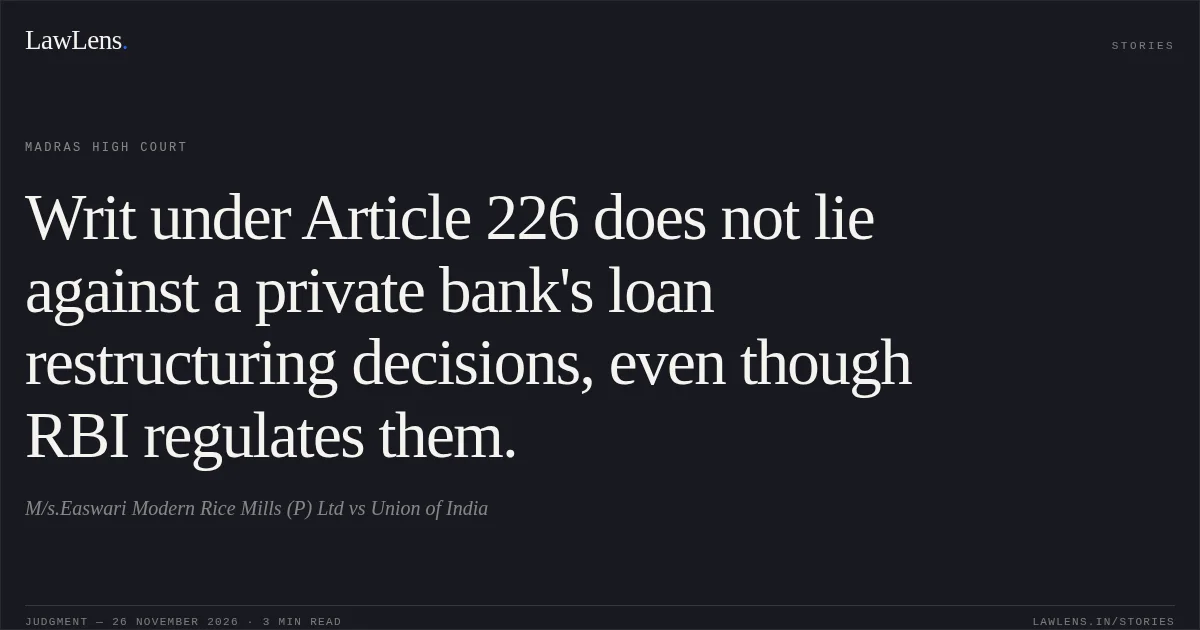
The Court held that the writ petition is not maintainable against the private respondent Bank (R4 and R5).
p. 5 · ¶ 5The writ petition was dismissed with no order as to costs. WMP Nos. 8827, 8828, and 8829 of 2020 were closed, and WMP No. 52973 of 2026 for impleadment of Edelweiss Asset Reconstruction Company was closed as consequential.
p. 5 · ¶ 5The holding rests on the threshold bar of maintainability under Federal Bank Ltd. v. Sagar Thomas and on the principle that writ courts cannot compel restructuring or rewrite contractual terms.
p. 4 · ¶ 3–4The petitioner's remedy against the Bank therefore lies outside Article 226, for example in civil proceedings or in a challenge under the SARFAESI framework (the Court did not expressly identify the forum).
Original Court PDF
M/s.Easwari Modern Rice Mills (P) LtdvsUnion of India
Click to open original judgment
Original judgment, available to read, download and summarize on LawLens.in