Facts
The respondent instituted a commercial suit for recovery of ₹23,75,000 with interest, arising from a Flipkart gift-voucher facilitation arrangement between the parties.
Source reference: p.1–2Summons were issued on 1 July 2022 and were returnable on 10 October 2022. On that date, the petitioners’ counsel entered appearance and stated that the written statement would be filed within two days.
Source reference: p.2The petitioners filed the written statement, Statements of Truth and an application for condonation of delay on 16 November 2022.
Source reference: p.2Their application stated that service had occurred on 9 July 2022 and attributed the delay to the petitioners’ Hyderabad-based location and difficulties in engaging counsel.
Source reference: p.2Subsequently, the petitioners asserted that the actual date of service was 7 September 2022, when they allegedly first became aware of the suit through an e-Courts email. Conversely, an RTI-based postal report indicated delivery of summons at the petitioners’ registered address on 12 July 2022.
Source reference: p.3The Trial Court found that the written statement was otherwise within 120 days even if 12 July 2022 were treated as the date of service, but dismissed the condonation application because the petitioners had not filed an affidavit of admission/denial of the plaintiff’s documents along with the written statement.
Source reference: p.3–5The petitioners challenged that order under Article 227 of the Constitution.
Source reference: p.5Issues
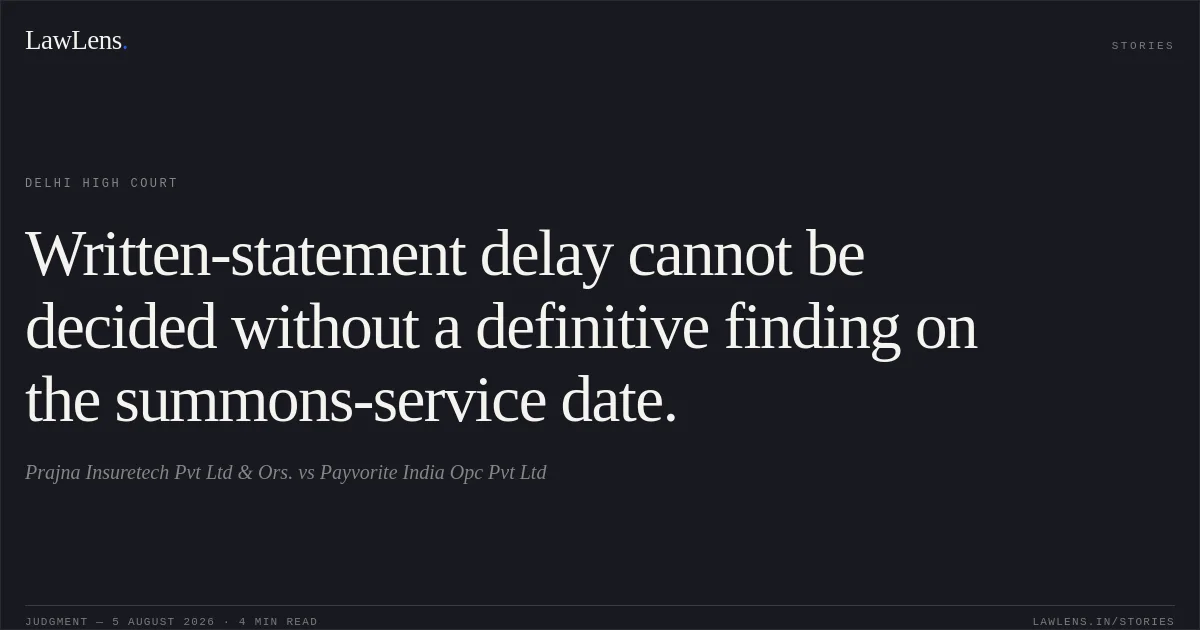
1. Whether the Trial Court was required to first determine the definite date of service of summons before computing the statutory 120-day period for filing the written statement in a commercial suit.
Source reference: p.6–7; para. 132. Whether the petitioners’ written statement could be rejected solely because an affidavit of admission/denial of documents was not filed along with it, particularly when the Trial Court had found the delay otherwise condonable.
Source reference: p.5–6; paras. 9–10, 14–153. Whether the Trial Court’s order dismissing the condonation application and directing that the written statement be taken off the record warranted interference under Article 227.
Source reference: p.5, 7; paras. 8, 15Law Applied
The Court considered Order VIII Rule 1 CPC, as applicable to commercial disputes, under which the written statement must ordinarily be filed within 30 days and may be permitted up to an outer limit of 120 days from service of summons; the prescribed period is treated as mandatory in commercial suits.
Source reference: no citationIt also considered the requirement under the commercial-procedure provisions of the CPC, including Order XI, that an affidavit of admission/denial of documents accompany the written statement.
Source reference: no citationIn UnilinBeheer B.V. v. Balaji Action Buildwell, 2019 SCC OnLine Del 8498, the Court had held that failure to file the affidavit with the written statement could result in the written statement not being taken on record and the plaintiff’s documents being deemed admitted.
Source reference: p.4–5A similar strict approach was noted from Mayank Gupta v. Aditya Birla Fashion & Retail Ltd., 2023 SCC OnLine Del 1485.
Source reference: p.3–5However, the petitioners relied on Sudhakar Singh v. Webkul Software (P) Ltd., 2020 SCC OnLine Del 436, and COSCO (India) Ltd. v. Paramsukh Nirman (P) Ltd., 2019 SCC OnLine Del 9633, which treated the omission as a curable procedural defect.
Source reference: p.5–6The Court also applied the principle that computation of the 120-day period must proceed from a judicially determined date of valid service.
Source reference: p.6–7; para. 13Reasoning
The Court identified uncertainty regarding the date from which the 120-day period had to be calculated. Computation from 12 July 2022, the date reflected in the postal and RTI record, resulted in a filing on the 127th day, while computation from 9 July 2022 resulted in 130 days; only computation from 7 September 2022 brought the filing within 120 days.
Source reference: p.6; para. 13Since the Trial Court had not made a definite finding regarding the date of service, it had not properly determined whether the written statement was filed within the permissible outer limit.
Source reference: p.6; para. 13Although the Trial Court observed that the delay was condonable even from 12 July 2022, it rejected the application on the separate ground that the affidavit of admission/denial had not accompanied the written statement.
Source reference: p.6; para. 14The High Court therefore considered it inappropriate to decide the competing legal positions concerning the effect of non-filing of that affidavit before the foundational question of service and limitation had been conclusively determined.
Source reference: p.7; para. 15It accordingly set aside the order and directed a fresh adjudication without expressing an opinion on the merits of either party’s submissions.
Source reference: p.7; para. 15Holding
The High Court allowed the petition to the limited extent of setting aside the Trial Court’s order dated 10 August 2023.
The matter was remanded to the Trial Court to first determine the actual date of service of summons and compute the applicable 120-day period, and thereafter decide the effect of the petitioners’ failure to file the affidavit of admission/denial in accordance with law.
Source reference: p.7; para. 15The Trial Court was directed to fix a hearing within one week of pronouncement and adjudicate the matter afresh.
Source reference: p.7; para. 16The petition and pending applications were disposed of accordingly.
Source reference: p.7; para. 17Original Court PDF
Prajna Insuretech Pvt Ltd & Ors.vsPayvorite India Opc Pvt Ltd
Click to open original judgment
Original judgment, available to read, download and summarize on LawLens.in