Facts
The Respondent was appointed as Managing Director of Appellant No. 1 on 02.07.2007.
Source reference: para. 3On 09.10.2013, he was served a Show Cause Notice alleging embezzlement, fraud, and moral tutpitude involving vendors.
Source reference: para. 8, 68Following his reply, the Appellants terminated his employment on 23.10.2013 without notice or benefits, citing misconduct and causing financial loss.
Source reference: para. 10, 73The Respondent filed a suit for declaration that the termination was void and sought consequential benefits.
Source reference: para. 2The Trial Court decreed the suit, awarding Rs. 44,73,735/- with 9% interest, holding that the Appellants failed to prove misconduct as their sole witness (DW-1) had no personal knowledge and the forensic report remained unproved.
Source reference: para. 1, 46-47Issues
1. Whether the Trial Court erred in granting a monetary decree for an amount neither specifically quantified in the plaint nor supported by court fees.
Source reference: para. 51, 872. Whether the termination of a private contractual employee, even if found to be without proved misconduct, entitles the employee to more than the contractual notice period salary.
Source reference: para. 60, 853. Whether the Respondent was entitled to forfeit of gratuity in the absence of proved misconduct.
Source reference: para. 102Law Applied
The Court applied Section 96 and Order XLI Rule 1 of the CPC.
Source reference: para. 1The principle from S.S. Shetty v. Bharat Nidhi Ltd. (AIR 1958 SC 12), which establishes that in private employment, even for illegal termination, damages are generally limited to the salary for the notice period.
Source reference: para. 85Relief not founded on pleadings or larger than ever claimed cannot be granted, as seen in Bachhaj Nahar v. Nilima Mandal (2008 17 SCC 491) and Rajendra Tiwary v. Basudeo Prasad (2002 1 SCC 90).
Source reference: para. 98-99Section 4(6) of the Payment of Gratuity Act regarding the forfeiture of benefits.
Source reference: para. 73Reasoning
The Court affirmed the Trial Court’s finding that the Appellants failed to prove misconduct; the testimony of DW-1 was hearsay and the Deloitte Forensic Report was inadmissible as it was never duly proved by its author.
Source reference: para. 77, 78Immediate termination under Clause 2.1 of the appointment letter was invalid; however, the Trial Court misdirected itself by granting Rs. 44.73 lakhs because the Plaintiff only sought "consequential relief" for reinstatement/back wages but never quantified a claim for specific dues in the plaint.
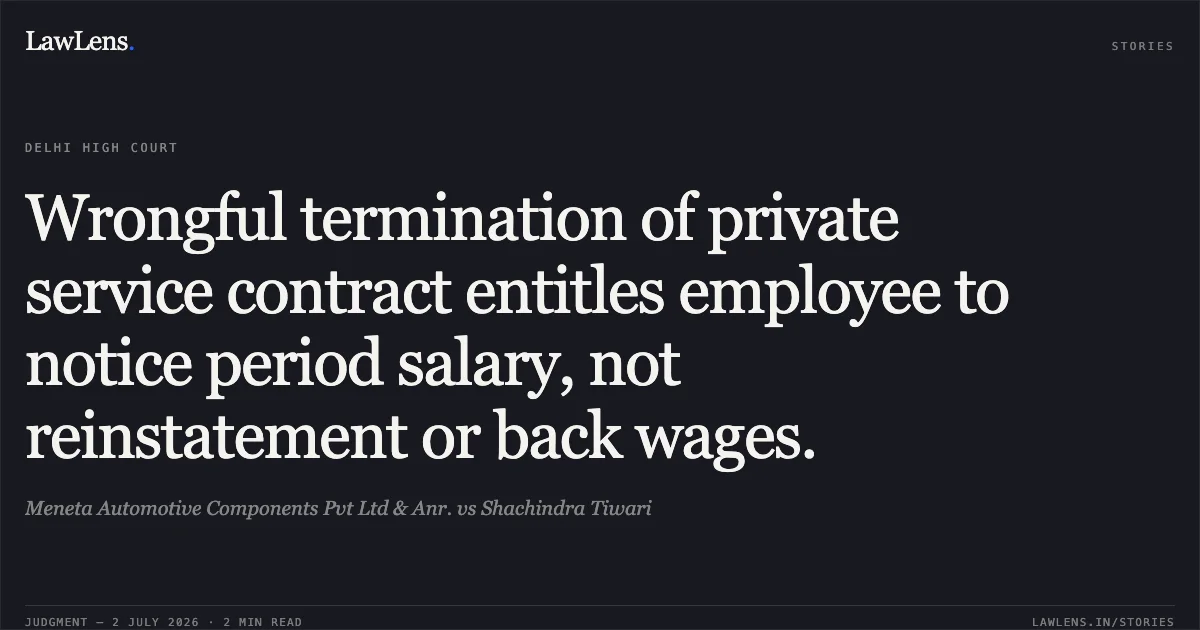
Source reference: para. 82, 88, 89-91Under Clause 2 of the contract, the employer could terminate without cause with three months' notice; following S.S. Shetty, since reinstatement is not available in private service, the Respondent's maximum entitlement was three months' basic salary.
Source reference: para. 84, 85, 101The Respondent's application for additional evidence (Order XLI Rule 27) was dismissed as it sought to fill lacunae regarding quantification which was irrelevant once the termination was held valid under the "notice pay" principle.
Source reference: para. 116-118Holding
The Court partly allowed the appeal, reducing the decree from Rs. 44,73,735/- to Rs. 8,12,500/-.
The reduced amount comprises Rs. 3,90,000/- as three months’ basic salary in lieu of notice and Rs. 4,22,500/- towards gratuity, as forfeiture was impermissible without proved misconduct, with interest at 9% p.a.
Source reference: para. 101, 102, 119Acts & Sections Cited
5 provisions across 3 statutes referred to in this judgment. Each provision opens on LawLens.
Code of Civil Procedure, 19083
Code of Criminal Procedure, 19731
Specific Relief Act, 19631
Original Court PDF
Meneta Automotive Components Pvt Ltd & Anr.vsShachindra Tiwari
Click to open original judgment
Original judgment, available to read, download and summarize on LawLens.in