Facts
The three applicants, serving as Constables at the North Eastern Police Academy (NEPA), were terminated in November 2017 under Rule 5(1) of the CCS (Temporary Services) Rules on the grounds that they were temporary employees/under probation
Source reference: p. 3This Tribunal set aside those terminations on 13.04.2021, and the Meghalaya High Court affirmed that decision on 18.04.2023
Source reference: p. 3Consequently, the respondents reinstated the applicants on 04.08.2023
Source reference: p. 3While the respondents treated the intervening absence as "duty for all purposes" under FR 54-A, they denied the applicants full pay and allowances for that period
Source reference: p. 3The respondents argued that the applicants were not entitled to back wages under the principle of "no work no pay" and noted that the Tribunal had not specifically granted back wages in the previous round of litigation
Source reference: p. 4, 6Issues
1. Whether the applicants are entitled to full pay and allowances for the period between their wrongful termination and reinstatement under FR 54-A(3)
Source reference: p. 52. Whether the principle of "no work no pay" applies when an employee is kept away from work by an illegal act of the employer
Source reference: p. 7Law Applied
Fundamental Rule (FR) 54-A(3), which mandates that when a dismissal/termination is set aside by a court on merits, the intervening period shall be treated as duty and the employee paid full pay/allowances they would have been entitled to
Source reference: p. 4-5Deepali Gundu Surwase v. Kranti Junior Adhyapak, which establishes that reinstatement with back wages is the normal rule for illegal termination, though courts possess judicial discretion to quantify back wages based on facts
Source reference: p. 8-9Principle from Commr., Karnataka Housing Board v. C. Muddaiah, holding that "no work no pay" cannot be applied if the employer's own fault prevented the employee from working
Source reference: p. 7-8Reasoning
The Tribunal reasoned that the applicants’ absence from duty was not due to their own fault or voluntary act, but resulted from a termination order that was subsequently declared "bad in law" and set aside by judicial intervention
Source reference: p. 7Consequently, the principle of "no work no pay" was held inapplicable because the respondents effectively prevented the applicants from performing their duties
Source reference: p. 7Applying the ratio in Deepali Gundu Surwase, the Tribunal noted that while back wages are the norm, there is no "straight-jacket formula" for the amount
Source reference: p. 9-10The Tribunal observed that the applicants had not provided specific pleadings or evidence to prove they were not "gainfully employed" during the long intervening period (2017–2023)
Source reference: p. 10Therefore, balancing the illegality of the termination against the lack of proof regarding the applicants' financial status during the hiatus, the Tribunal determined that a partial grant was appropriate
Source reference: p. 10Holding
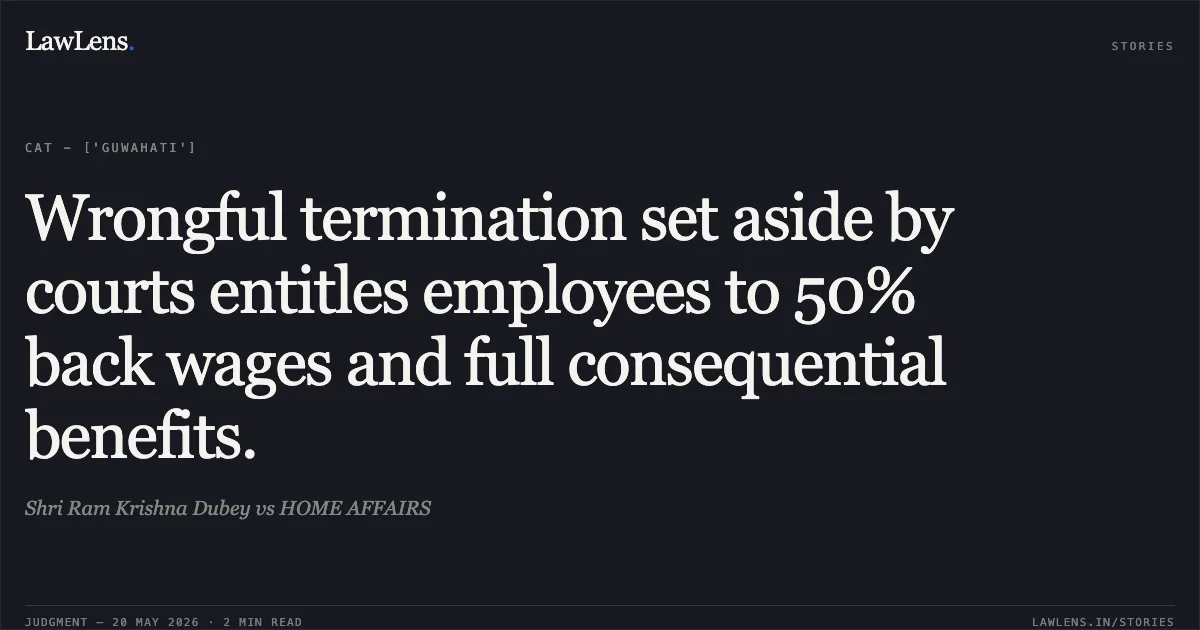
The Tribunal partially allowed the O.A., holding that the applicants are entitled to back wages restricted to 50% of their full pay and allowances for the period between their termination in 2017 and reinstatement in 2023
The court ordered the respondents to grant all consequential benefits, including financial upgradation, pay fixation, seniority, and increments. The respondents were directed to complete this exercise within two months of receiving the order
Source reference: p. 10, 11Acts & Sections Cited
2 provisions across 1 statute referred to in this judgment. Linked provisions open on LawLens.
Industrial Disputes Act, 19472
Original Court PDF
Shri Ram Krishna DubeyvsHOME AFFAIRS
Click to open original judgment
Original judgment, available to read, download and summarize on LawLens.in