01Facts
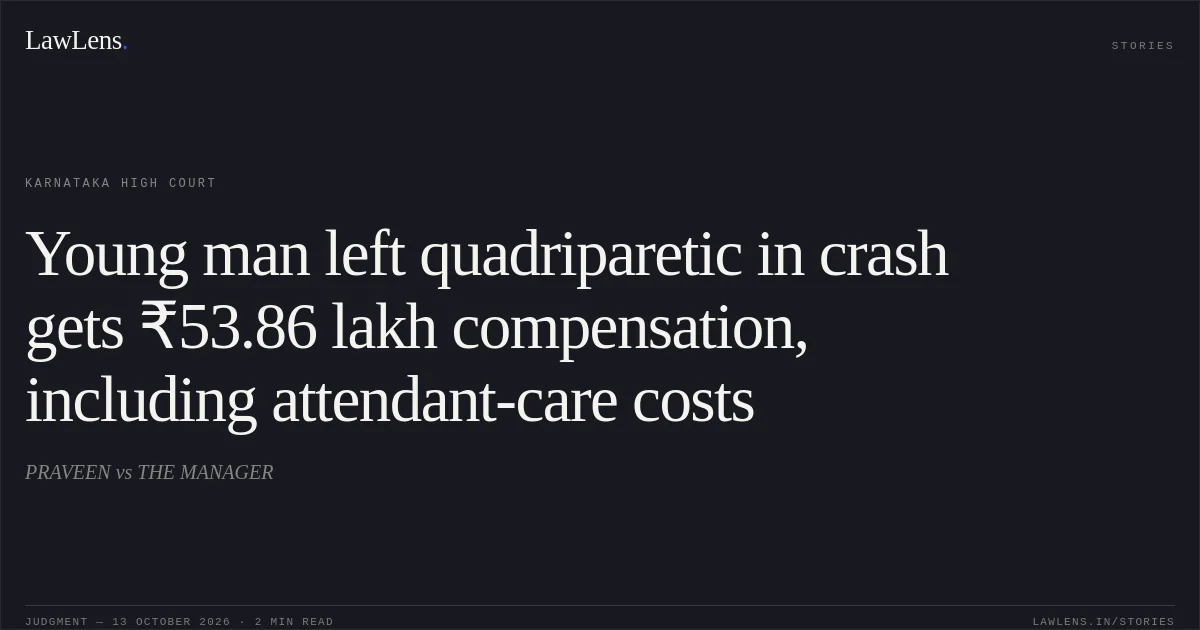
On 6 September 2009, the claimant was injured when an auto-rickshaw collided with his motorcycle.
pp. 2–4, 7–10He sustained serious spinal injuries and quadriparesis.
pp. 2–4, 7–10The Motor Accident Claims Tribunal found negligence, assessed his disability at 100%, and awarded ₹14,26,000 with interest at 6% per annum.
pp. 2–4, 7–10The claimant appealed, seeking enhancement of compensation, including for loss of earning capacity, attendant care, pain and suffering, amenities, marriage prospects, and future medical expenses.
pp. 2–4, 7–1002Issues
i.1. Whether the claimant was entitled to enhancement of compensation, including reassessment of income and compensation for attendant care and other consequences of his injuries.
p. 7 · ¶ 13ii.2. If so, what enhanced compensation and consequential directions should be ordered.
pp. 8–12 · ¶ 14–1703Law Applied
Under Sections 166 and 173(1) of the Motor Vehicles Act, 1988, a claimant may seek compensation for injuries and appeal an award on quantum.
pp. 2–3In personal-injury cases, future prospects may be added to income when assessing loss of earning capacity; the Court relied on Erudhaya Priya v. State Express Transport Corporation Ltd., which applied that principle.
p. 8 · ¶ 14For a claimant requiring continuous care, attendant costs may be assessed on a basis comparable to loss of dependency, and two attendants per day may be considered where the circumstances warrant; the Court relied on Kajal v. Jagadish Chand.
p. 9 · ¶ 15Compensation for loss of amenities may reflect the severity and lasting effects of the injury, with Rajkumar v. Ajay Kumar cited as a comparator.
pp. 9–10 · ¶ 16The Court also referred to Smt. Mangal v. Divisional Manager, MSRTC in assessing agricultural income.
p. 8 · ¶ 14Provisions in the judgment · 2 · Linked ones open on LawLens
Motor Vehicles Act, 1988 Section 166Section 173
04Reasoning
The Court found the Tribunal’s monthly income assessment of ₹4,000 unjustified: the claimant’s evidence concerning land, milk supply, and work supported an assessment of ₹6,000 per month, notwithstanding the limited documentary proof.
p. 8 · ¶ 14Given his age of 20 and self-employment, the Court added 40% future prospects and applied multiplier 18, assessing future loss of income at ₹18,14,400.
p. 8 · ¶ 14Because quadriparesis required round-the-clock care, it awarded ₹21,60,000 for two attendants, calculated using a notional income of ₹5,000 and multiplier 18.
p. 9 · ¶ 15It further enhanced compensation for pain and suffering, special diet, and loss of amenities; awarded ₹2,00,000 for loss of marriage prospects and ₹2,00,000 for future medical expenses; and retained the Tribunal’s ₹2,12,000 award for medical expenses already incurred.
pp. 9–10 · ¶ 1605Holding
The appeal was allowed in part.
pp. 10–11 · ¶ 17The Court enhanced the award from ₹14,26,000 to ₹53,86,400, with interest at 6% per annum from the date of the claim petition until deposit, and directed the insurer to deposit the amount before the Tribunal within six weeks.
pp. 10–11 · ¶ 17It directed release of ₹10,00,000 with proportionate interest, subject to the stated condition regarding prior withdrawals, permitted the claimant to seek a higher release for specified debts or land loans, and directed periodic verification to ensure proper use of the compensation for his treatment and care.
pp. 11–12 · ¶ 17Original Court PDF
PRAVEENvsTHE MANAGER
Click to open original judgment
Original judgment, available to read, download and summarize on LawLens.in