01Facts
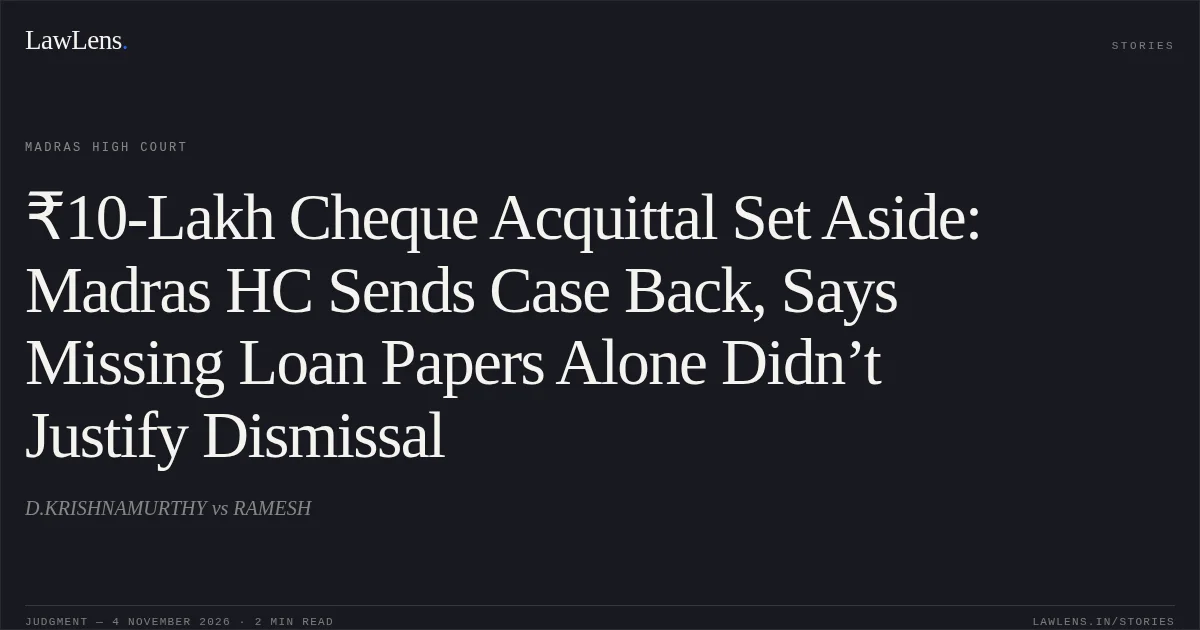
The complainant alleged that he advanced the respondent ₹10,00,000 in cash on 27 August 2018 and received a post-dated cheque for repayment. The cheque was returned unpaid with the endorsement “Other Reasons”; the respondent received a statutory demand notice but denied the debt.
pp. 2–3He admitted the cheque and signature, but claimed that blank signed cheques had been given to the complainant in 2011 in connection with property dealings.
pp. 2–3The Trial Court acquitted him, finding that the presumption had been rebutted in light of inconsistencies in the complainant’s evidence and the absence of adequate supporting material. The complainant appealed under Section 378 CrPC.
pp. 2–302Issues
i.1. Whether the respondent’s admission of the cheque and signature attracted the presumptions under Sections 118(a) and 139 of the Negotiable Instruments Act, and whether the respondent had raised a probable defence to rebut them
pp. 13–15ii.2. Whether the Trial Court’s acquittal warranted appellate interference, particularly in its assessment of the alleged loan, the parties’ earlier property dealings, and the supporting evidence
pp. 13, 21–2303Law Applied
Sections 118(a) and 139 of the Negotiable Instruments Act, 1881 require the court, once execution of a cheque is admitted or established, to presume consideration and that the holder received it towards discharge of a debt or liability; the presumption under Section 139 includes a legally enforceable debt.
p. 14The accused may rebut the presumption on a preponderance of probabilities and need not disprove the complainant’s case beyond reasonable doubt. The Court applied Rangappa v. Sri Mohan, (2010) 11 SCC 441, and Kalamani Tex v. P. Balasubramanian, (2021) 5 SCC 283, on these principles.
p. 14The appeal was brought under Section 378 CrPC.
p. 1Provisions in the judgment · 5 · Linked ones open on LawLens
Code of Criminal Procedure, 1973 Section 378Section 200
Negotiable Instruments Act, 1881 Section 138Section 118Section 139
04Reasoning
The High Court held that the admitted cheque and signature triggered the statutory presumptions, which had to be weighed against the respondent’s explanation that the cheque arose from earlier property dealings.
p. 16It considered the complainant’s bank statement, including a cash withdrawal of ₹9,70,000 shortly before the alleged loan, and his income-tax return as relevant support for his financial capacity, while recognising that financial capacity alone did not prove payment.
p. 16The Court considered the absence of a written loan agreement, receipt, independent witnesses, and the original settlement deed, as well as the inconsistency about interest, but concluded that these matters could not, on their own, discredit the complainant’s case.
pp. 17–18, 21–23It found that the Trial Court had dismissed the complaint principally for lack of additional documentary proof and interest-payment records, without adequately accounting for the statutory presumptions and the other evidence.
pp. 21–2305Holding
The High Court held that the Trial Court had not properly appreciated the material evidence and that its acquittal required interference.
pp. 23–24It set aside the acquittal and remitted the matter to the Trial Court for fresh consideration after hearing both parties; it did not itself convict the respondent.
pp. 23–24The Trial Court was directed to complete the proceedings within two months, and the parties were directed to appear without awaiting further notice and avoid unnecessary adjournments.
pp. 23–24Original Court PDF
D.KRISHNAMURTHYvsRAMESH
Click to open original judgment
Original judgment, available to read, download and summarize on LawLens.in