01Facts
The appellant, A1, was convicted by the I Additional Special Court for Exclusive Trial of Cases under the NDPS Act, Chennai, for offences under Section 8(c) read with Sections 29, 21(a), 22(c), 27A and 28 of the NDPS Act.
¶ 1–9The prosecution alleged that, following prior information, NCB officers searched a flat where A1 was present and seized cocaine and LSD; it also relied on A1’s statement under Section 67 and a subsequent search of A2’s premises.
¶ 1–9A1 appealed under Section 374(2) CrPC
¶ 1–902Issues
i.1. Whether the search and seizure at A1’s flat was vitiated by non-compliance with Section 42 of the NDPS Act
¶ 19(1)ii.2. Whether the prosecution proved, by reliable evidence, recovery of the contraband from A1’s possession
¶ 19(2)iii.3. Whether, despite the absence of Section 52A procedures and discrepancies in the physical evidence, the prosecution proved that the substances seized were those tested and produced in Court
¶ 19(3)iv.4. Whether the Chemical Examiner’s report could be relied upon to establish the identity of the substances
¶ 19(4)v.5. Whether statements recorded under Section 67 of the NDPS Act could be relied upon against A1
¶ 19(5)vi.6. Whether the convictions under Sections 27A, 28 and 29 of the NDPS Act could be sustained, and what the overall outcome should be
¶ 19(6)03Law Applied
Section 42(1)–(2) of the NDPS Act requires information about drugs kept or concealed in a building to be recorded and a copy of that record sent to the immediate superior; under Karnail Singh v. State of Haryana, total non-compliance is impermissible, while delayed compliance may be accepted if satisfactorily explained
¶ 21–24Section 52A provides for Magistrate-certified inventories, photographs or representative samples; under Bharat Aambale v. State of Chhattisgarh, non-compliance is assessed in light of whether it creates doubt about the physical evidence
¶ 38–41Under Tofan Singh v. State of Tamil Nadu, confessional statements made to NCB officers empowered under Section 53 are inadmissible against an accused under Section 25 of the Evidence Act
¶ 37, 48The prosecution must prove the foundational fact of possession before presumptions under Sections 35 and 54 of the NDPS Act can arise; Section 106 of the Evidence Act does not displace that burden
¶ 20, 35A chemical expert’s report must disclose the data and reasons supporting the opinion, and Section 293 CrPC makes a report admissible without making it conclusive
¶ 44–46A witness’s prior statement is not substantive evidence and may be used to contradict the witness only in accordance with Section 145 of the Evidence Act; Section 27 permits proof only of the portion of information distinctly related to a discovery
¶ 29, 49Offences under Sections 27A, 28 and 29 require proof of their respective elements, including financing or harbouring, an attempt, or an agreement constituting conspiracy
¶ 51Provisions in the judgment · 18 · Linked ones open on LawLens
Code of Criminal Procedure, 1973 Section 374Section 428Section 313Section 293Section 162
Narcotic Drugs and Psychotropic Substances Act, 1985 13 provisions
Section 8Section 21Section 22Section 28Section 29Section 35Section 42Section 50Section 53Section 54Section 57Section 66Section 6704Reasoning
The Court found that PW1 had ample time to comply with Section 42 but the original handwritten information was neither produced nor shown to have been sent to his superior; the typed note was admittedly not a verbatim record, and the officer could not explain his additions.
¶ 22–25The sole independent witness examined did not support the material parts of the seizure, his earlier statement was improperly relied upon, and the other cited witness and the raiding-team members were not produced.
¶ 27–36The evidence also failed to establish A1’s exclusive possession of the flat or the contraband, so the statutory presumptions could not fill the evidentiary gap.
¶ 27–36No Section 52A process was followed, and unexplained discrepancies in weight, gaps in custody, absent seal documentation and failures to identify the case property undermined the link between the alleged seizure and the tested material.
¶ 38–43The chemical report disclosed no underlying test data, and the examiner’s evidence did not resolve the deficiencies.
¶ 44–47The Court therefore excluded the Section 67 confessions, found no independent proof of financing, attempt or conspiracy, and held that the prosecution had not established guilt beyond reasonable doubt.
¶ 48–5305Holding
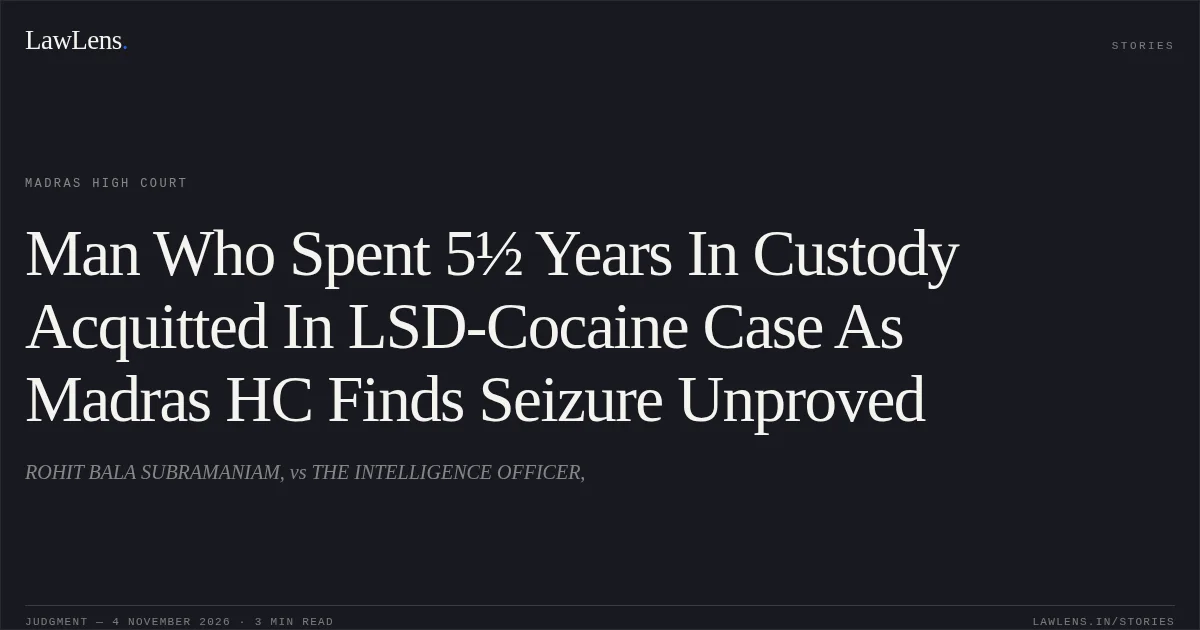
The High Court allowed the appeal, set aside A1’s conviction and sentences, and acquitted him of the charges under Section 8(c) read with Sections 29, 21(a), 22(c), 27A and 28 of the NDPS Act.
¶ 55His bail bond and sureties were discharged, and any fine paid was ordered to be refunded
¶ 55Original Court PDF
ROHIT BALA SUBRAMANIAM,vsTHE INTELLIGENCE OFFICER,
Click to open original judgment
Original judgment, available to read, download and summarize on LawLens.in