01Facts
The petitioner was convicted under Section 138 of the Negotiable Instruments Act and sentenced to six months’ simple imprisonment, a fine of ₹5,000, and compensation of ₹50,000.
pp. 2–3The appellate court affirmed the conviction; the judgment identifies the appellate decision as dated 22 February 2022, although another passage gives a different date.
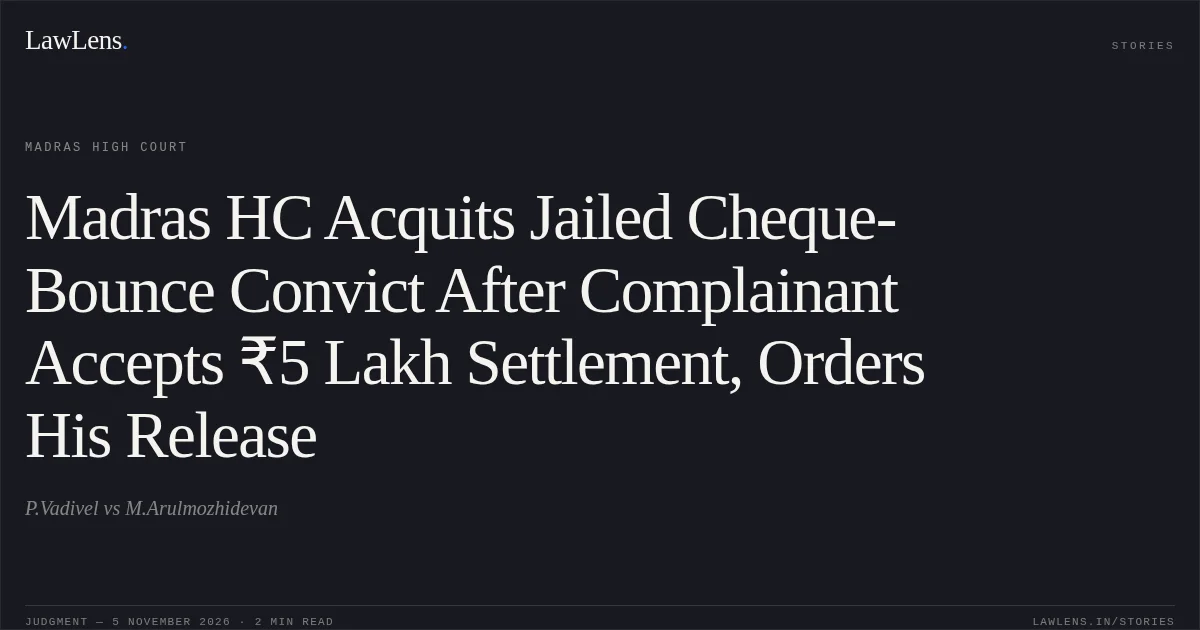
pp. 2–3While the revision was pending, the parties executed a joint compromise memo providing for full and final settlement of ₹5,50,000, the cheque amount. The petitioner had deposited that sum with the trial court in two instalments, and the respondent agreed to accept it and sought permission to withdraw it.
pp. 4–602Issues
i.1. Whether the High Court could permit compounding of the Section 138 offence, and set aside the conviction affirmed on appeal, on the basis of the parties’ subsequent compromise.
p. 12 · ¶ 17ii.2. Whether the respondent could withdraw the ₹5,50,000 deposited by the petitioner with the trial court under the terms of the compromise.
pp. 5–6, 16–1703Law Applied
Section 147 of the Negotiable Instruments Act makes every offence punishable under that Act compoundable, notwithstanding the Code of Criminal Procedure.
p. 13 · ¶ 18The Court also referred to Section 359(6) and (8) of the Bharatiya Nagarik Suraksha Sanhita, 2023, under which a revisional court may permit compounding where authorised, and compounding results in acquittal.
pp. 12–13 · ¶ 18It considered the principles in Damodar S. Prabhu v. Sayed Babalal H., on staged costs for delayed compounding; Meters and Instruments (P) Ltd. v. Kanchan Mehta, on the primarily compensatory object of Section 138 and the possibility of late compounding; and Vinay Devanna Nayak v. Ryot Seva Sahakari Bank Ltd., on setting aside a conviction following settlement.
pp. 7–10The Court also cited K. Balachenniappan v. Jeyakrishnan in support of permitting compounding in the circumstances.
p. 15 · ¶ 15Provisions in the judgment · 15 · Linked ones open on LawLens
Code of Criminal Procedure, 1973 Section 397Section 401Section 357Section 258Section 431Section 264Section 482
Negotiable Instruments Act, 1881 Section 138Section 139Section 147Section 143
Indian Penal Code, 1860 Section 64
Bharatiya Nagarik Suraksha Sanhita, 2023 Section 359
Bharatiya Nyaya Sanhita, 2023 Section 3Section 190
04Reasoning
The Court accepted that the conviction had been affirmed on appeal but considered the subsequent compromise and the circumstances of the case.
pp. 14–15 · ¶ 20–23Both parties had voluntarily settled the dispute; the petitioner had deposited the entire cheque amount, and the respondent confirmed that no amount remained due and that he did not wish to continue the case.
pp. 4–6Treating the settlement as a sufficient basis to permit compounding in the interests of justice, the Court held that the conviction and sentence could be annulled notwithstanding the prior appellate decision.
pp. 14–15 · ¶ 20–2305Holding
The Court disposed of the revision in accordance with the joint compromise memo and allowed the application to compound the offence.
pp. 15–17It annulled the conviction and sentence and treated the petitioner as acquitted upon compounding.
pp. 15–17The respondent was permitted to apply to the trial court to withdraw the deposited ₹5,50,000 within three weeks of receiving the order; upon such application, the trial court was directed to release the amount to him within three weeks.
p. 17Original Court PDF
M.VENKATESANvsC.SELVAJOTHILINGAM
Click to open original judgment
Original judgment, available to read, download and summarize on LawLens.in