01Facts
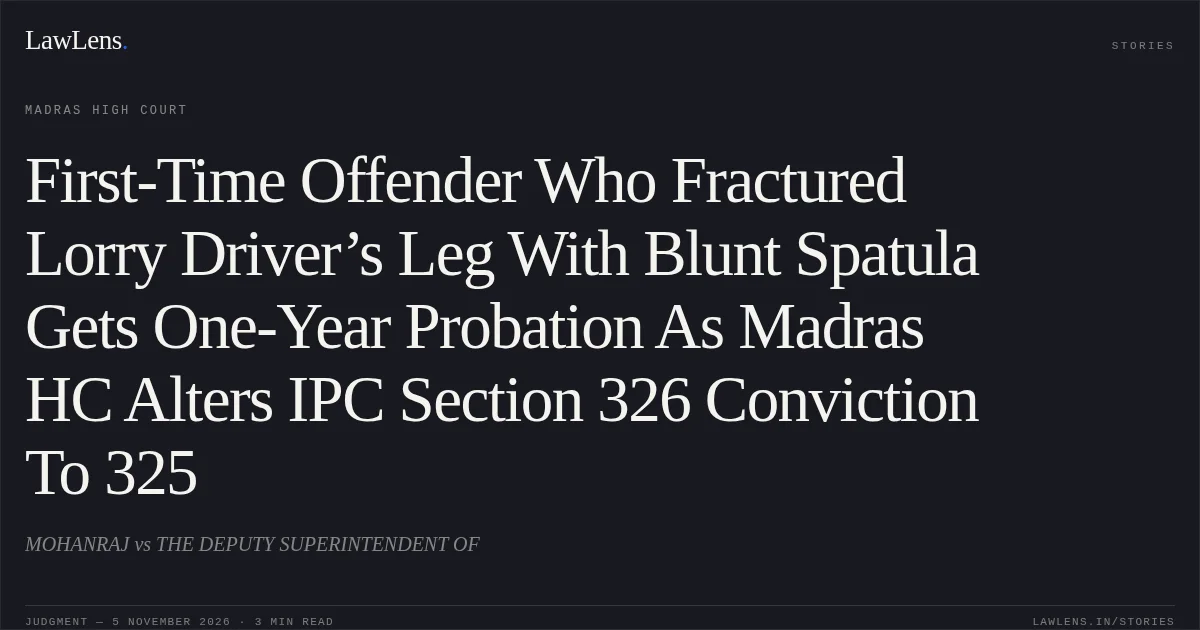
On 29 December 2016, following a quarrel, the appellant struck Periyasamy (PW1) with an iron spatula, causing two fractures in his right leg.
pp. 2–3The Sessions Court acquitted the other accused and convicted the appellant under Section 326 IPC, sentencing him to one year’s simple imprisonment and a fine of ₹25,000, payable as compensation to the victim.
pp. 2–3On appeal, the appellant’s counsel did not challenge the evidence of guilt but sought a reduction in sentence; the Court nevertheless considered whether the spatula qualified as a dangerous weapon under Section 326 IPC.
pp. 3–6The appellant also sought release on probation, supported by a Probation Officer’s report recommending it.
pp. 7–802Issues
i.1. Whether the appellant’s conviction under Section 326 IPC was sustainable where the weapon used was a flat, blunt iron spatula.
pp. 5–6ii.2. Whether the appellant should be released on probation under Section 4 of the Probation of Offenders Act, 1958, and on what terms.
pp. 7–903Law Applied
Section 326 IPC requires grievous hurt to be caused by a dangerous weapon or means; whether an object is dangerous depends on its nature, characteristics and manner of use, not merely its material or the injury caused (Mathai v. State of Kerala, (2005) 3 SCC 260).
p. 6Fractures constitute grievous hurt under Section 320 IPC and, where the requirements of Section 326 are not established, may support conviction under Section 325 IPC.
p. 6The testimony of an injured eyewitness carries substantial evidentiary weight and should not be rejected without cogent reason (State of M.P. v. Mansingh, (2003) 10 SCC 414; Lakshman Singh v. State of Bihar (now Jharkhand), AIR 2021 SC 3552).
p. 5Section 4 of the Probation of Offenders Act permits release on probation for an offence not punishable with death or life imprisonment, and Section 11(1) empowers an appellate court to exercise that power; the Court also treated consideration of a Probation Officer’s report as mandatory, relying on Chellammal v. State, 2025 INSC 540.
pp. 7–8Provisions in the judgment · 12 · Linked ones open on LawLens
Code of Criminal Procedure, 1973 Section 378
Indian Penal Code, 1860 Section 294Section 342Section 323Section 307Section 506Section 326Section 320Section 325
Scheduled Castes and the Scheduled Tribes (Prevention of Atrocities) Act, 1989 Section 3
Probation of Offenders Act, 1958 Section 4Section 11
04Reasoning
PW1’s clear evidence identifying the appellant was corroborated by PW7 and by the medical evidence establishing two fractures; the Court found no basis to discredit that evidence.
pp. 4–5However, the spatula was flat and blunt, with no sharp edge or point, and the Court held that the fractures alone did not establish that it was a dangerous weapon under Section 326 IPC. It therefore substituted Section 325 IPC for Section 326 IPC.
p. 6As the altered offence was not punishable with death or life imprisonment, probation was legally available. Given the appellant’s lack of prior convictions, the favourable Probation Officer’s report, and the absence of evidence that he posed a continuing danger or had misused bail, the Court considered probation appropriate.
pp. 7–905Holding
The appeal was allowed in part: the conviction was altered from Section 326 to Section 325 IPC, while the one-year sentence of simple imprisonment and fine of ₹25,000, payable as compensation to the victim, were maintained.
p. 6, 9The imprisonment sentence was kept suspended, and the appellant was directed to execute a bond with one surety before the Trial Court within one week, to appear and receive sentence if called upon during the one-year period and to keep the peace and maintain good behaviour.
p. 9Original Court PDF
MOHANRAJvsTHE DEPUTY SUPERINTENDENT OF
Click to open original judgment
Original judgment, available to read, download and summarize on LawLens.in