01Facts
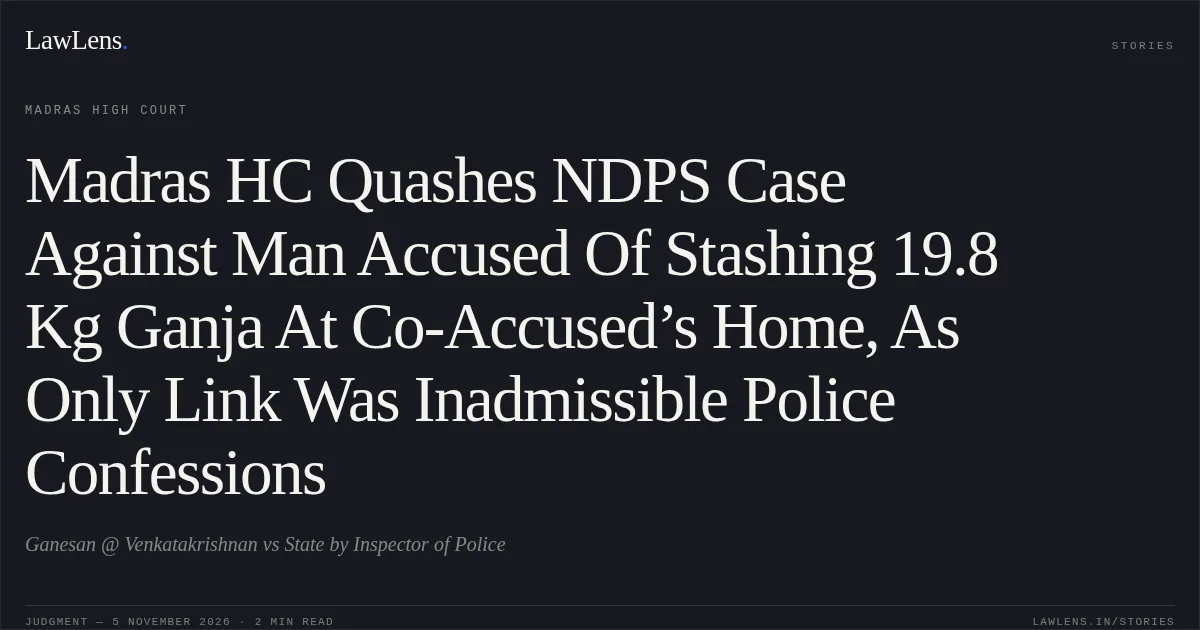
The petitioner, arrayed as A1, sought to quash proceedings in C.C. No. 184 of 2025 for offences under Sections 8(c) read with 20(b)(ii)(C) of the NDPS Act.
p. 1The prosecution alleged that, during a vehicle check, two pillion riders were apprehended while the motorcycle’s rider escaped; the apprehended accused allegedly identified the petitioner as the rider and implicated him in storing ganja at another accused’s house.
p. 2Police later seized approximately 19.8 kg of ganja from that house.
p. 2The petitioner’s alleged involvement rested on co-accused statements; no contraband was recovered from him, and the prosecution had not recovered the motorcycle or produced call-detail records connecting him to the other accused.
pp. 3–4After the final report was filed and cognizance taken, the petitioner invoked Section 528 of the BNSS to quash the proceedings.
p. 102Issues
i.Whether the prosecution materials, taken at face value, disclosed a legally sufficient case against the petitioner for the alleged NDPS offences.
pp. 4–5ii.Whether police-recorded confession statements of co-accused, without other legally admissible material connecting the petitioner to the contraband, could sustain the prosecution against him.
pp. 4–503Law Applied
Section 528 of the BNSS empowers the High Court to quash proceedings where their continuation would amount to an abuse of process or where the materials do not disclose an offence.
p. 1The alleged offences were under Sections 8(c) and 20(b)(ii)(C) of the NDPS Act.
p. 1The Court applied Section 23 of the Bharatiya Sakshya Adhiniyam, corresponding to Section 25 of the Indian Evidence Act, concerning the inadmissibility of confessions made to police officers.
p. 4Relying on Tofan Singh v. State of Tamil Nadu, (2021) 4 SCC 1, it stated that officers empowered under Section 53 of the NDPS Act are police officers for this purpose and that a confession recorded under Section 67 of the NDPS Act cannot be used as a confession against an accused at trial.
pp. 4–5Provisions in the judgment · 6 · Linked ones open on LawLens
Bharatiya Nagarik Suraksha Sanhita, 2023 Section 528
Narcotic Drugs and Psychotropic Substances Act, 1985 Section 8Section 20Section 53Section 67
Bharatiya Sakshya Adhiniyam, 2023 Section 23
04Reasoning
The Court found that the prosecution’s case against the petitioner depended on co-accused statements, while the investigation yielded no recovery from him or other legally admissible material establishing his conscious possession, knowledge, participation, or nexus with the seized contraband.
pp. 3–5The alleged escape, absence of the motorcycle, and lack of call-detail records further left the petitioner’s connection to the other accused and the contraband unsupported.
p. 3Applying Tofan Singh and the cited evidentiary rule, the Court held that the co-accused statements could not, by themselves, provide an admissible basis for continuing the prosecution against the petitioner.
pp. 4–505Holding
The Court held that the materials did not disclose an offence against the petitioner and that continuing the proceedings against him would be unsustainable and an abuse of process.
p. 5It allowed the petition and quashed C.C. No. 184 of 2025 only insofar as A1, the petitioner, was concerned; the trial was directed to proceed against A2 to A4 in accordance with law.
p. 5Original Court PDF
Ganesan @ VenkatakrishnanvsState by Inspector of Police
Click to open original judgment
Original judgment, available to read, download and summarize on LawLens.in