01Facts
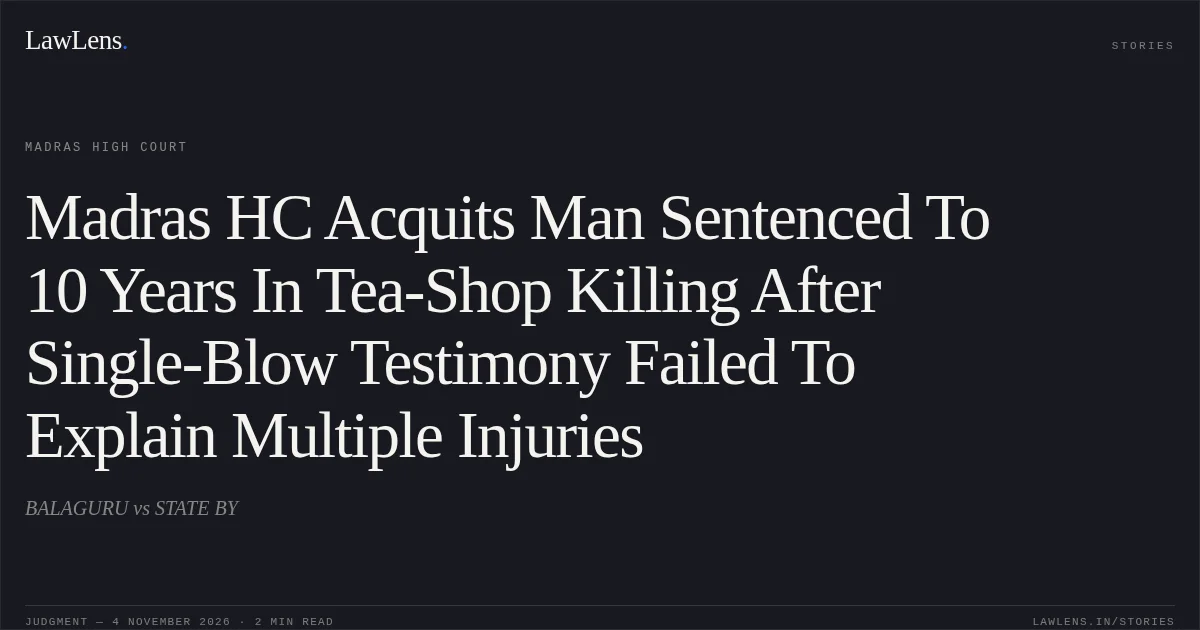
The prosecution alleged that, after a quarrel on 5 July 2018, the appellant returned to the scene with a wooden log and struck the deceased on the head. The deceased died three days later.
pp. 2–4The appellant was convicted under Section 304(ii) IPC and sentenced to ten years’ simple imprisonment. He appealed under Section 374 CrPC, challenging the reliability and sufficiency of the evidence, including the eyewitness accounts, medical evidence and CCTV footage.
pp. 2–4, 7–11On appeal, the High Court assessed the prosecution evidence and concluded that material doubts remained about the identification of the assailant and the circumstances of the assault.
pp. 12–18 · ¶ 14–2102Issues
i.1. Whether the prosecution proved beyond reasonable doubt that the appellant was the person who assaulted the deceased and caused his death.
pp. 15–18 · ¶ 18–21ii.2. Whether the inconsistencies in the eyewitness evidence, its apparent conflict with the medical evidence, and the deficiencies in the CCTV evidence created reasonable doubt warranting acquittal.
pp. 12–18 · ¶ 15–2103Law Applied
The appeal was brought under Section 374 CrPC, which permits an appeal against a conviction. The charged offence was culpable homicide not amounting to murder under Section 304(ii) IPC.
The Court applied the criminal-law requirement that the prosecution prove guilt beyond reasonable doubt; where the evidence, considered cumulatively, leaves a reasonable doubt, the accused is entitled to its benefit.
p. 18 · ¶ 21It also considered the requirements governing electronic records under Section 65-B of the Indian Evidence Act, including the need to assess the certificate, authenticity and integrity of the recording and its evidentiary foundation.
pp. 16–17 · ¶ 20Provisions in the judgment · 3 · Linked ones open on LawLens
Code of Criminal Procedure, 1973 Section 374
Indian Penal Code, 1860 Section 304Section 302
04Reasoning
The Court found that PW3 did not witness the assault; PW2’s account contained inconsistencies, including as to the weapon; and PW6 and PW7 did not report the alleged assault until questioned three days later and could not give material details. PW14 referred to the assailant as “Balamurugan,” did not identify the appellant in court, and the prosecution did not establish that the appellant was also known by that name.
pp. 12–15 · ¶ 15–18The Court further found that the prosecution had not satisfactorily reconciled the eyewitnesses’ account of a single blow with the multiple injuries recorded in the post-mortem report.
p. 16 · ¶ 19The CCTV material did not reliably establish the appellant’s identity or the manner of assault, and the delayed forwarding of witness statements added to the concerns about the evidence.
pp. 14, 16–17 · ¶ 17, 20Taken together, these deficiencies left reasonable doubt about the prosecution case.
p. 18 · ¶ 2105Holding
The High Court allowed the appeal, set aside the conviction and sentence under Section 304(ii) IPC, and acquitted the appellant because the prosecution had not proved his guilt beyond reasonable doubt.
p. 18 · ¶ 22It directed that any bail bond be cancelled and any fine paid be refunded.
p. 18 · ¶ 22Original Court PDF
BALAGURUvsSTATE BY
Click to open original judgment
Original judgment, available to read, download and summarize on LawLens.in