Facts
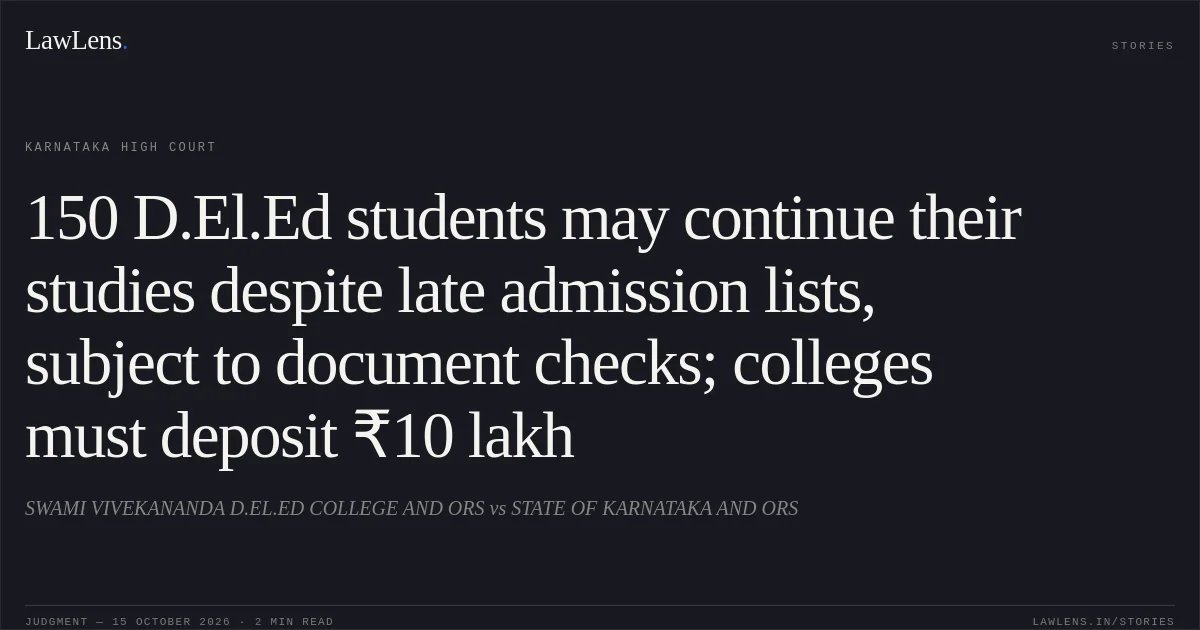
Three D.El.Ed. colleges and their students appealed the dismissal of a writ petition seeking approval of admissions for the 2022–23 academic year.
Source reference: pp. 21–24The colleges had been recognised for an intake of 50 students each and said they had admitted students before the cut-off date, but submitted the admission lists late.
Source reference: pp. 21–24They attributed the delay partly to verification of documents belonging to students from outside Karnataka.
Source reference: pp. 21–24The State disputed the adequacy of the documents and questioned the admissions.
Source reference: pp. 21–24By the time the appeal was considered, the students had completed the first year and were partway through the second year of the two-year course; they had taken examinations pursuant to an interim order.
Source reference: pp. 21–24The Single Judge had dismissed the petition, reserving the students’ liberty to pursue remedies against the colleges for any loss.
Source reference: p. 22Issues
1. Whether the respondents should be directed to consider and approve the students’ late-submitted admission lists for the 2022–23 academic year, subject to verification of eligibility and documents.
Source reference: pp. 24–262. Whether the students should be permitted to continue their course while that verification is undertaken.
Source reference: p. 26Law Applied
The appeal was brought under Section 4 of the Karnataka High Court Act.
Source reference: p. 20The Court relied on Sri Prakash Ambedkar Education Society v. State of Karnataka, W.P. Nos. 28086/2016 and 29462–71/2016 and connected matters, decided on 27 January 2017, in which the Single Judge had directed consideration of late-submitted admission lists subject to students meeting prescribed qualifications and eligibility criteria.
Source reference: p. 25Applying that approach, the Court permitted consideration of the lists and supporting documents, subject to verification, compliance with the DSERT calendar of events, and a monetary penalty imposed on the colleges.
Source reference: pp. 25–27Reasoning
The Court accepted that the colleges had failed to submit the admission lists within the prescribed time, but considered that the students had already completed one year and were partway through the second year, and had taken examinations under an interim order.
Source reference: pp. 23–25Following the approach in Sri Prakash Ambedkar, it considered that the delay could be condoned while protecting the regulatory process: the respondents were to verify the students’ documents and eligibility, and the colleges were penalised for the delay and required to comply with future DSERT timelines.
Source reference: pp. 25–27Holding
The appeal was disposed of with directions that the respondents consider the admission lists and supporting documents and permit eligible students with genuine documents to continue the course.
The colleges were required to deposit ₹10,00,000 with the State within four weeks; failure to deposit would disentitle them from the benefit of the order.
Source reference: pp. 25–27The colleges must adhere to DSERT’s calendar of events, and the respondents may initiate appropriate proceedings, including contempt proceedings, if the colleges breach their undertakings.
Source reference: pp. 25–27Acts & Sections Cited
1 provisions across 1 statute referred to in this judgment. Each provision opens on LawLens.
KARNATAKA HIGH COURT ACT, 19611
Original Court PDF
SWAMI VIVEKANANDA D.EL.ED COLLEGE AND ORSvsSTATE OF KARNATAKA AND ORS
Click to open original judgment
Original judgment, available to read, download and summarize on LawLens.in