Facts
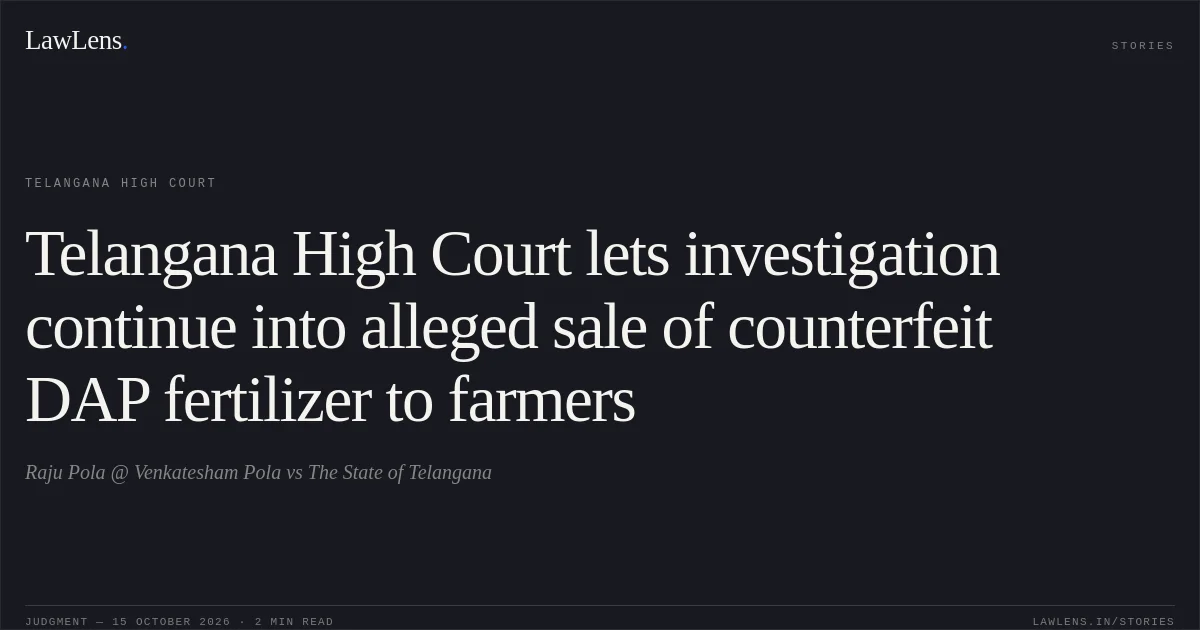
The petitioner sought to quash three FIRs registered at Yalal, Karankote and Bantwaram Police Stations for alleged offences relating to spurious fertilizer, including offences under the Bharatiya Nyaya Sanhita, 2023 (BNS), the Essential Commodities Act, 1955, the Fertilizer (Control) Order, 1985, and the Trade Marks Act, 1999
Source reference: para. 1, 14In the Yalal case, an Agriculture Officer reported that 28 bags of suspected spurious DAP fertilizer had been found and seized, and that the petitioner and others had allegedly sold them
Source reference: para. 4.1The State alleged that the petitioner facilitated the connection between other accused and received ₹50,000 towards sale proceeds; the investigation was ongoing
Source reference: paras. 7.1–7.2, 9The petitioner denied involvement and sought both quashing and protection from coercive steps
Source reference: paras. 6.1–6.2Issues
Whether the allegations and material disclosed a basis to quash the three FIRs under Section 528 of the BNSS while investigation was ongoing
Source reference: paras. 8–10, 14Whether the Court could direct the police not to take coercive steps against the petitioner after declining to quash the FIRs
Source reference: para. 13Law Applied
Section 528 of the BNSS preserves the High Court’s inherent power to prevent abuse of process and secure the ends of justice; under State of Haryana v. Bhajan Lal, that power may be exercised in exceptional cases, including where the allegations taken at face value disclose no offence, are inherently improbable, legally barred, or manifestly mala fide
Source reference: para. 11Neeharika Infrastructure (P) Ltd. v. State of Maharashtra recognizes the police’s statutory right and duty to investigate cognizable offences and cautions against interrupting investigation at the threshold unless the FIR, read on its face, discloses no cognizable offence
Source reference: para. 12The judgment also relied on Sanjay Kumar Gupta v. State of U.P. for the proposition that a blanket “no coercive steps” or “no arrest” order is not to be granted as a substitute for anticipatory bail
Source reference: para. 13The alleged offences were under Sections 318(4) and 338 of the BNS, Section 7 of the Essential Commodities Act, Sections 8 and 19 of the Fertilizer (Control) Order, and Sections 29(1), 29(2)(c), 29(3) and 29(6) of the Trade Marks Act
Source reference: paras. 1, 10Reasoning
The Court considered the allegations that the petitioner participated with the other accused in supplying spurious fertilizer as genuine products of reputed companies, and that he received part of the sale proceeds
Source reference: paras. 8–9It found that the allegations, taken at face value, disclosed cognizable offences and that the investigation was still in progress; the case therefore did not warrant quashing at the threshold under the principles in Bhajan Lal and Neeharika Infrastructure
Source reference: paras. 10–12The Court also refused the requested protection from coercive steps, treating such relief as impermissible in the circumstances and directing that any anticipatory-bail remedy be pursued before the competent court
Source reference: para. 13Holding
The Court dismissed all three criminal petitions and declined to quash the FIRs or grant protection from coercive steps
Pending miscellaneous applications were closed
Source reference: para. 15Acts & Sections Cited
7 provisions across 5 statutes referred to in this judgment. Each provision opens on LawLens.
Bharatiya Nagarik Suraksha Sanhita, 20231
Bharatiya Nyaya Sanhita, 20232
Essential Commodities Act, 19551
Trade Marks Act, 19991
Code of Criminal Procedure, 19732
Original Court PDF
Raju Pola @ Venkatesham PolavsThe State of Telangana
Click to open original judgment
Original judgment, available to read, download and summarize on LawLens.in