Facts
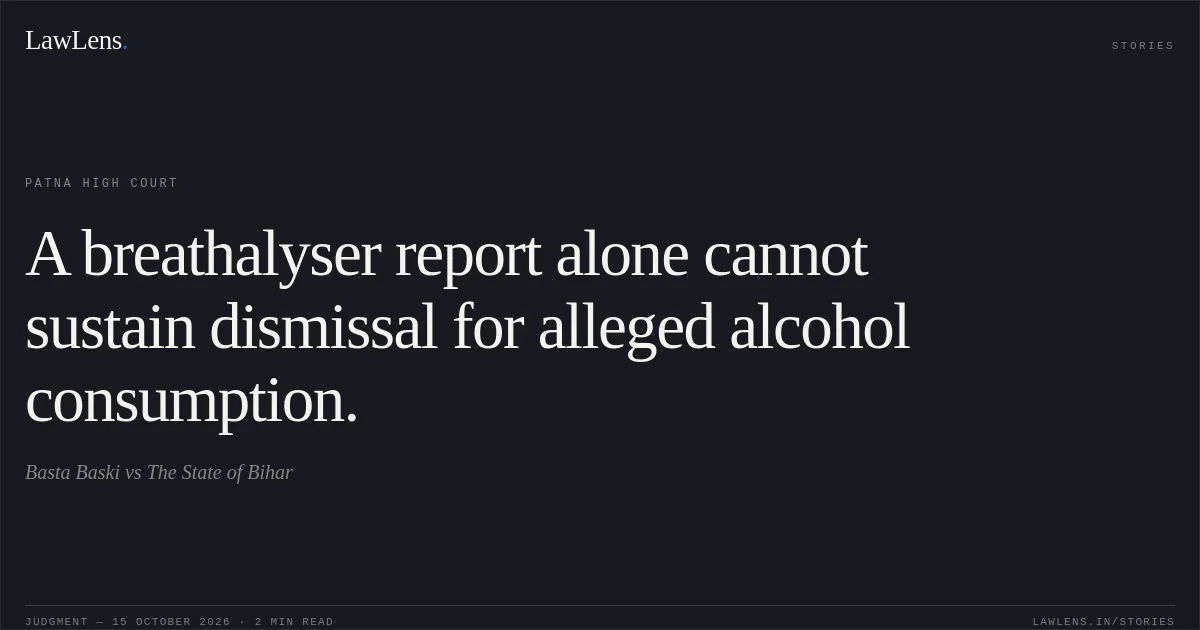
The petitioner, a government clerk, was arrested in an excise case in February 2018 after a Breath Analyzer Test allegedly indicated alcohol consumption.
Source reference: pp. 2–4He was suspended, departmental proceedings were initiated, and he was dismissed by the District Magistrate, Madhepura, on 5 February 2020.
Source reference: pp. 2–4His departmental appeal was dismissed by the Commissioner, Koshi Division, on 10 June 2022.
Source reference: pp. 2–4The petitioner challenged both orders, contending, among other things, that the charge memo was issued by an incompetent authority and that the finding of alcohol consumption rested on a Breath Analyzer Test without supporting urine or blood testing.
Source reference: pp. 4–6The State maintained that the District Magistrate had taken the decision to initiate proceedings and defended the punishment.
Source reference: p. 7Issues
Whether the dismissal orders could stand where the finding of alcohol consumption was based on a Breath Analyzer Test without a urine or blood test.
Source reference: pp. 6–7, 33–34Whether the charge memo was invalid because it had been issued by an authority lacking competence.
Source reference: pp. 4, 7–8Law Applied
The Court relied on Bachubhai Hassanalli Karyani v. State of Maharashtra, (1971) 3 SCC 930, as applied in the cited Patna High Court decisions, for the proposition that a Breath Analyzer result or indicia such as the smell of alcohol do not conclusively establish alcohol consumption and that blood or urine testing is required to ascertain it.
Source reference: pp. 7–8, 17–18, 23–24The Court also referred to the Bihar Government Servants (Classification, Control & Appeal) Rules, 2005, including Rule 17(3), concerning initiation of disciplinary proceedings, as discussed in the cited authorities.
Source reference: pp. 7, 9–10It noted that Rule 17(14) requires consideration of the delinquent employee’s defence in the departmental process.
Source reference: pp. 20–21Reasoning
The Court found that the punishment had been imposed on the basis of the Breath Analyzer Test alone and that no urine-test report was available; it treated the cited authorities, including the Division Bench decision in L.P.A. No. 1095 of 2024, as establishing that such a test was not conclusive proof of consumption.
Source reference: pp. 7–8, 33–34On that basis, it held that the charge was not sustainable and set aside the disciplinary and appellate orders.
Source reference: pp. 33–34Although the judgment also observed that a charge memo issued by a non-jurisdictional authority would not be sustainable, the State’s submission was that the District Magistrate had taken the initiation decision; the Court’s final disposition rested on the evidentiary insufficiency of the Breath Analyzer Test.
Source reference: pp. 7–8, 33–34Holding
The Court allowed the writ petition and quashed the dismissal order dated 5 February 2020 and the appellate order dated 10 June 2022.
It directed that the petitioner be permitted to join service within two months of producing the judgment; it did not expressly grant consequential monetary benefits.
Source reference: p. 34Acts & Sections Cited
1 provisions across 1 statute referred to in this judgment. Each provision opens on LawLens.
BIHAR PROHIBITION AND EXCISE ACT, 20161
Original Court PDF
Basta BaskivsThe State of Bihar
Click to open original judgment
Original judgment, available to read, download and summarize on LawLens.in