Facts
The claimant sustained injuries, including 5% permanent disability in the right lower limb, in a motor-vehicle accident on 8 August 1996 involving truck/vehicle No. CH-01-H-5042.
Source reference: para. 10He filed a claim petition under Section 166 of the Motor Vehicles Act, 1988 before the Motor Accident Claims Tribunal, Chandigarh.
Source reference: no citationThe Tribunal held that the accident occurred because the claimant himself negligently struck the tempo ahead of him when it stopped at a traffic-light point.
Source reference: para. 4Although the Tribunal assessed compensation at ₹25,000—₹10,000 for pain and suffering, ₹10,000 for permanent partial disability, and ₹5,000 towards medical expenses—it dismissed the claim petition on the ground of the claimant’s negligence.
Source reference: para. 4In appeal, the claimant contended that, irrespective of negligence, he was entitled to no-fault compensation under the subsequently enacted Section 164 of the Act, relying on Ram Murti v. Punjab State Electricity Board, 2023 ACJ 631.
Source reference: paras. 6, 8–9Issues
Whether the claimant could be awarded no-fault compensation despite the Tribunal’s finding that the accident resulted from his own negligence?
Source reference: paras. 4, 6, 9–10Whether the beneficial compensation provision under Section 164 of the Motor Vehicles Act, 1988 could be applied to an accident that occurred before that provision came into force?
Source reference: paras. 6, 9–10Whether the claimant was entitled to ₹2,50,000 as compensation for grievous hurt, and from whom and with what interest?
Source reference: paras. 10–11Law Applied
The Court considered the claimant’s petition under Section 166 of the Motor Vehicles Act, 1988, which ordinarily requires adjudication of the accident and negligence.
Source reference: no citationIt applied the no-fault compensation framework formerly contained in Section 163-A and the substituted Section 164 of the Act.
Source reference: no citationSection 164 provides compensation of ₹2,50,000 for grievous hurt, without requiring proof of rash or negligent driving.
Source reference: paras. 6, 8–10The Court relied on Ram Murti v. Punjab State Electricity Board, 2023 ACJ 631, where the Supreme Court held that the beneficial provisions introduced by Parliament could be extended to an earlier accident and awarded statutory no-fault compensation despite the accident predating Section 164.
Source reference: paras. 6, 8–9The Court noted that Section 164 had been brought into force with effect from 1 September 2019 under the Motor Vehicles (Amendment) Act, 2019, notwithstanding the later repeal/substitution position referred to in the judgment.
Source reference: para. 10Reasoning
The Tribunal had already found that the claimant suffered injuries in an accident involving the insured vehicle and had assessed compensation, but denied recovery solely because it attributed negligence to the claimant.
Source reference: para. 4The High Court held that negligence is not relevant when compensation is claimed under the no-fault statutory scheme.
Source reference: no citationFollowing Ram Murti, it treated Section 164 as a beneficial provision capable of application to the claimant’s pending claim, even though the accident occurred in 1996, before Section 164 came into force.
Source reference: paras. 8–10Since the claimant had suffered multiple injuries and 5% permanent disability, the Court held that the statutory amount for grievous hurt was payable, replacing the Tribunal’s refusal to award any compensation.
Source reference: para. 10Holding
The appeal was partly allowed.
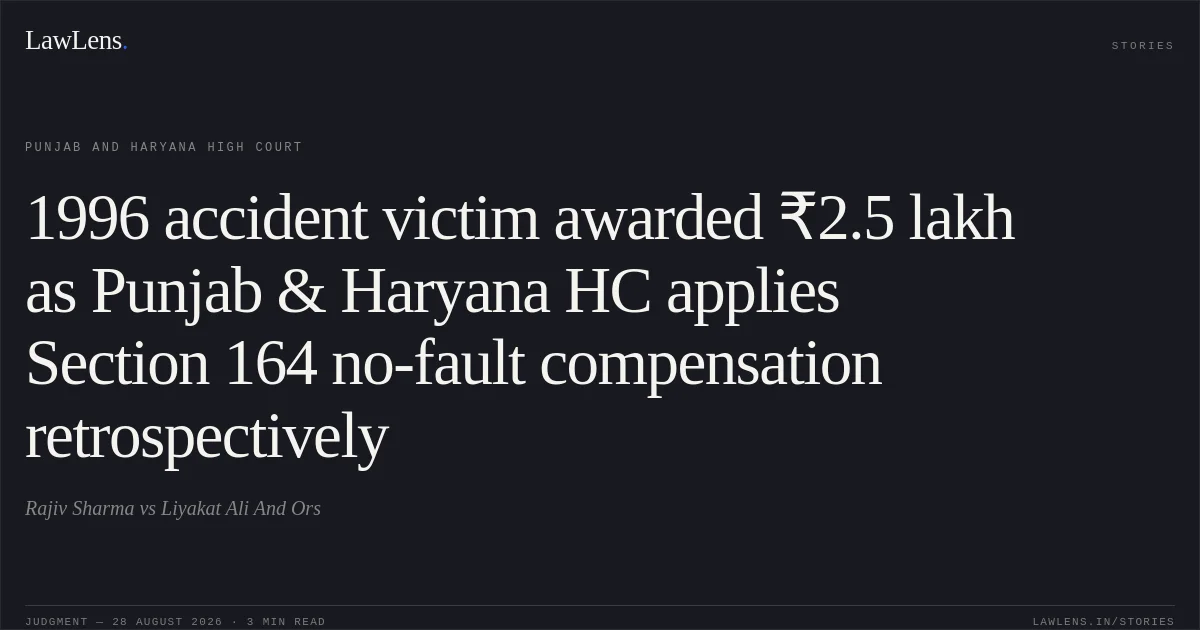
The claimant was held entitled to ₹2,50,000 as compensation under Section 164 of the Motor Vehicles Act, 1988, notwithstanding the finding of his own negligence.
Source reference: para. 10The amount was made payable by the vehicle’s owner and insurer jointly and severally, with interest at 9% per annum from 1 September 2019, the date on which Section 164 was held to have come into force, until realization.
Source reference: para. 11The Registry was directed to email the authenticated judgment to the insurer in accordance with the Supreme Court’s directions in Bajaj Allianz General Insurance Co. v. Union of India, W.P. (C) No. 534 of 2020.
Source reference: para. 12Acts & Sections Cited
4 provisions across 1 statute referred to in this judgment. Each provision opens on LawLens.
Motor Vehicles Act, 19884
Original Court PDF
Rajiv SharmavsLiyakat Ali And Ors
Click to open original judgment
Original judgment, available to read, download and summarize on LawLens.in
![Courts will not interfere with transfers absent mala fides or violation of statutory rules.. M Ramya vs EMPLOYEES STATE INSURANCE CORPORATION (ESIC). CAT - ['Chennai']. LawLens](/stories/thumbnails/courts-will-not-interfere-with-transfers-absent-mala-fides-or-violation-of-statutory-rules-a6845e9ca6f548fca284c51c8351957f.webp)
![Courts cannot direct one-time recruitment age relaxation absent authority in the governing rules or advertisement.. UT OF PUDUCHERRY vs M ANDAL. CAT - ['Chennai']. LawLens](/stories/thumbnails/courts-cannot-direct-one-time-recruitment-age-relaxation-absent-authority-in-the-governing-895d78fde47143e2a8ed0207c4b6a44f.webp)
![A review cannot correct an allegedly erroneous decision absent an error apparent on the record.. Ajit Kumar Jha vs RAILWAY BOARD. CAT - ['Delhi']. LawLens](/stories/thumbnails/a-review-cannot-correct-an-allegedly-erroneous-decision-absent-an-error-apparent-on-the-re-8ac952fd4eba470c92f7da20af72a220.webp)