01Facts
The connected appeals arose from the common Award dated 25.02.2004 passed by the Motor Accident Claims Tribunal, Jagadhri, concerning an accident dated 02.04.2001 involving truck Nos. HR-58-0742 and HNL-6569. The accident resulted in the deaths of Bimla, Sunni, Kapoor Chand and Kishori Lal, and injuries to Manni, Rajani, Chanderwati and Bhupinder Kaur.
¶ 2–10The Tribunal awarded compensation under Section 163-A of the Motor Vehicles Act, 1988, namely ₹3,09,500 to the claimants of Bimla; ₹17,665 to Manni; ₹1,54,500 to the parents of Sunni; ₹3,60,500 to the claimants of Kapoor Chand; ₹41,917 to Rajani; ₹45,750 to Chanderwati; ₹3,12,000 to the claimants of Kishori Lal; and ₹61,780 to Bhupinder Kaur.
¶ 3–10Liability was apportioned at 50% against the owner and insurer of truck No. HR-58-0742 and 50% against the owner of truck No. HNL-6569. The insurer of truck No. HNL-6569 was exonerated because gratuitous passengers were being carried in breach of the insurance policy.
¶ 13The claimants appealed seeking enhancement of compensation. The respondents did not challenge the Tribunal’s finding that the accident arose from the use of both vehicles.
¶ 1502Issues
i.Whether the claimants, whose accident occurred before the enactment of Section 164 of the Motor Vehicles Act, were entitled to the enhanced no-fault compensation prescribed under that provision retrospectively?
¶ 16, 18–20ii.Whether, in a case involving the use of two vehicles, the liability could be apportioned between the vehicles at 50:50 as against the claimants, or whether the owners and insurers were jointly and severally liable?
¶ 16, 22–23iii.Whether the insurer of truck No. HNL-6569 could be completely exonerated for carrying gratuitous passengers in breach of the insurance policy, or whether it was required to pay the compensation with liberty to recover it from the insured?
¶ 16–17, 2103Law Applied
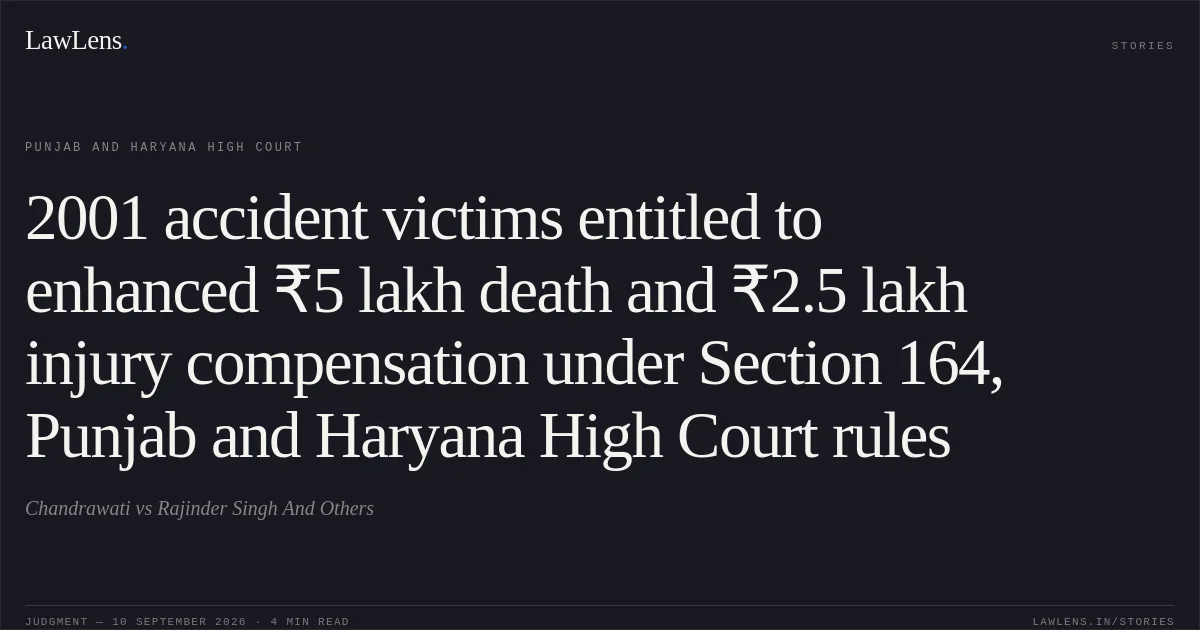
The Court applied Section 163-A of the Motor Vehicles Act, 1988, under which compensation could be claimed on a no-fault basis, and Section 164, introduced by the Motor Vehicle (Amendment) Act, 2019, prescribing ₹5,00,000 for death and ₹2,50,000 for grievous hurt.
¶ 18–20Relying on Ram Murti v. Punjab State Electricity Board, 2023 ACJ 631, the Court held that the beneficial compensation regime under Section 164 could be applied to pending claims arising from earlier accidents.
¶ 18–20On composite negligence, the Court relied on Khenyei v. New India Assurance Co. Ltd., Law Finder Doc ID #669171, which establishes that joint tortfeasors are jointly and severally liable to the claimant; apportionment between them is not enforceable against the claimant, although inter se contribution may subsequently be determined.
¶ 22Regarding breach of policy by carrying gratuitous passengers, the Court applied National Insurance Co. Ltd. v. Baljit Kaur, (2004) 2 SCC 1, and subsequent decisions including Anu Bhanvara v. IFFCO Tokio General Insurance Co. Ltd. and ICICI Lombard General Insurance Co. Ltd. v. Rajani Sahoo, holding that the insurer must first satisfy the award and may thereafter recover the amount from the insured.
¶ 21Provisions in the judgment · 5 · Linked ones open on LawLens
Code of Civil Procedure, 1908 Section 151
Motor Vehicles Act, 1988 Section 140Section 163Section 164Section 166
04Reasoning
The Court held that the claims were founded on no-fault liability and that it was undisputed that the deaths and injuries resulted from the use of the two vehicles; proof of rash or negligent driving was therefore unnecessary under Section 163-A.
¶ 23Following Ram Murti, the Court treated Section 164 as a beneficial statutory provision applicable to the pending claims notwithstanding that the accident occurred in 2001. Consequently, the death claimants were entitled to ₹5,00,000 each and the injured claimants to ₹2,50,000 each, after adjusting the amounts already awarded.
¶ 18–20, 25–32The Court further reasoned that the claimants were third parties vis-à-vis both vehicles and that the accident involved composite liability. Accordingly, the Tribunal could not restrict the claimants to recovery of only 50% from either set of respondents. The owners and insurers of both vehicles were held jointly and severally liable, leaving any inter se recovery dispute to be resolved between the liable parties.
¶ 23Although the insurer of truck No. HNL-6569 established a policy breach arising from the carriage of gratuitous passengers, complete exoneration was impermissible under the applicable “pay and recover” principle. Respondent No. 4 was therefore directed to satisfy the award, with liberty to recover the amount from respondent No. 3, together with interest at 6% per annum from the date of deposit until realization.
¶ 2105Holding
The appeals were partly allowed with costs. The owners and insurers of both vehicles—respondents Nos. 1 to 4—were held jointly and severally liable to pay the compensation.
¶ 24Respondent No. 4, the insurer of truck No. HNL-6569, was directed to pay the award despite the policy breach, with the right to recover the amount from respondent No. 3.
¶ 24The enhanced compensation, with interest at 9% per annum from 01.09.2019, the date on which Section 164 was stated to have come into force, was fixed as follows:
¶ 25–32FAO-2853-2004: ₹1,90,500 for the death of Bimla, to be shared equally.
¶ 25FAO-2854-2004: ₹2,32,335 for Manni’s injuries.
¶ 26FAO-2855-2004: ₹3,45,500 for the death of Sunni, to be shared equally.
¶ 27FAO-2856-2004: ₹1,39,500 for the death of Kapoor Chand, to be shared equally.
¶ 28FAO-2857-2004: ₹2,08,083 for Rajani’s injuries.
¶ 29FAO-5153-2004: ₹2,04,250 for Chanderwati’s injuries.
¶ 30FAO-5154-2004: ₹1,88,000 for the death of Kishori Lal, to be shared equally.
¶ 31FAO-5155-2004: ₹1,88,220 for Bhupinder Kaur’s injuries.
¶ 32The Registry was also directed to email the authenticated judgment to the concerned insurance companies in accordance with the Supreme Court’s directions in Bajaj Allianz General Insurance Co. v. Union of India.
¶ 33Original Court PDF
ChandrawativsRajinder Singh And Others
Click to open original judgment
Original judgment, available to read, download and summarize on LawLens.in