Facts
The Union of India, through the Director General, Married Accommodation Project, entered into a contract with NCC Limited on 9 March 2010 for construction of dwelling units at Binnaguri and Cooch Behar, West Bengal, for approximately ₹190.58 crore. The work, stipulated to be completed in three phases within 24 months, was ultimately completed after a delay of approximately 76 months, on 18 July 2016.
Source reference: pp.5, para. 12.2–12.4Disputes arose regarding the final bill and various claims for additional payments, escalation, prolongation costs, bank-guarantee expenses and interest. NCC invoked arbitration under Clause 60 of the General Conditions of Contract, and a sole arbitrator was appointed by agreement between the parties.
Source reference: pp.5–7, para. 12.5–12.6The arbitral proceedings were conducted principally on the basis of pleadings and documents. The Union sought adjournments, a change of venue, determination of procedural rules and permission to lead oral evidence; these requests were rejected or addressed by the arbitrator, who granted further opportunities to the Union to make submissions and produce or comment upon documents.
Source reference: pp.6–9, para. 12.9–12.20; pp.29–36, paras. 26–50By award dated 18 March 2019, the arbitrator partly or wholly allowed ten of NCC’s fifteen claims, awarding ₹12,14,18,020 with interest, directing release of the ₹9.53 crore performance bank guarantee, and rejecting all four counterclaims of the Union. The Union challenged the award under Section 34 of the Arbitration and Conciliation Act, 1996, while NCC initiated enforcement proceedings under Section 36.
Source reference: pp.2–3, para. 3; pp.9–13, paras. 12.25–13; pp.2–3, paras. 1–3Issues
Whether the Union was denied a full and fair opportunity to present its case, in violation of Sections 18 and 34(2)(a)(iii) of the Arbitration and Conciliation Act, 1996, because its requests for adjournment, change of venue, procedural directions and oral evidence were rejected?
Source reference: pp.21–32, paras. 22–41Whether the arbitrator acted beyond his procedural authority by deciding the dispute on the basis of documents without permitting witness examination or formal admission and denial of documents?
Source reference: pp.32–41, paras. 42–53Whether the arbitrator’s prior adjudication of a dispute between the same parties, delayed disclosure under Section 12, and appointment under the contractual arbitration clause rendered the award vulnerable for want of independence or impartiality?
Source reference: pp.41–44, paras. 54–60Whether the arbitrator’s mandate had terminated before the award because of expiry under Section 29A, resignation and superannuation, notwithstanding the High Court’s subsequent extension of time?
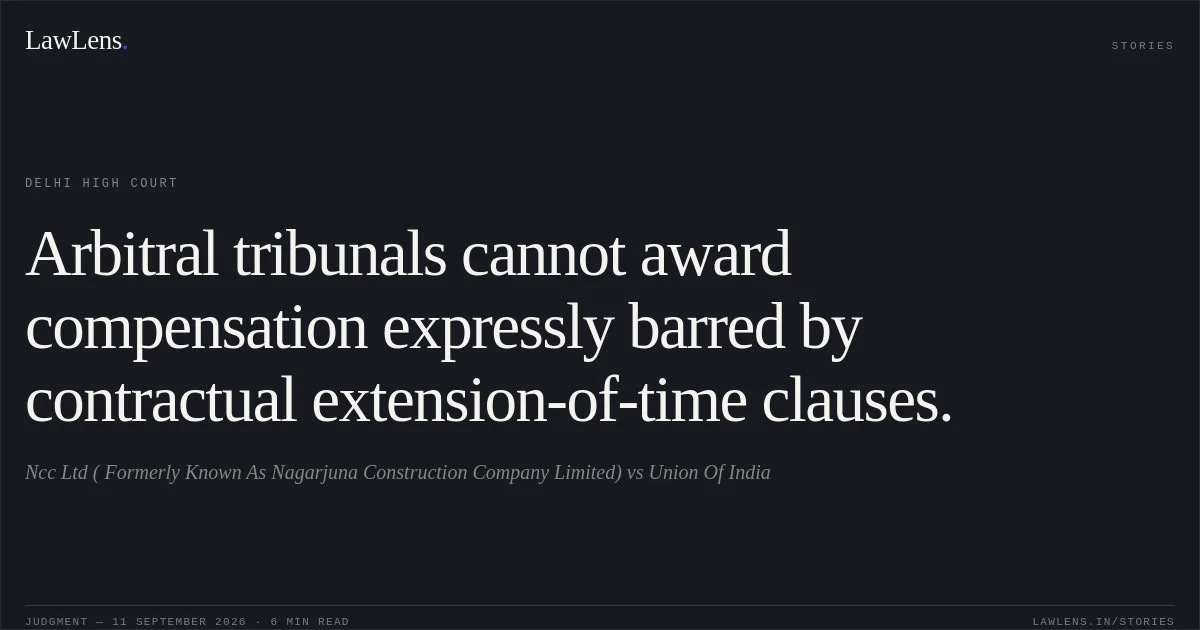
Source reference: pp.44–50, paras. 61–72Whether the award of escalation and prolongation compensation under Claim Nos. 7 and 9 was patently illegal because Clause 13(B) of the GCC barred compensation arising from extensions of time granted under Clause 13(A)?
Source reference: pp.50–65, paras. 73–96Whether the impugned award could be set aside only in respect of Claim Nos. 7 and 9, while preserving the remaining determinations?
Source reference: pp.65–66, paras. 97–99Whether the award of pre-reference, pendente lite and future interest at 12% per annum was impermissible in the absence of notice under the Interest Act, 1978 or otherwise excessive?
Source reference: pp.66–75, paras. 100–108Law Applied
Section 34 of the Arbitration and Conciliation Act, 1996 provides a narrow supervisory jurisdiction; a court does not sit in appeal or reappreciate evidence, but may interfere where an award is patently illegal, perverse, contrary to the Arbitration Act, or in conflict with a clear contractual prohibition.
Source reference: pp.17–21, paras. 16–21Under Sections 18, 19 and 24, parties must receive equal treatment and a reasonable opportunity to present their cases, but the tribunal is not bound by the CPC or the Evidence Act and may determine whether oral evidence is necessary.
Source reference: pp.21–28, paras. 23–25; pp.36–40, para. 52Section 12(5) permits waiver of ineligibility by an express written agreement, while Section 29A permits the court to extend the arbitrator’s mandate after its statutory expiry.
Source reference: pp.41–50, paras. 54–72An arbitrator is bound by the contract and cannot award compensation contrary to an express contractual bar; the Supreme Court’s interpretation in Ramnath International Construction (P) Ltd. v. Union of India, (2007) 2 SCC 453, established that a clause barring compensation arising from extensions of time applies even where delay is attributable to the employer, contractor or both.
Source reference: pp.55–58, paras. 82–83The same principle was reinforced through Indian Oil Corporation Ltd. v. Shree Ganesh Petroleum Rajgurunagar, (2022) 4 SCC 463, concerning the arbitrator’s obligation to act within the contract.
Source reference: pp.60–61, para. 85Under the doctrine of severability, recognised in Gayatri Balasamy v. ISG Novasoft Technologies Ltd., (2025) 7 SCC 1, an invalid portion of an award may be set aside separately if it is legally and practically severable from the valid portions.
Source reference: pp.65–66, paras. 97–99Finally, Section 31(7) confers broad discretion on the tribunal to award pre-reference, pendente lite and post-award interest, subject to contractual restrictions; a separate notice under the Interest Act is not necessary for such an award under the Arbitration Act.
Source reference: pp.66–75, paras. 100–108Reasoning
The Court held that the Union had received adequate notice and multiple opportunities to present its case. The hearing schedule was fixed more than a month in advance, the Union was permitted to continue its submissions, provide comments on documents, obtain soft copies of allegedly illegible documents, and participate in a further hearing with legal and technical representatives. The Union failed to identify any specific witness, document or evidence that it was prevented from producing, or any concrete prejudice caused by the refusal of adjournment.
Source reference: pp.29–32, paras. 30–41Since the parties had not agreed upon a specific procedure, the arbitrator was authorised under Sections 19 and 24 to decide the dispute on the basis of documents and to dispense with oral evidence; this was a plausible procedural determination and did not violate natural justice.
Source reference: pp.32–41, paras. 42–53The Court also rejected the objections concerning impartiality and mandate. The parties had expressly waived objections under Section 12(5), and the arbitrator’s prior adjudication of a connected dispute did not, in the circumstances, establish bias or justifiable doubts as to impartiality.
Source reference: pp.41–44, paras. 54–60However, the Court found patent illegality in Claims 7 and 9. Clause 13(B) expressly barred compensation arising from extensions granted under Clause 13(A). Clause 13(A)(vii), unlike the provision considered in Union of India v. Inderjit Mehta Construction Pvt. Ltd., was not restricted by ejusdem generis language and was materially identical to the clause interpreted in Ramnath International. Therefore, the arbitrator could not avoid the contractual bar by characterising the relevant delays as attributable to the Union or as falling outside Clause 13(A). The awards of escalation under Claim 7 and prolongation compensation under Claim 9 consequently contradicted both the GCC and binding Supreme Court authority.
Source reference: pp.50–65, paras. 73–96These claims were severable from the remaining claims, so only that portion of the award was set aside. The Court upheld the interest award, finding it within the arbitrator’s discretion under Section 31(7) and not dependent upon prior notice under the Interest Act.
Source reference: pp.65–75, paras. 97–108Holding
The Section 34 petition was partly allowed. The Court upheld the award against the Union insofar as it rejected the natural-justice, procedural, impartiality, mandate and interest objections.
However, the portions awarding amounts under Claim Nos. 7 and 9 were set aside as patently illegal for violating Clause 13(B) of the GCC and the binding interpretation in Ramnath International.
Source reference: pp.75–76, paras. 109–110The interim stay on execution and consequential orders were vacated. The enforcement proceedings were directed to be listed for determination of the final amount payable under the surviving portions of the award, including interest, and for consideration of the connected chamber appeal.
Source reference: p.76, paras. 111–112Acts & Sections Cited
21 provisions across 3 statutes referred to in this judgment. Each provision opens on LawLens.
Arbitration and Conciliation Act, 1996
Indian Contract Act, 18721
Interest Act, 19781
Original Court PDF
Ncc Ltd ( Formerly Known As Nagarjuna Construction Company Limited)vsUnion Of India
Click to open original judgment
Original judgment, available to read, download and summarize on LawLens.in