Facts
D.P. Dhall, a General Manager of Bharat Petroleum Corporation Limited (“BPCL”), was allotted residential premises at A-10, First Floor, South Extension-II, New Delhi, which BPCL had taken on lease.
Source reference: pp.2–4The lessor subsequently obtained a decree for possession against BPCL.
Source reference: pp.2–4During execution, on 25 October 2004, the premises were opened in Dhall’s absence, and his belongings were removed and placed outside.
Source reference: pp.3–4, 10–14Dhall alleged loss of cash, jewellery and household articles, damage to goods, and mental agony and inconvenience.
Source reference: pp.3–4, 10–14He claimed damages of Rs.20,00,000 with interest.
Source reference: pp.3–4, 10–14The Trial Court awarded Rs.15,30,000, comprising Rs.10,00,000 for mental agony, loss of prestige and inconvenience, Rs.4,80,000 for loss of cash, jewellery and valuable goods, and Rs.50,000 for repair of damaged household goods, together with interest and costs of Rs.22,278.
Source reference: pp.1–2During the suit, Dhall died on 30 January 2016, and his wife and children were substituted as legal representatives by order dated 21 March 2016.
Source reference: pp.4–5BPCL challenged the decree, contending, inter alia, that the suit was barred by res judicata, suffered from non-joinder of the lessor, was unsupported by evidence, and had abated upon Dhall’s death under Section 306 of the Indian Succession Act, 1925.
Source reference: pp.5–9Issues
1. Whether the suit was barred by res judicata because of the dismissal of an objection petition filed in the execution proceedings?
Source reference: paras. 28–36; pp.17–202. Whether the suit was liable to be dismissed for non-joinder of the lessor/owner of the premises?
Source reference: paras. 37–38; pp.20–213. Whether BPCL was liable in negligence for failing to inform Dhall of the eviction decree and impending execution proceedings?
Source reference: paras. 39–51; pp.21–274. Whether the compensation awarded for repair of damaged goods, loss of cash and jewellery, mental agony, loss of prestige and inconvenience was supported by the evidence and legally recoverable by Dhall’s legal representatives?
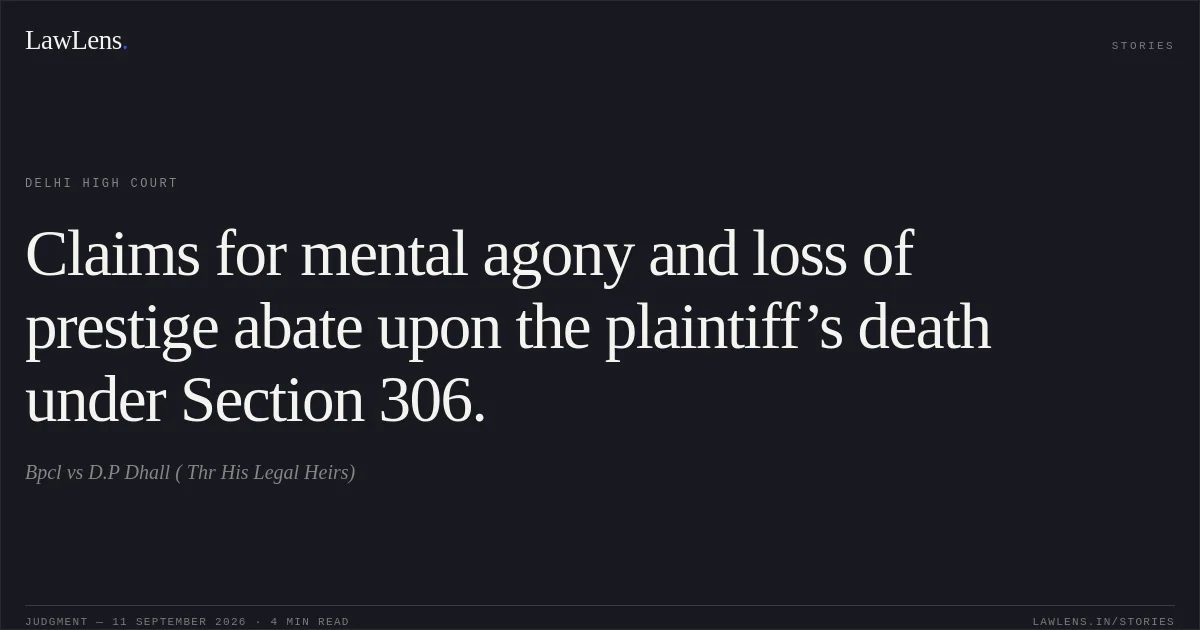
Source reference: paras. 52–77; pp.27–415. Whether the claim for compensation for mental agony, loss of prestige and inconvenience abated on Dhall’s death under Section 306 of the Indian Succession Act, 1925?
Source reference: paras. 67–77; pp.33–41Law Applied
The Court applied Section 11 CPC, holding that res judicata requires the matter to have been directly and substantially in issue in the former proceeding and to have been finally decided on merits; a dismissal on a preliminary or technical ground does not ordinarily operate as res judicata, relying on Prem Kishore v. Brahm Prakash, (2023) 19 SCC 244.
Source reference: paras. 33–35Order I Rule 9 CPC provides that non-joinder does not defeat a suit unless the omitted party is a necessary party.
Source reference: paras. 37–38The Court held that an employer who allots residential accommodation to an employee owes a duty of care to inform the employee of an eviction decree and impending execution where the employee occupies the premises.
Source reference: paras. 41, 48–51Section 306 of the Indian Succession Act, 1925 preserves rights of action after death except claims relating to defamation, assault, other personal injuries not causing death, or relief that becomes incapable of enjoyment.
Source reference: paras. 71–75Applying M. Veerappa v. Evelyn Sequeira, (1988) 1 SCC 556, and Kumud Lall v. Suresh Chandra Roy, 2026 SCC OnLine SC 797, the Court distinguished proprietary or estate-related claims, which survive, from personal claims for mental agony, reputation and pain and suffering, which abate on death.
Source reference: paras. 71–75Compensation for damage to property must be established by evidence; unsupported claims for cash and jewellery cannot be awarded merely on the basis of surrounding circumstances.
Source reference: paras. 60–66Reasoning
The execution objection petition had not adjudicated BPCL’s liability on merits; it merely indicated that any grievance concerning BPCL’s failure to inform the occupant could be pursued separately. It therefore did not bar the subsequent damages suit under Section 11 CPC.
Source reference: paras. 31–36The lessor was not a necessary party because the suit concerned BPCL’s independent negligence in failing to communicate the eviction proceedings, not the validity of the lessor’s title or possession decree.
Source reference: para. 38On negligence, the Court found that BPCL had a duty to inform Dhall of the eviction decree and execution proceedings.
Source reference: paras. 41–48BPCL produced no documentary proof of such notice and itself maintained that it had been unaware of the execution; its police complaint also recorded that no prior notice had been given before the locks were broken and the belongings removed.
Source reference: paras. 41–48The finding of negligence was consequently upheld.
Source reference: paras. 49–51However, the claims for cash and jewellery were unsupported by bank records, purchase bills or other documentary evidence, and the FIR did not mention those losses; the inconsistent amounts claimed in the execution objection further weakened the claim.
Source reference: paras. 61–66The award for repair of damaged goods was sustained because BPCL’s valuer assessed damage at Rs.1,43,000, while the Trial Court had awarded only Rs.50,000.
Source reference: paras. 56–59The award of Rs.10,00,000 for mental agony, loss of prestige and inconvenience was set aside because those claims represented personal injuries that did not form part of Dhall’s estate and therefore did not survive his death under Section 306.
Source reference: paras. 71–77Holding
The appeal was partly allowed.
The Court upheld BPCL’s tortious liability for negligence and maintained the award of Rs.50,000 for repair of damaged household goods, together with applicable interest, and Rs.22,278 towards costs.
Source reference: paras. 78–81The awards of Rs.4,80,000 for loss of cash, jewellery and valuable goods and Rs.10,00,000 for mental agony, loss of prestige and inconvenience were set aside because the former was not proved by evidence and the latter claim abated upon Dhall’s death.
Source reference: paras. 66, 76–81The Trial Court’s judgment and decree were modified accordingly, and a revised decree sheet was directed to be drawn.
Source reference: para. 79Acts & Sections Cited
7 provisions across 5 statutes referred to in this judgment. Each provision opens on LawLens.
Code of Civil Procedure, 19083
Indian Succession Act, 19251
Indian Penal Code, 18601
Indian Contract Act, 18721
Transfer of Property Act, 18821
Original Court PDF
BpclvsD.P Dhall ( Thr His Legal Heirs)
Click to open original judgment
Original judgment, available to read, download and summarize on LawLens.in