Facts
The petitioner-Trust purchased land measuring 4 Bighas 3 Kathas from the respondent and his two brothers under a registered sale deed for a total consideration of ₹1,15,00,000.
Source reference: para. 4; p. 31Although ₹35,00,000 was initially paid, the balance was allegedly tendered through post-dated cheques. One cheque for ₹10,00,000 was dishonoured with the endorsement “payment stopped by drawer,” leading to complaints under Section 138 of the Negotiable Instruments Act.
Source reference: para. 4; p. 31The petitioner’s defence was that it had paid the entire sale consideration, and in fact paid amounts exceeding it, including approximately ₹50,00,000 to Anil Das, one of the co-executants and co-owners of the property.
Source reference: paras. 7–8; p. 14During the trial, after the petitioner had initially declined to adduce defence evidence and the matters had been fixed for arguments, it filed applications under Section 311 CrPC seeking to summon Anil Das as a Court/material witness or defence witness.
Source reference: paras. 10, 17, 32The learned Chief Judicial Magistrate rejected the applications, holding that the alleged payment to Anil Das was not shown to have been made on behalf of the complainant and that the applications appeared intended to fill a lacuna and delay the proceedings.
Source reference: paras. 9–10, 32Issues
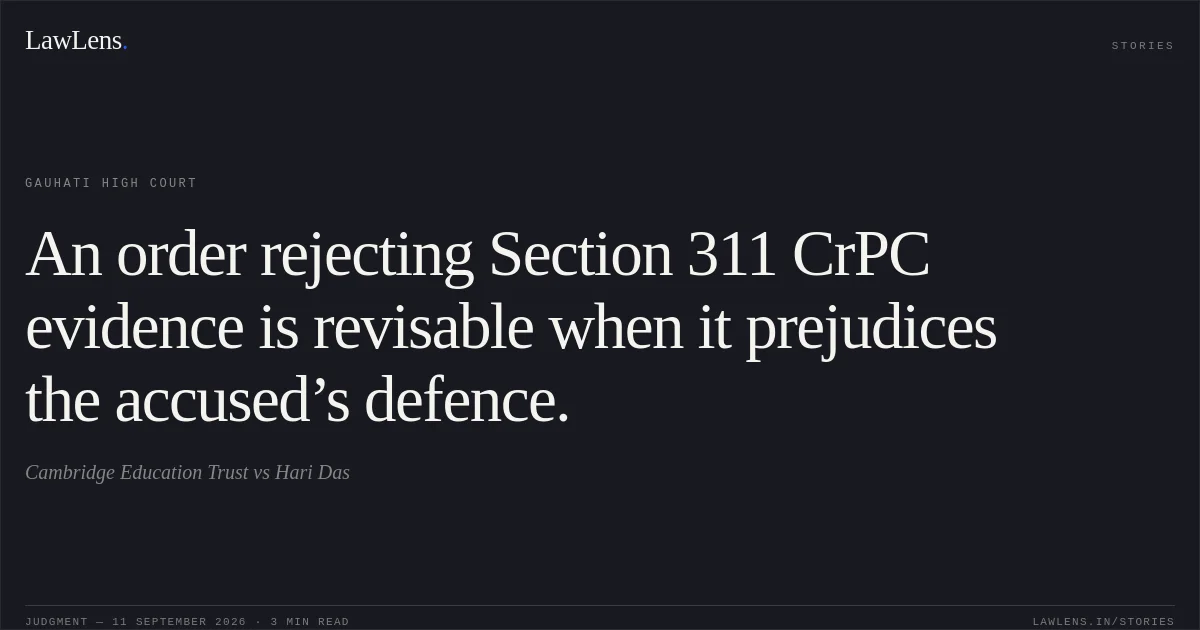
Whether a revision petition under Sections 397 and 401 CrPC is maintainable against an order rejecting an application under Section 311 CrPC, where the order may substantially prejudice the accused’s defence and affect the final adjudication.
Source reference: paras. 15–24, 33–38Whether the evidence of Anil Das was essential for the just decision of the cheque-dishonour cases and ought to have been summoned under Section 311 CrPC.
Source reference: paras. 29, 31–38Law Applied
Section 311 CrPC empowers the Court, at any stage of an inquiry or trial, to summon or examine any person if the evidence appears essential to the just decision of the case.
Source reference: paras. 29, 36–38Section 397(2) CrPC bars revision against purely interlocutory orders, while revision may lie against a final or intermediate order whose setting aside would materially affect or culminate the proceedings.
Source reference: para. 22The Court considered Sethuraman v. Rajamanickam, (2009) 5 SCC 153, and Girish Kumar Suneja v. CBI, (2017) 14 SCC 809, on the non-revisability of purely interlocutory orders.
Source reference: paras. 20–22It also relied on Akanksha Arora v. Tanay Maben, 2024 Legal Eagle (SC) 1108, for the principle that nomenclature is not decisive and that the Court may convert or entertain proceedings to advance substantial justice.
Source reference: para. 28Further, Mohanlal Shyamji Soni v. Union of India, 1991 Legal Eagle (SC) 119, recognizes the Court’s duty to obtain the best available evidence and exercise Section 311 CrPC to discover the truth and render a just decision.
Source reference: para. 29Reasoning
The High Court held that although an order rejecting a Section 311 application would ordinarily appear interlocutory, its effect in the present case was more substantial.
Source reference: paras. 31–34Anil Das was not a stranger to the transaction: he was an executant of the sale deed and a co-owner of the land.
Source reference: paras. 31–34The petitioner specifically asserted that ₹50,00,000 had been paid to him towards the sale consideration.
Source reference: paras. 31–34His testimony could therefore clarify whether the payment discharged, wholly or partly, the petitioner’s alleged liability to the complainant and whether the cheque represented a legally enforceable debt.
Source reference: paras. 31–34The trial court had prematurely concluded that the payment could not affect the complainant’s claim, without permitting the witness to explain the nature and purpose of the payment.
Source reference: paras. 34–38Since refusal to summon him could materially prejudice the petitioner’s defence and influence the final judgment, the order was treated as an intermediate, rather than a purely interlocutory, order for purposes of Section 397 CrPC.
Source reference: paras. 34–38The Court further held that the fact that the application was filed after the petitioner had initially declined to lead evidence did not, by itself, justify its rejection when the proposed evidence appeared relevant and essential to a just adjudication.
Source reference: paras. 36–39Holding
The High Court answered both issues in favour of the petitioner.
It held that the impugned orders rejecting the Section 311 CrPC applications were revisable because they could cause substantial prejudice and affect the final outcome of the proceedings.
Source reference: paras. 34–38The orders dated 26 June 2023 in C.R. Case Nos. 202c/2017, 152c/2017 and 201c/2017 were accordingly set aside and quashed.
Source reference: paras. 39–41The three criminal revision petitions were allowed, permitting the petitioner to summon and examine Anil Das as a material witness.
Source reference: paras. 39–41Acts & Sections Cited
7 provisions across 2 statutes referred to in this judgment. Each provision opens on LawLens.
Code of Criminal Procedure, 19736
Negotiable Instruments Act, 18811
Original Court PDF
Cambridge Education TrustvsHari Das
Click to open original judgment
Original judgment, available to read, download and summarize on LawLens.in