Facts
The petitioner’s deceased father, Dibakar Sarmah, had mortgaged land and obtained a loan of ₹2,80,000 from the Assam Financial Corporation in 1993.
Source reference: pp. 3–4, para. 2Following his father’s death, the petitioner sought settlement of the loan.
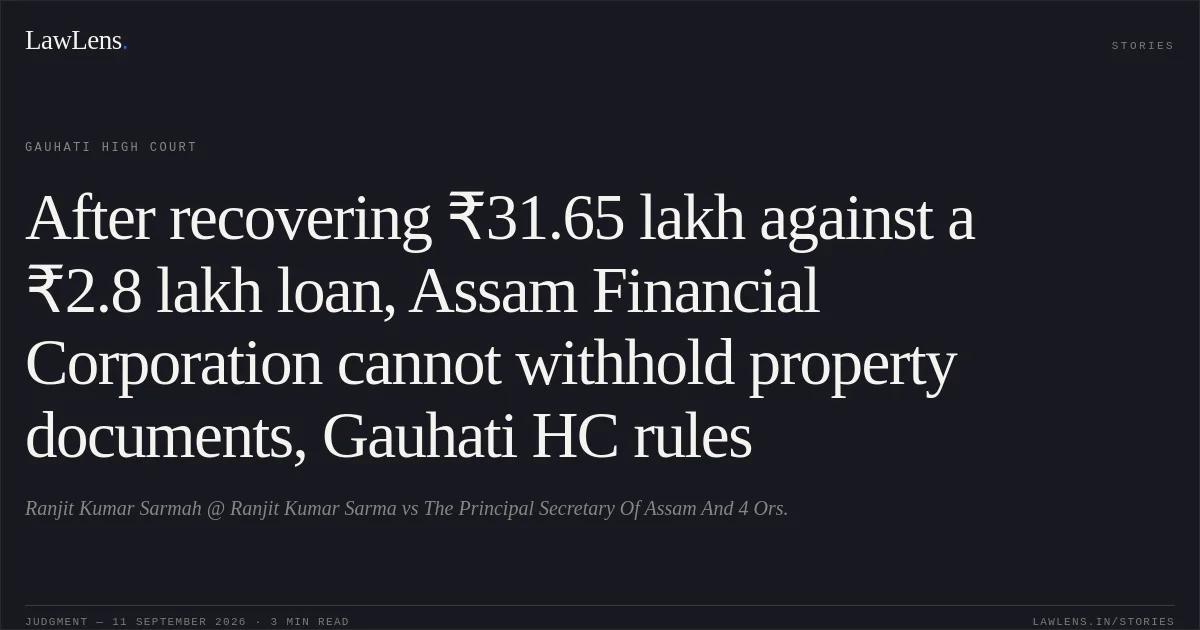
Source reference: pp. 3–4, para. 2By communication dated 16 March 2018, the Corporation quantified the principal at ₹2,69,214, interest at ₹27,30,652, and legal, valuation and takeover expenses at ₹1,65,639, requiring a total payment of ₹31,65,505, subject inter alia to an undertaking to withdraw pending proceedings against the Corporation.
Source reference: pp. 3–4, para. 2The petitioner paid the entire amount within the stipulated time, which was certified by the Deputy General Manager on 10 July 2018.
Source reference: p. 4, para. 3Despite receipt of the settled amount, the Corporation did not return the original title documents relating to the mortgaged property.
Source reference: p. 4, para. 4In its affidavit, the Corporation admitted receipt of ₹31,65,505 but demanded a further ₹50,000 on the ground that the petitioner had not immediately withdrawn the case.
Source reference: pp. 4–5, para. 5It also claimed that the documents could not be released without no-objection certificates from the other legal heirs of the deceased borrower.
Source reference: pp. 4–5, para. 5Issues
Whether the Assam Financial Corporation could retain the original title documents after the loan liability had been fully settled and liquidated?
Source reference: p. 5, para. 6; para. 9(i)Whether the Corporation could condition release of the documents upon payment of an additional ₹50,000 on account of delayed withdrawal of proceedings?
Source reference: pp. 4–5, para. 5; p. 5, para. 7Whether the Corporation could refuse to return the documents for want of no-objection certificates from the other legal heirs of the deceased borrower?
Source reference: p. 5, para. 5; p. 6, para. 8Law Applied
The Court applied the constitutional principle that a public financial corporation falling within the expression “State” under Article 12 must act lawfully, fairly and non-arbitrarily.
Source reference: p. 5, para. 7It held that once the secured loan liability has been liquidated to the satisfaction of the creditor, the creditor has no authority to retain the original title documents deposited as security for that loan.
Source reference: p. 5, para. 6; para. 9(i)The Court further treated the Corporation’s insistence on additional payment and production of no-objection certificates, after accepting the settled amount, as coercive, illegal and arbitrary conduct.
Source reference: pp. 5–6, paras. 7–8No specific statutory provision or judicial precedent was cited in the judgment.
Source reference: no citationReasoning
The petitioner had complied with the Corporation’s settlement terms by paying the entire amount of ₹31,65,505, and that payment had been officially certified.
Source reference: p. 4, para. 3Consequently, the purpose for retaining the mortgage documents had ceased.
Source reference: no citationThe Corporation’s demand for a further ₹50,000 was not supported by the settlement communication and was viewed as an impermissible attempt to impose an additional condition after full payment.
Source reference: pp. 4–5, paras. 5–7The Court also rejected the objection concerning the other legal heirs, reasoning that the Corporation had accepted the settlement amount from the petitioner without requiring such NOCs and could not subsequently rely on their absence to withhold the documents.
Source reference: p. 6, para. 8Since the Corporation was “State” under Article 12, its conduct was required to satisfy standards of legality and non-arbitrariness; retention of the documents in these circumstances was therefore unlawful.
Source reference: p. 5, para. 7Holding
The Court held that the Assam Financial Corporation had no authority to retain the original documents after liquidation of the loan amount to its satisfaction.
It directed Respondent Nos. 2–5 to hand over the original documents relating to the mortgaged property to the petitioner forthwith upon receipt of a certified copy of the order.
Source reference: para. 9(ii)The Court clarified that delivery of the documents would not prejudice the rights of the deceased borrower’s other legal heirs.
Source reference: para. 9(iii)The writ petition was accordingly disposed of without costs.
Source reference: para. 9(iv)Original Court PDF
Ranjit Kumar Sarmah @ Ranjit Kumar SarmavsThe Principal Secretary Of Assam And 4 Ors.
Click to open original judgment
Original judgment, available to read, download and summarize on LawLens.in