Facts
The petitioners, who are related to respondent No. 2, were involved in a dispute concerning title and possession over land at Bheluguri, Hojai. The petitioners claimed inheritance and possession through their father, while respondent No. 2 asserted competing rights over the property. The parties had also initiated mutation-related proceedings and the petitioners filed Title Suit No. 173/2023 seeking declaration of title, recovery of possession, injunction and consequential reliefs
Source reference: pp. 3–5, paras. 3(i)–3(ii)Respondent No. 2 subsequently filed a complaint alleging that, on 24 October 2023, the petitioners trespassed into his premises, abused him, assaulted him and threatened to cause serious bodily harm if he pursued cancellation of the mutation standing in the name of petitioner No. 1. The complaint was registered as C.R. Case No. 819/2023 under Sections 447, 294, 323, 506 and 34 of the Indian Penal Code
Source reference: pp. 4–5, para. 3(iii)–3(iv)After recording the complainant’s statement under Section 200 CrPC and the statement of an inquiry witness under Section 202 CrPC, the Judicial Magistrate First Class, Hojai, issued summons to the petitioners by order dated 22 February 2024
Source reference: p. 5, para. 3(iv)The petitioners invoked the High Court’s inherent jurisdiction under Section 528 of the Bharatiya Nagarik Suraksha Sanhita, 2023, seeking quashing of the complaint proceedings and the summoning order
Source reference: pp. 5–6, para. 4Issues
Whether the allegations in the complaint, taken at face value, prima facie disclosed the offences under Sections 447, 294, 323, 506 and 34 IPC against the petitioners?
Source reference: pp. 7–8, paras. 8, 15–17Whether the criminal complaint was an abuse of process because the dispute was essentially civil in nature and concerned competing claims to title, possession and mutation over the disputed land?
Source reference: pp. 11–13, paras. 15–20Whether the proceedings and the summoning order dated 22 February 2024 were liable to be quashed under the High Court’s inherent jurisdiction under Section 528 BNSS?
Source reference: pp. 5–6, 12–14, paras. 4, 20–23Law Applied
The Court exercised inherent jurisdiction under Section 528 BNSS, 2023, corresponding to the inherent-power jurisdiction traditionally exercised under Section 482 CrPC, to prevent abuse of process and secure the ends of justice
Source reference: p. 5, para. 2It applied the illustrative categories in State of Haryana v. Ch. Bhajan Lal, 1992 Supp (1) SCC 335, particularly where the allegations do not prima facie constitute an offence, where the allegations are inherently insufficient, or where the prosecution is manifestly mala fide and instituted with an ulterior motive
Source reference: pp. 8–10, paras. 10–11Relying on Anukul Singh v. State of Uttar Pradesh, 2025 SCC OnLine SC 2060, the Court reiterated that the High Court cannot conduct a mini-trial or weigh evidence at the quashing stage, but may examine whether the complaint and accompanying material disclose the ingredients of the alleged offences
Source reference: pp. 9–10, para. 11It also relied on Sujoy Ghosh v. State of Jharkhand, 2026 SCC OnLine SC 454, concerning the requirement that a Magistrate apply judicial mind before summoning an accused
Source reference: p. 10, para. 12Further, under Mitesh Kumar J. Sha v. State of Karnataka, AIR 2021 SC 5298, purely civil disputes should not be given a criminal colour merely to exert pressure or secure an expedited settlement
Source reference: pp. 12–13, para. 18Reasoning
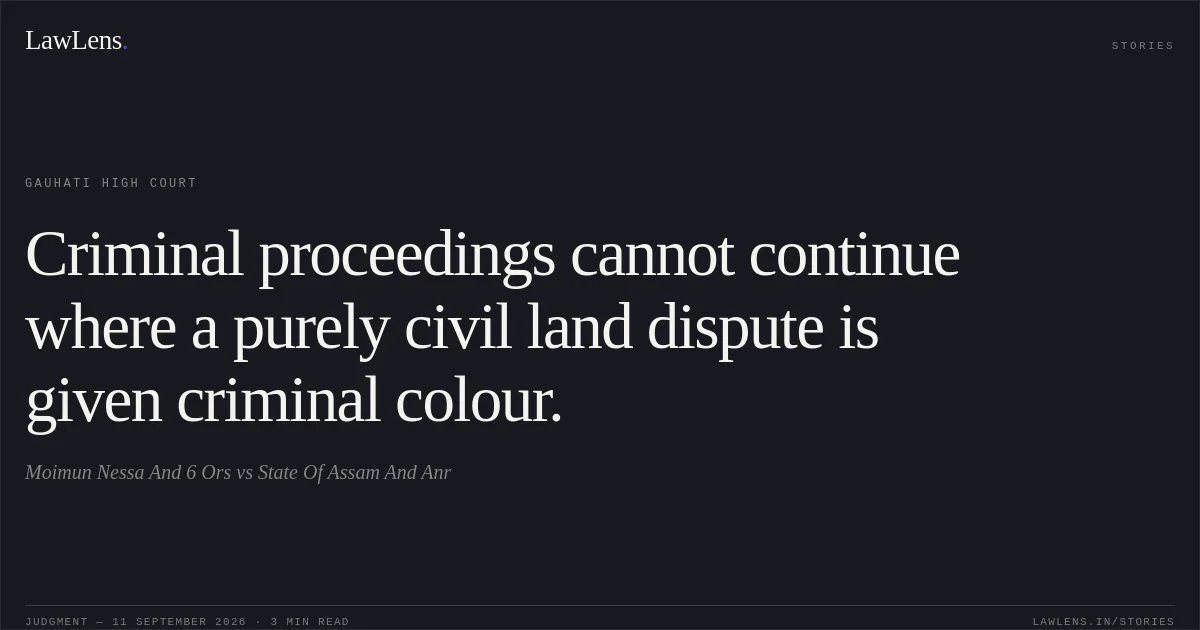
The Court found that the parties’ competing claims to title and possession, the pending civil suit, and the mutation proceedings demonstrated that the underlying controversy was essentially a property dispute
Source reference: pp. 11–13, paras. 15–17Since possession of the disputed land remained uncertain and both sides asserted rights over it, the allegation of criminal trespass was held not to be prima facie established
Source reference: p. 12, para. 16The Court further considered that the allegations of abuse, assault and threats were connected with the property and mutation dispute and concluded that the criminal complaint had been used to give a criminal colour to an essentially civil controversy
Source reference: pp. 12–13, paras. 17–20Applying the Bhajan Lal principles and the rule against converting civil disputes into criminal prosecutions, the Court held that continuation of the complaint proceedings would amount to abuse of the process of court
Source reference: pp. 12–13, paras. 18–20Holding
The Court answered the issues in favour of the petitioners. It held that the dispute was predominantly civil, that the complaint did not disclose a sustainable criminal case in the circumstances, and that continuation of the proceedings would constitute an abuse of process
Accordingly, the criminal proceedings in C.R. Case No. 819/2023, pending before the Judicial Magistrate First Class, Hojai, Sankardev Nagar, together with the summoning order dated 22 February 2024, were set aside and quashed. The criminal petition was allowed and disposed of
Source reference: p. 14, paras. 22–23Acts & Sections Cited
11 provisions across 3 statutes referred to in this judgment. Each provision opens on LawLens.
Bharatiya Nagarik Suraksha Sanhita, 20231
Indian Penal Code, 18605
Code of Criminal Procedure, 19735
Original Court PDF
Moimun Nessa And 6 OrsvsState Of Assam And Anr
Click to open original judgment
Original judgment, available to read, download and summarize on LawLens.in