Facts
The respondent joined Vallabhbhai Patel Chest Institute (VPCI), a Delhi University-maintained institution, as Assistant Registrar (Group A) on 9 June 2001.
Source reference: p.3, para. 3(a)The Governing Body of VPCI initiated disciplinary proceedings against him on 21 January 2011 and issued a charge-sheet on 28 March 2011. After the inquiry, the Governing Body resolved to dismiss him, and an order of dismissal was issued on 18 February 2013.
Source reference: pp.3–4, para. 3(b)–(c)The respondent challenged the dismissal in W.P.(C.) 2110/2013. The learned Single Judge set aside the dismissal on 29 January 2014, holding that Rule 69 of the University Non-Teaching Employees (Terms and Conditions of Service) Rules, 1971 vested the power to institute disciplinary proceedings in the Executive Council, unless delegated, and that no such delegation to VPCI’s Governing Body had been shown.
Source reference: pp.3–4, para. 3(d)The learned Single Judge, in W.P.(C.) 10595/2018, quashed the termination order and held the Executive Council’s resolutions inoperative against the respondent, while permitting the appellant to consider fresh disciplinary proceedings in accordance with the applicable rules and after obtaining the requisite delegation. VPCI challenged that judgment in the present appeal.
Source reference: pp.1–3, paras. 2–2.2; p.9, para. 4Issues
1. Whether the Governing Body of VPCI had the authority under the 1955 administrative Ordinance or Rule 69 of the 1971 Service Rules to institute disciplinary proceedings against the respondent and impose the penalty of dismissal
Source reference: pp.12–14, paras. 9, 13–172. Whether the Executive Council’s resolutions dated 28 February/7 March 2017 could retrospectively validate or endorse the disciplinary proceedings and dismissal initiated by the Governing Body
Source reference: pp.20–22, paras. 18–213. Whether the 2013 Service Rules and the alleged delegation of disciplinary power to the Governing Body applied so as to sustain the respondent’s termination
Source reference: pp.22–23, para. 22Law Applied
The Court applied Rule 69 of the University Non-Teaching Employees (Terms and Conditions of Service) Rules, 1971, under which disciplinary proceedings may be instituted by the Executive Council or by an authority empowered by it through a general or special order.
Source reference: pp.10–11, para. 6Ordinance XX, clause 2(f), permits the Governing Body to appoint, suspend or terminate administrative and non-academic staff only in respect of whom the Executive Council has delegated such powers, while clause 2(h) permits the Governing Body to exercise powers assigned by the Executive Council.
Source reference: pp.12–13, para. 9Rule 58 of the 2013 Service Rules similarly permits delegation by the Executive Council through a general or special order, and Rule 64 specifies the appointing and disciplinary authorities for different categories of employees.
Source reference: pp.10–12, paras. 7–8The Court further applied the principle that the service conditions governing the respondent’s disciplinary proceedings were those in force when the proceedings were initiated in 2011; consequently, the 1971 Rules governed the initiation of the proceedings.
Source reference: p.22, para. 22Reasoning
The Court held that the 1955 Executive Council resolution merely framed the administrative Ordinance for VPCI. Although clause 2(d) authorised the Governing Body to appoint administrative, clerical and other staff, it did not expressly confer disciplinary powers; clause 2(f) only permitted the exercise of additional powers assigned by the Executive Council.
Source reference: pp.14–19, paras. 11–14Since the respondent’s proceedings were initiated in 2011, Rule 69 of the 1971 Rules applied, and that Rule placed the power to institute disciplinary proceedings in the Executive Council unless a valid delegation was established. No valid general or special order delegating that power to the Governing Body was produced.
Source reference: p.19, paras. 16–17The later Executive Council resolutions did not constitute a lawful retrospective delegation; instead, they incorrectly treated the 1955 resolution as having already vested disciplinary authority in the Governing Body and purported to endorse the earlier invalid proceedings.
Source reference: pp.20–22, paras. 18–21The 2013 Rules could not cure proceedings initiated before their commencement, and, in any event, the record did not contain the requisite delegation under Rule 58. Because the termination order dated 2 May 2017 was founded on the invalid Executive Council endorsement, it could not be sustained.
Source reference: p.22–23, para. 22; p.21, para. 19Holding
The Division Bench dismissed the appeal and affirmed the learned Single Judge’s judgment dated 28 April 2026.
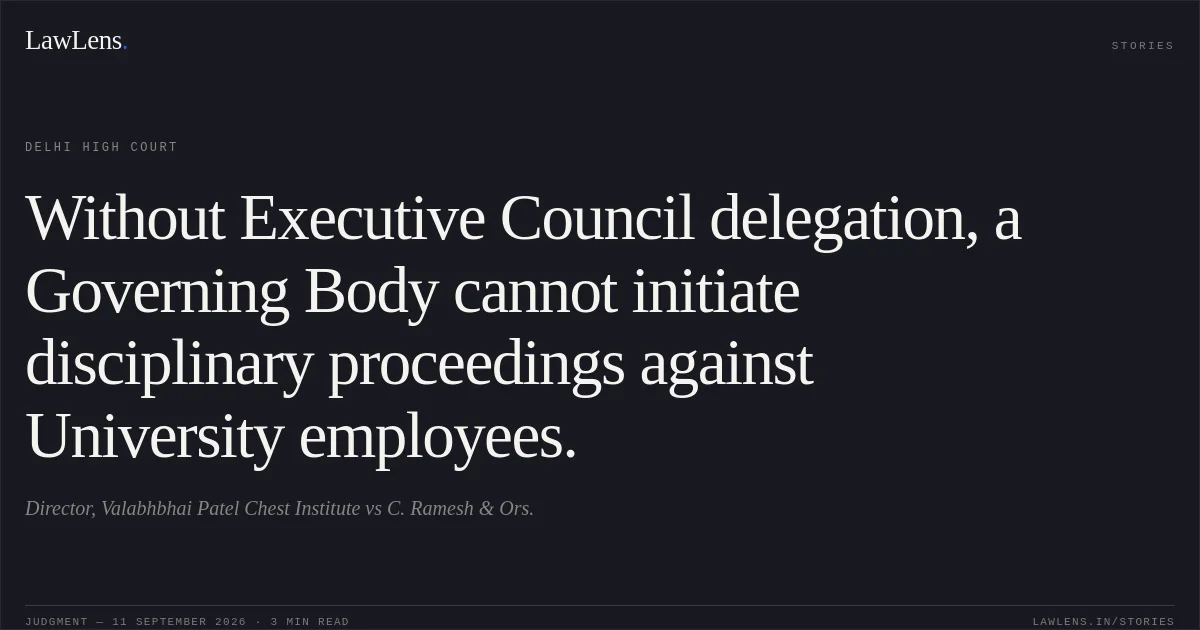
It held that the Governing Body lacked authority to institute the respondent’s disciplinary proceedings or dismiss him, that the Executive Council’s resolutions dated 28 February/7 March 2017 could not validate the defective proceedings, and that the termination order dated 2 May 2017 was legally unsustainable.
Source reference: pp.23–24, paras. 23–25The appellant was directed to pay costs of ₹50,000 to the respondent within six weeks, failing which the amount would be recoverable as arrears of land revenue.
Source reference: p.24, para. 26Acts & Sections Cited
2 provisions across 1 statute referred to in this judgment. Each provision opens on LawLens.
Delhi University Act, 19222
Original Court PDF
Director, Valabhbhai Patel Chest InstitutevsC. Ramesh & Ors.
Click to open original judgment
Original judgment, available to read, download and summarize on LawLens.in