Facts
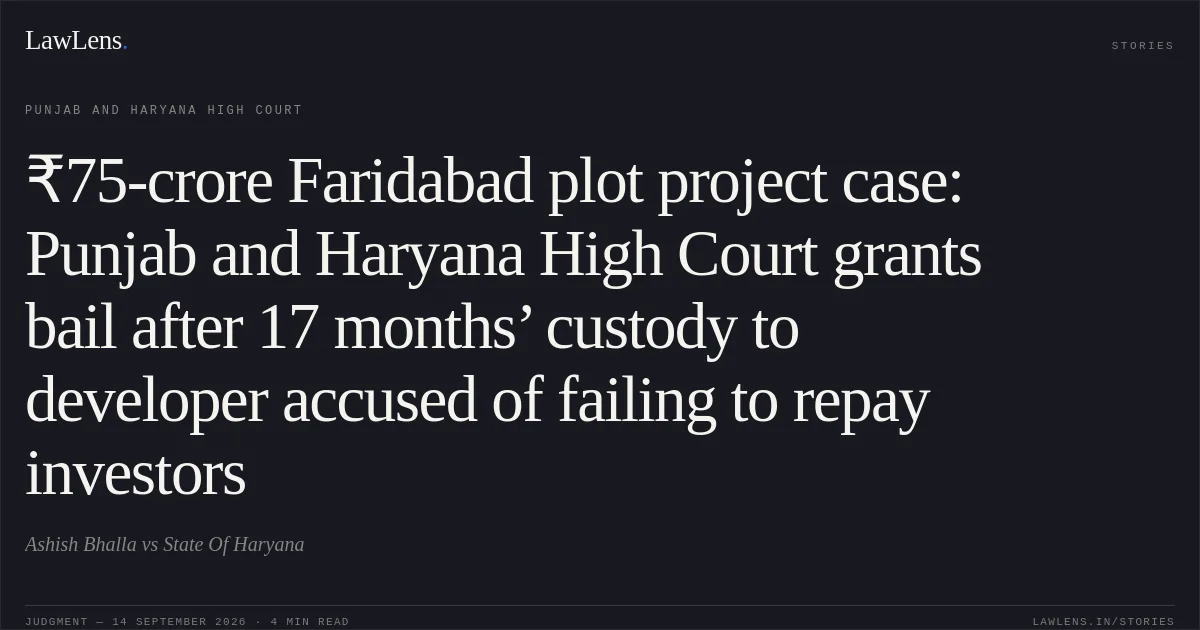
The petitioner sought regular bail under Section 483 of the Bharatiya Nagarik Suraksha Sanhita, 2023, corresponding to Section 439 Cr.P.C., in FIR No. 369 dated 16.11.2024, registered at Police Station Central, Faridabad, under Sections 406, 420 and 120-B IPC, corresponding to Sections 316(2), 318(4) and 61(2) BNS, along with Sections 3, 4 and 5 of the Haryana Protection of Interest of Depositors in Financial Establishment Act, 2013.
Source reference: p.1, para.1The petitioner had entered into collaboration agreements with intending purchasers for contributions towards a proposed plotted residential project in Faridabad. The project was subject to land acquisition, statutory approvals, licences and RERA approval.
Source reference: p.2, para.2The petitioner acquired substantial land and applied for nine licences under the Deen Dayal Upadhyaya Scheme, of which only two were granted. He allotted plots to approximately 267 purchasers in the sanctioned projects, while claims of several other purchasers remained unresolved. The alleged liability was stated to exceed Rs.74 crore.
Source reference: p.3, para.3The petitioner had been in custody for approximately one year and five months. His assets had been attached by the Enforcement Directorate, and the Delhi High Court had constituted an Empowered Committee to verify investors’ claims and consider the utilisation of attached assets for their benefit.
Source reference: pp.3–5, paras.5, 7.1Issues
Whether the petitioner was entitled to regular bail under Section 483 BNSS, having regard to the nature of the allegations, the applicable punishment, the period of custody and the anticipated duration of the trial?
Source reference: pp.1, 4–8, paras.1, 7–8Whether, on the material available, the allegations primarily attracted Section 406 IPC corresponding to Section 316(2) BNS, rather than sustaining the simultaneous application of Sections 406 and 420 IPC on the same factual foundation?
Source reference: pp.3–4, 7–8, paras.4, 8Whether the attachment of the petitioner’s assets and the institutional mechanism constituted by the Empowered Committee sufficiently addressed the concerns regarding restitution and protection of the complainants’ interests?
Source reference: pp.3–8, paras.5, 7.1–8Law Applied
The Court applied Section 483 BNSS, corresponding to Section 439 Cr.P.C., governing the High Court’s power to grant regular bail.
Source reference: p.1, para.1It considered the ingredients and punishment of Sections 406 and 420 IPC, corresponding to Sections 316(2) and 318(4) BNS, and observed that criminal breach of trust and cheating rest on distinct and mutually inconsistent foundational ingredients; on the material available, the case was primarily referable to Section 406 IPC, which carries a maximum sentence of three years.
Source reference: pp.3–4, 7–8, paras.4, 8In applying general bail principles, the Court balanced the seriousness of the accusation, severity of punishment, likelihood of absconding, possibility of tampering with evidence or influencing witnesses, antecedents, and the need to protect the administration of justice.
Source reference: p.4, para.7Relying on Sanjay Chander v. CBI, 2012 (1) SCC 40, it reiterated that pre-trial detention should not become punitive, that the nature of the accusation must be considered with the severity of the possible punishment, and that bail may be granted where continued custody is unnecessary, subject to stringent conditions.
Source reference: pp.6–7, paras.7.1–7.2Reasoning
The Court found that, prima facie, the allegations were principally referable to criminal breach of trust under Section 406 IPC, carrying a maximum sentence of three years, and that the petitioner had already undergone approximately half of that maximum period in custody.
Source reference: pp.7–8, para.8Although the alleged financial liability was substantial and involved numerous investors, the petitioner had acquired substantial land, obtained two project licences, allotted plots to 267 purchasers and allegedly settled the claims of nearly 800 others through refunds or alternative plots.
Source reference: p.5, para.7.1The Court further noted that the petitioner’s assets had been attached and that the Empowered Committee constituted by the Delhi High Court was tasked with verifying claims, determining the use of attached assets and considering a holistic resolution of the projects.
Source reference: pp.5–6, para.7.1Since investigation had progressed, the petitioner’s assets were secured, and the trial involving extensive evidence was unlikely to conclude soon, continued incarceration was held unnecessary and potentially punitive.
Source reference: pp.6–10, paras.7.1–8.1The interests of justice could be protected through stringent bail conditions concerning witnesses, travel, disclosure of assets and attendance before the trial court.
Source reference: pp.6–10, paras.7.1–8.1Holding
The Court allowed the petition and granted the petitioner regular bail under Section 483 BNSS, subject to furnishing bail and surety bonds to the satisfaction of the competent Magistrate.
The bail was made conditional upon, inter alia, non-interference with witnesses or evidence, no inducement or intimidation, prior permission before leaving India, disclosure and verification of residential addresses, furnishing PAN, Aadhaar, bank-account and immovable-property details, reporting changes in contact particulars, refraining from similar offences, and regular appearance before the trial court.
Source reference: pp.8–10, para.8.1Violation of the conditions could result in cancellation of bail and issuance of coercive process. Pending miscellaneous applications were disposed of as infructuous.
Source reference: p.10, para.9Acts & Sections Cited
7 provisions across 4 statutes referred to in this judgment. Each provision opens on LawLens.
Bharatiya Nagarik Suraksha Sanhita, 20231
Code of Criminal Procedure, 19731
Indian Penal Code, 18602
Bharatiya Nyaya Sanhita, 20233
Original Court PDF
Ashish BhallavsState Of Haryana
Click to open original judgment
Original judgment, available to read, download and summarize on LawLens.in