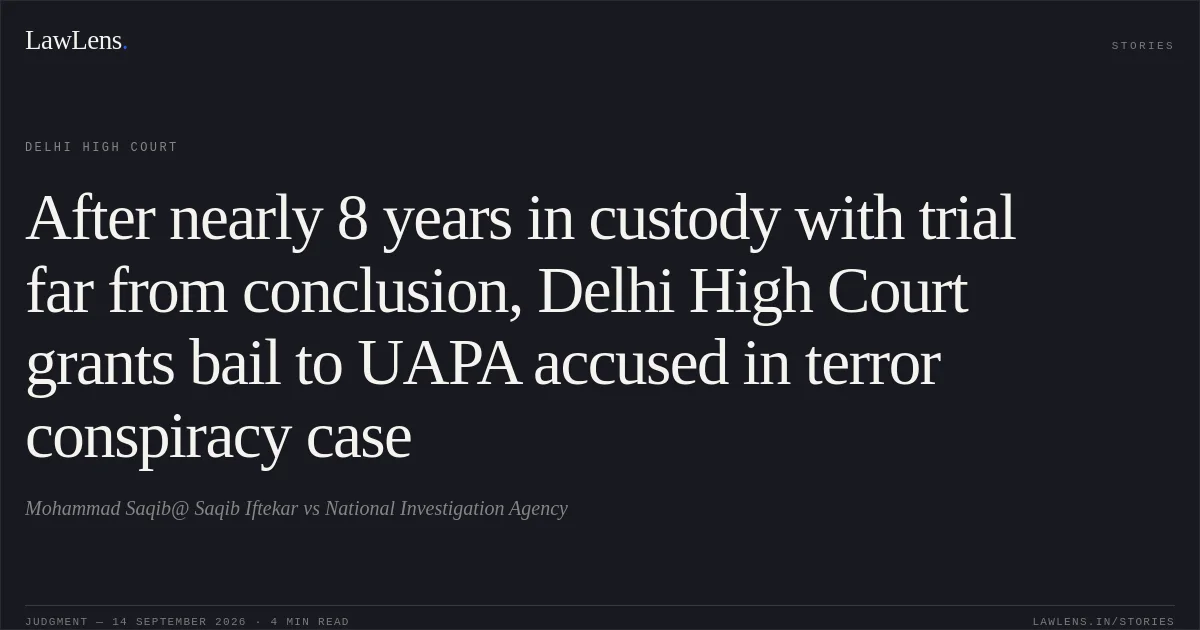
Facts
The appellant was arrested on 26 December 2018 in RC-38/2018/NIA/DLI, registered for offences under Sections 120B, 121, 121A and 122 IPC; Sections 17, 18, 18B, 20, 38 and 39 of the UAPA; and Sections 4 and 5 of the Explosive Substances Act.
Source reference: p.2, para.1The prosecution alleged that he was associated with the pro-ISIS group Harkat-ul-Harb-E-Islam, helped procure arms, introduced A-1 Mufti Mohammad Suhail to A-11 Naim for weapons procurement, and visited Tral, Jammu and Kashmir, with A-6 to establish contact with militants and obtain training and weapons.
Source reference: pp.17–27, para.13The appellant contended that his role was peripheral and that the principal witnesses concerning his Kashmir visits did not materially implicate him.
Source reference: pp.2–4, paras.3–6His bail application was rejected by the Trial Court on 27 May 2024, leading to the present appeal under Section 21(4) of the NIA Act.
Source reference: p.2, para.2At the time of consideration, he had undergone nearly eight years of custody; only 40 of 120 prosecution witnesses had been examined, and the trial was unlikely to conclude soon.
Source reference: p.5, para.10Issues
Whether the appellant was entitled to bail under Section 21(4) of the NIA Act, notwithstanding the statutory restriction under Section 43D(5) of the UAPA, on account of prolonged incarceration and the unlikely completion of trial within a reasonable time.
Source reference: pp.5–17, paras.10–12Whether the High Court could consider the depositions of prosecution witnesses recorded after the Trial Court rejected bail, particularly when the appeal had remained pending and the witnesses were examined pursuant to proceedings before the High Court.
Source reference: pp.4–5, 27–28, paras.8, 14–15Whether the prosecution material, assessed at the bail stage on an accused-specific basis, disclosed a sufficiently grave and meaningful nexus between the appellant and the alleged terrorist activities to justify continued detention.
Source reference: pp.17–27, paras.13–18Law Applied
The Court applied Section 21(4) of the NIA Act and Section 43D(5) of the UAPA, which impose special restrictions on bail in prosecutions involving scheduled offences and UAPA offences, while recognising that those restrictions do not exclude the constitutional courts’ power to grant bail where continued detention violates Article 21.
Source reference: pp.5–8, para.11Relying principally on Union of India v. K.A. Najeeb, (2021) 3 SCC 713, the Court held that prolonged incarceration and the unlikelihood of conclusion of trial within a reasonable time may justify bail notwithstanding Section 43D(5).
Source reference: pp.8–12, paras.11–12It also considered the contextual and accused-specific approach discussed in Gulfisha Fatima v. State (NCT of Delhi), 2026 SCC OnLine SC 10, including the nature of the allegations, the accused’s role, the stage and likely trajectory of the trial, the causes of delay, and risks upon release.
Source reference: pp.8–12, paras.11–12The Court further noted Syed Iftikhar Andrabi v. NIA, 2026 INSC 503, and the reference in Tasleem Ahmed v. State (NCT of Delhi), while applying the law presently binding on it in accordance with Union Territory of Ladakh v. Jammu and Kashmir National Conference, (2024) 18 SCC 643.
Source reference: pp.12–17, paras.11–12Under the Section 43D(5) framework, the Court was required to examine whether the prosecution material, taken at face value, disclosed the statutory ingredients and a real nexus between the individual accused and the alleged unlawful or terrorist activity, without conducting a mini-trial.
Source reference: pp.11–12, para.11Reasoning
The Court found that the appellant had been in custody for almost eight years, while only 40 of 120 witnesses had been examined and the prosecution itself proposed to drop 39 witnesses; consequently, the trial was not likely to conclude in the near future.
Source reference: p.5, para.10Applying K.A. Najeeb and the Article 21 proportionality principle, the Court held that the statutory embargo under Section 43D(5) could not operate as the sole basis for indefinite pre-trial detention.
Source reference: p.5, para.10It considered the evidence of PW-27, PW-35 and PW-37, who were the principal witnesses concerning the appellant’s alleged Kashmir visits, and found no sufficient reason in their testimony to deny bail.
Source reference: p.27, para.14In the peculiar circumstances—including the appellant’s prolonged custody, the pendency of the appeal, and the fact that the High Court had facilitated examination of the relevant witnesses—the Court permitted consideration of their subsequent depositions rather than remanding the appellant to seek bail afresh before the Trial Court.
Source reference: pp.27–28, para.15Although the allegations concerning arms procurement, terrorist associations and electronic chats were serious, the Court found that the testimonial and electronic material, assessed without conducting a mini-trial, did not warrant continued detention for the duration of the protracted trial.
Source reference: pp.28–29, paras.16–19Holding
The Court allowed the appeal, set aside the Trial Court’s order dated 27 May 2024, and directed the appellant’s release on bail.
Bail was subject to a personal bond of ₹50,000 with two sureties of the like amount, surrender of passport, restrictions on foreign travel and movement outside District Hapur, use of a single traceable telephone number, disclosure of residential and contact details, regular appearance before the Trial Court, non-interference with witnesses or evidence, no public statements concerning the case, and fortnightly reporting to the NIA Branch Office at Lucknow.
Source reference: pp.28–30, para.20Breach of any condition was made a ground for seeking cancellation of bail.
Source reference: p.31, para.21The Court clarified that its observations were confined to the consideration of bail and would not prejudice the merits of the trial.
Source reference: p.31, para.23Acts & Sections Cited
12 provisions across 6 statutes referred to in this judgment. Each provision opens on LawLens.
National Investigation Agency Act, 20081
Indian Penal Code, 18602
Unlawful Activities (Prevention) Act, 19675
Narcotic Drugs and Psychotropic Substances Act, 19851
Code of Criminal Procedure, 19731
Original Court PDF
Mohammad Saqib@ Saqib IftekarvsNational Investigation Agency
Click to open original judgment
Original judgment, available to read, download and summarize on LawLens.in
![Long-serving casual labourers performing regular duties must receive 1/30th minimum pay plus DA and be considered for regularization.. SMT S D SRIVASTAVA vs Archoelogical Survey Of India. CAT - ['Allahabad']. LawLens](/stories/thumbnails/long-serving-casual-labourers-performing-regular-duties-must-receive-1-30th-minimum-pay-pl-545c373533744ff49cae0672d629ab9b.webp)