Facts
Rachhpal Singh, an officer of J&K Grameen Bank, served as Senior Manager/Branch Head at Simbal Morh Branch.
Source reference: paras. 2–2.1The Bank alleged that he had sanctioned loans to selected borrowers by exceeding his delegated powers and violating the Bank’s operational guidelines and norms.
Source reference: paras. 2–2.1After a departmental inquiry, most charges were held proved, while one charge was partially proved.
Source reference: para. 2.3The disciplinary authority reduced him to the lowest stage in the pay scale of Officer Scale-II and directed that his superannuation benefits be released on the reduced pay.
Source reference: para. 2.4On appeal, the punishment was modified to reduction to the lowest stage in the pay scale of Officer Scale-I, but release of his superannuation benefits was made conditional upon recovery or adjustment of the concerned loan accounts; potential recovery from his pension was also directed in case of financial loss to the Bank.
Source reference: para. 2.5The Single Judge quashed both orders on the grounds that the Bank had suffered no established financial loss, the respondent had obtained no pecuniary gain, and most irregularities had been rectified.
Source reference: para. 5The Bank challenged that decision in the intra-court appeal.
Source reference: no citationIssues
Whether the Single Judge exceeded the permissible scope of judicial review by reassessing the evidence and interfering with the disciplinary punishment imposed upon a Bank officer for acting beyond his delegated authority.
Source reference: paras. 10–12.1Whether absence of actual financial loss, absence of mala fide intention, or subsequent rectification of irregularities could absolve the respondent of misconduct for sanctioning loans beyond his authority.
Source reference: paras. 8–9.1, 12.2–13.1Whether the appellate authority was legally entitled to withhold the respondent’s superannuation benefits until recovery or adjustment of the loan accounts without quantifying the Bank’s loss.
Source reference: paras. 15–15.3Law Applied
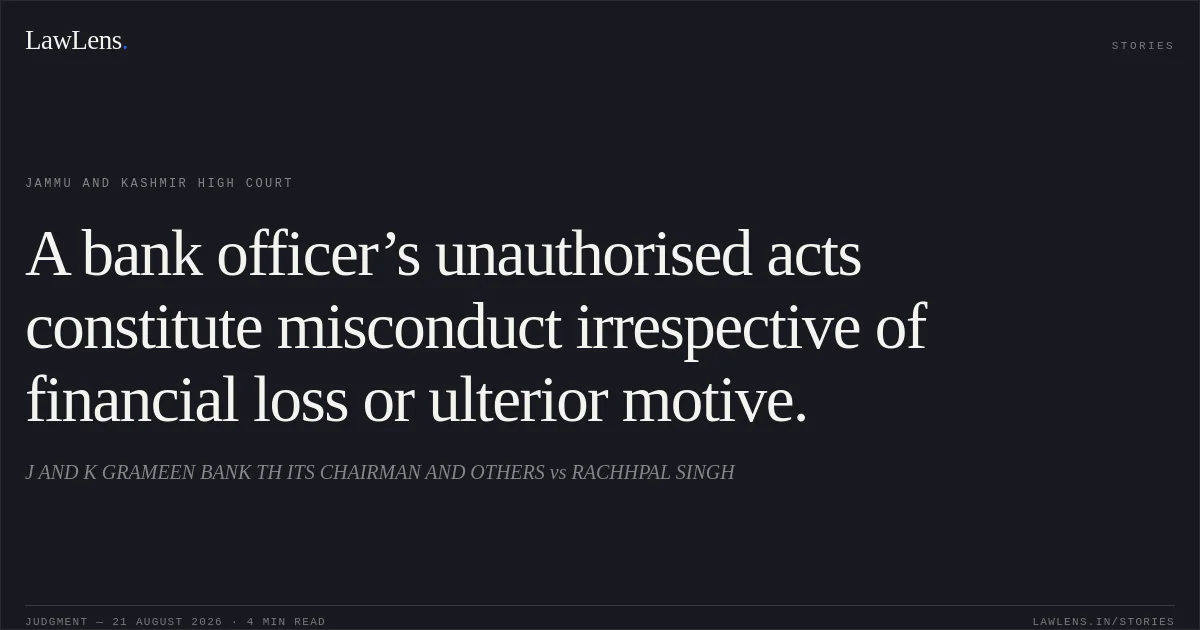
The Court applied the disciplinary standards governing Bank officers under the applicable service regulations, under which officers must protect the Bank’s interests, discharge their duties with integrity, honesty, devotion and diligence, and act within the authority delegated to them; acting beyond such authority constitutes misconduct.
Source reference: para. 9.1Relying on Disciplinary Authority-cum-Regional Manager v. Nikunja Bihari Patnaik, the Court held that acting beyond authority is misconduct even where the Bank earns a profit or suffers no actual loss, and absence of ulterior motive is no defence.
Source reference: paras. 8.1, 9–9.1Chairman & Managing Director, United Commercial Bank v. P.C. Kakkar was relied upon for the principle that Bank employees guilty of financial irregularities involving public money do not ordinarily deserve leniency.
Source reference: para. 9.2Under Divisional Controller, KSRTC v. A.T. Mane, loss of confidence, rather than the monetary amount involved, is the primary consideration in determining punishment.
Source reference: paras. 9.3–9.4Damoh Panna Sagar Rural Regional Bank v. Munna Lal Jain, State Bank of India v. Ramesh Dinkar Punde and Bank of India v. T. Jogram establish that judicial review does not permit re-appreciation of evidence or substitution of the Court’s view on punishment, except where the punishment is shockingly disproportionate or there is a procedural or natural-justice violation.
Source reference: paras. 10.1–10.5However, forfeiture or withholding of superannuation benefits must correspond to quantified loss or damage and cannot be imposed without determination of the recoverable amount and an opportunity of hearing.
Source reference: paras. 15.1–15.3Reasoning
The Division Bench held that the Single Judge had effectively acted as an appellate authority by relying on the absence of actual loss, the Bank’s improved financial performance and the respondent’s alleged lack of mala fide intention.
Source reference: paras. 12–12.1Those considerations could not negate the established misconduct because a Bank officer is required to operate strictly within delegated limits, irrespective of whether individual transactions ultimately produce profit or loss.
Source reference: paras. 9.1, 13.1The respondent’s admitted misconduct, his prior disciplinary penalties, and the fact that 24 loan accounts were settled under OTS, 10 became NPAs and recovery in 14 accounts remained stalled demonstrated the seriousness of the conduct.
Source reference: paras. 12.2–12.3The modified punishment imposed by the appellate authority—reduction to the lowest stage in the Officer Scale-I pay scale—was therefore not shown to be shockingly disproportionate.
Source reference: no citationHowever, the direction withholding superannuation benefits until recovery of all loan accounts was unsustainable because neither authority had quantified any loss attributable to the respondent.
Source reference: paras. 15.2–15.3The Bank could pursue recovery against the borrowers through appropriate legal remedies, but could not indefinitely withhold retirement benefits on an unquantified basis.
Source reference: paras. 15.2–15.3Holding
The appeal was allowed and the Single Judge’s judgment was set aside.
The appellate authority’s punishment reducing the respondent’s basic pay to the lowest stage in the Officer Scale-I pay scale, i.e., ₹48,170/-, was upheld.
Source reference: para. 16The direction withholding his superannuation benefits until recovery or adjustment of the loan accounts was quashed, and the Bank was directed to immediately release those benefits.
Source reference: para. 16The Bank was left at liberty to recover the loan amounts by availing appropriate legal remedies.
Source reference: para. 16Original Court PDF
J AND K GRAMEEN BANK TH ITS CHAIRMAN AND OTHERSvsRACHHPAL SINGH
Click to open original judgment
Original judgment, available to read, download and summarize on LawLens.in