Facts
The applicant sought bail under Section 483 of the BNSS after the Special Judge, NDPS Cases, Phalodi, rejected his application.
Source reference: p.1–2He was charged under Sections 8 and 15 of the NDPS Act after police recovered 210 kg of poppy straw from a shed near his father-in-law’s house; the applicant was arrested on 14 March 2024 and the charge-sheet had been filed
Source reference: p.1–2, 5–6He argued that he did not own or exclusively possess the shed, that the search was conducted by an officer without proper authority under Section 42, that the grounds of arrest had not been communicated, and that his custody and the expected duration of trial supported bail
Source reference: p.2–5The State opposed release
Source reference: p.5Issues
1. Whether the material available at the bail stage prima facie indicated the applicant’s conscious or constructive possession of the poppy straw, despite the shed being in his father-in-law’s name
Source reference: p.5–82. Whether the search and seizure were prima facie unlawful because the officer acted outside his usual police-station jurisdiction or lacked authority under Section 42 of the NDPS Act
Source reference: p.8–153. Whether the contemporaneous record showed that the applicant had been informed of the grounds of arrest, as required by Article 22(1) of the Constitution and Section 52(1) of the NDPS Act
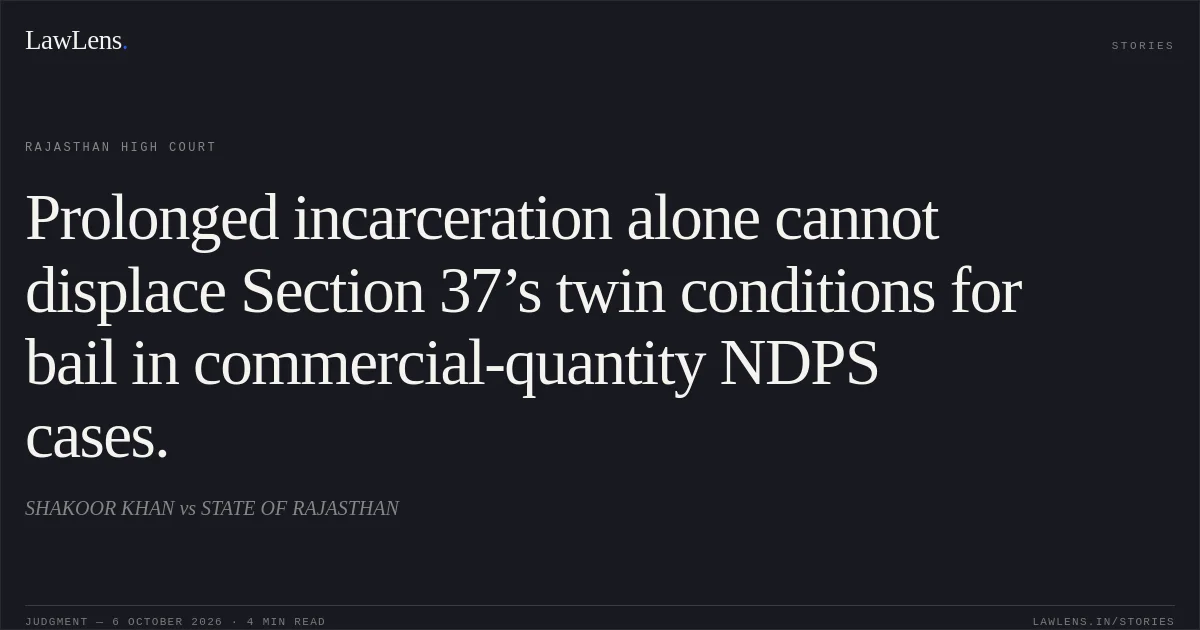
Source reference: p.15–184. Whether the applicant’s period of custody and anticipated trial delay justified bail despite the restrictions in Section 37 of the NDPS Act
Source reference: p.18–24Law Applied
Section 37(1)(b) of the NDPS Act imposes twin conditions for bail in cases involving commercial quantities: the court must have reasonable grounds to believe that the accused is not guilty and must be satisfied that the accused is unlikely to commit an offence while on bail
Source reference: p.5–6, 20–24“Possession” may be actual or constructive and may be joint; it requires knowledge of the contraband and the power or intention to exercise control over it, as explained in Mohan Lal v. State of Rajasthan, (2015) 6 SCC 222, and Madan Lal v. State of H.P., (2003) 7 SCC 465
Source reference: p.6–8Section 42 authorises specified officers to search, seize and arrest on recorded information; the Rajasthan Government notification dated 16 October 1986 empowered Inspectors and Sub-Inspectors posted as SHOs to exercise those powers
Source reference: p.9–12Article 22(1) of the Constitution and Section 52(1) of the NDPS Act require that an arrested person be informed of the grounds of arrest as soon as may be
Source reference: p.15–16The Court also applied Section 479 of the BNSS concerning the maximum period of detention of undertrial prisoners, while holding that custody alone could not displace Section 37’s requirements in this commercial-quantity case.
Source reference: p.22–24It considered, among other authorities, Roy V.D. v. State of Kerala, (2000) 8 SCC 590, on action by unauthorised officers, and Supreme Court decisions addressing Section 37 and prolonged incarceration
Source reference: p.13–15, 18–22Reasoning
The Court treated the recovery of 210 kg as well above the 50 kg commercial-quantity threshold.
Source reference: p.5–8Although the shed was in the father-in-law’s name, the prosecution material—including prior information alleging that the applicant had brought and concealed the contraband, his presence and alleged attempt to flee, the recovery, and material concerning communications and phone locations—prima facie supported knowledge and control; ownership was not decisive.
Source reference: p.5–8The Court found that Dalpat Singh was a Sub-Inspector posted as an SHO and therefore fell within the class empowered by the 1986 notification; the record also showed that he had been assigned proceedings in Lohawat, recorded and forwarded the prior information, and acted while the regular SHO was on medical leave. Non-exhibition of the assignment order at that stage did not establish invalidity.
Source reference: p.10–15The recovery and arrest records contained contemporaneous recitals that the applicant had been informed of the grounds of arrest, so the Court declined to accept the claim of complete non-communication at the bail stage.
Source reference: p.16–18Finally, custody since March 2024 did not, by itself, satisfy the Section 37 conditions or amount to prolonged incarceration warranting release; the Court found the statutory detention threshold under Section 479 had not been reached.
Source reference: p.18–24Holding
The Court held that the applicant had not established reasonable grounds to believe that he was not guilty, nor satisfied the other condition under Section 37(1)(b) of the NDPS Act.
It rejected the arguments concerning possession, Section 42 authority, communication of arrest grounds and prolonged incarceration, and dismissed the bail application
Source reference: p.20–24The Court clarified that its observations were not an opinion on the merits and directed that the trial court decide the case independently on the evidence
Source reference: p.24Acts & Sections Cited
16 provisions across 3 statutes referred to in this judgment. Each provision opens on LawLens.
Bharatiya Nagarik Suraksha Sanhita, 20232
Narcotic Drugs and Psychotropic Substances Act, 1985
Code of Criminal Procedure, 19734
Original Court PDF
SHAKOOR KHANvsSTATE OF RAJASTHAN
Click to open original judgment
Original judgment, available to read, download and summarize on LawLens.in