Facts
The petitioner sought anticipatory bail under Section 482 of the Bharatiya Nagarik Suraksha Sanhita, 2023 (BNSS), in an e-FIR alleging theft-related offences under Sections 303(2) and 317(2) of the Bharatiya Nyaya Sanhita, 2023 (BNS).
Source reference: p. 1, para. 1The complainant alleged that, after his mobile phone was stolen, 12 unauthorised transactions debited Rs. 2,95,000 from his bank account; Rs. 1,00,000 was allegedly credited to and withdrawn from the petitioner’s account.
Source reference: p. 2, para. 5The petitioner claimed that he withdrew and handed over the money to an acquaintance, unaware of its unlawful source.
Source reference: p. 2, para. 6His earlier anticipatory-bail application had been dismissed after the Sessions Court noted the need for custodial interrogation.
Source reference: p. 2, para. 7The petitioner had joined the investigation; the Investigating Officer’s earlier reply recorded no allegation of non-cooperation, though it asserted that custodial interrogation was needed to apprehend other accused persons.
Source reference: p. 3, para. 8Issues
1. Whether the petitioner should receive interim protection from arrest while his anticipatory-bail application remained pending.
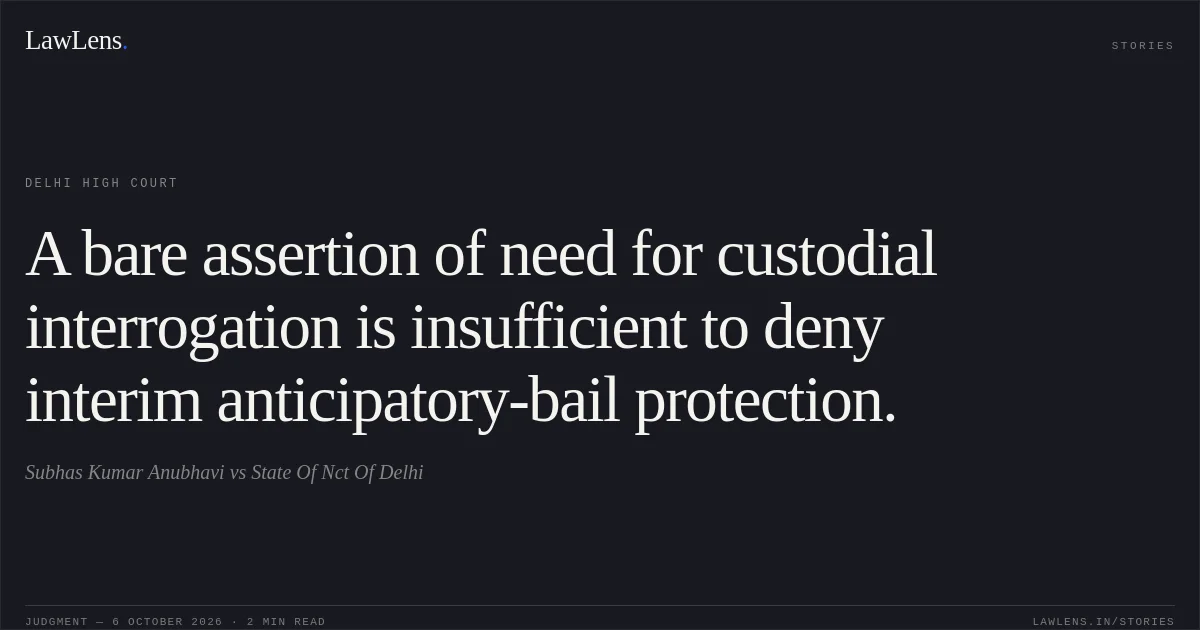
Source reference: pp. 3–4, paras. 9–132. Whether the State’s stated need for custodial interrogation justified denying such interim protection, given the petitioner’s participation in the investigation and the circumstances of the alleged offences.
Source reference: pp. 3–4, paras. 8, 11–12Law Applied
Section 482 of the BNSS provides the procedural basis for seeking anticipatory bail.
Source reference: no citationThe alleged offences under Sections 303(2) and 317(2) of the BNS each carried a maximum sentence of three years in the circumstances identified by the Court.
Source reference: p. 3, para. 10Relying on Arnesh Kumar v. State of Bihar, (2014) 8 SCC 273, and Siddharam Satlingappa Mhetre v. State of Maharashtra, (2011) 1 SCC 694, the Court reiterated that arrest should not be routine and should be justified by the circumstances; arrest should be a last resort in appropriate cases.
Source reference: pp. 3–4, para. 10 and footnote 1Under Ashok Kumar v. State of Union Territory Chandigarh, (2024) 12 SCC 199, a bare assertion that custodial interrogation is required is insufficient; the State must indicate why it is required for the investigation.
Source reference: p. 4, para. 11Reasoning
The Court considered that the petitioner had joined the investigation, had been interrogated and made disclosures, and was not alleged to have failed to cooperate.
Source reference: pp. 2–3, paras. 7–8The petitioner undertook to provide information about the co-accused, continue appearing before the Investigating Officer, avoid tampering with evidence or influencing witnesses, and not leave India without permission.
Source reference: p. 3, para. 9In light of those undertakings, the maximum punishment for the alleged offences, and the fact that the money trail could be traced through bank records, the Court found limited interim protection appropriate at that stage.
Source reference: p. 4, para. 12Holding
The Court did not finally determine the anticipatory-bail application.
It directed that, until the next hearing, no coercive steps be taken against the petitioner, subject to his continued cooperation with the investigation and compliance with his undertakings.
Source reference: p. 4, para. 13The State was directed to file a status report, and the matter was listed for 27 January 2027.
Source reference: p. 4, para. 14; p. 5, para. 16The Court clarified that its observations were not an expression of opinion on the merits.
Source reference: p. 5, para. 15Acts & Sections Cited
3 provisions across 2 statutes referred to in this judgment. Each provision opens on LawLens.
Bharatiya Nagarik Suraksha Sanhita, 20231
Bharatiya Nyaya Sanhita, 20232
Original Court PDF
Subhas Kumar AnubhavivsState Of Nct Of Delhi
Click to open original judgment
Original judgment, available to read, download and summarize on LawLens.in