Facts
The petitioners, plaintiffs in Special Civil Suit No. 37 of 2018, challenged under Article 227 of the Constitution the Trial Court’s order dated 4 June 2026 rejecting their application below Exhibit 331 under Order VI Rule 17 read with Section 151 CPC.
Source reference: para. 2Earlier, the petitioners had filed an amendment application below Exhibit 42 under Order VI Rule 17 read with Order I Rule 10 CPC.
Source reference: para. 3.1By order dated 3 November 2012, the Trial Court permitted the joining of additional government parties but, according to the High Court, did not grant the substantive amendment to the plaint.
Source reference: paras. 3.1, 8.1The petitioners subsequently filed Exhibit 62 on 19 October 2013 seeking the same amendment; that application was rejected on 17 January 2015.
Source reference: paras. 4–6, 9Although the order contained observations regarding the earlier order below Exhibit 42, neither order was challenged.
Source reference: paras. 4–6, 9At the final stage of the suit, the petitioners filed Exhibit 331, asserting that the amendment had already been granted and had not been carried out due to inadvertence.
Source reference: para. 9.1The Trial Court rejected the application on the grounds of delay, negligence, prejudice to the defendants, and the finality of the earlier orders.
Source reference: para. 9.1Issues
1. Whether the petitioners could, after an extended delay, obtain permission to carry out the substantive amendment allegedly granted by the Trial Court while allowing Exhibit 42.
Source reference: paras. 8.1, 10–11.22. Whether the Trial Court’s rejection of the application below Exhibit 331 disclosed a gross error of law or perversity warranting interference under Article 227 of the Constitution.
Source reference: paras. 12–143. Whether the petitioners’ suppression of the earlier application below Exhibit 62 disentitled them to equitable or discretionary relief.
Source reference: paras. 4, 6–7, 12.1Law Applied
The Court applied Order VI Rule 17 CPC, governing amendment of pleadings, along with Section 151 CPC concerning the Court’s inherent powers, and Order I Rule 10 CPC concerning addition of parties.
Source reference: paras. 3.1, 8.1It held that an amendment must have been expressly granted before the Court can merely extend the time for carrying it out; an amendment not granted by the order is treated as refused, and an unchallenged order attains finality.
Source reference: para. 8.1The Court also relied on the principle that a party seeking equitable or discretionary relief must approach the Court with clean hands and must not suppress material procedural history.
Source reference: paras. 6–7In exercising supervisory jurisdiction under Article 227, the High Court does not reappreciate the matter or correct every error of law; interference is warranted only for gross jurisdictional or legal errors, findings contrary to the record, or decisions violating settled legal principles, as explained in Sameer Suresh Gupta, TR. PA Holder v. Rahul Kumar Agarwal, (2013) 9 SCC 374, and Garment Craft v. Prakash Chand Goel, (2022) 4 SCC 181.
Source reference: para. 13Reasoning
The High Court examined the orders below Exhibits 42 and 62 and concluded that the order dated 3 November 2012 permitted only the addition of parties and did not grant the substantive amendment sought in the plaint.
Source reference: para. 8.1This interpretation was reinforced by the petitioners’ own Exhibit 62 application, which proceeded on the basis that the amendment had not been granted.
Source reference: para. 8.2Once Exhibit 62 was rejected on 17 January 2015 and the earlier orders were not challenged, the petitioners could not revive the same claim through Exhibit 331 after more than thirteen years.
Source reference: paras. 9–11.2The Court found no due diligence and treated the prolonged inaction as gross negligence rather than inadvertence.
Source reference: paras. 9.1, 10, 12Allowing the amendment at the final hearing stage would prejudice the defendants and potentially require a de novo trial.
Source reference: paras. 9.1, 10, 12The petitioners’ failure to disclose the Exhibit 62 proceedings also weakened their claim to discretionary relief.
Source reference: para. 12.1Since the Trial Court’s order was supported by the procedural history and disclosed no gross error or perversity, Article 227 jurisdiction was not attracted.
Source reference: para. 13Holding
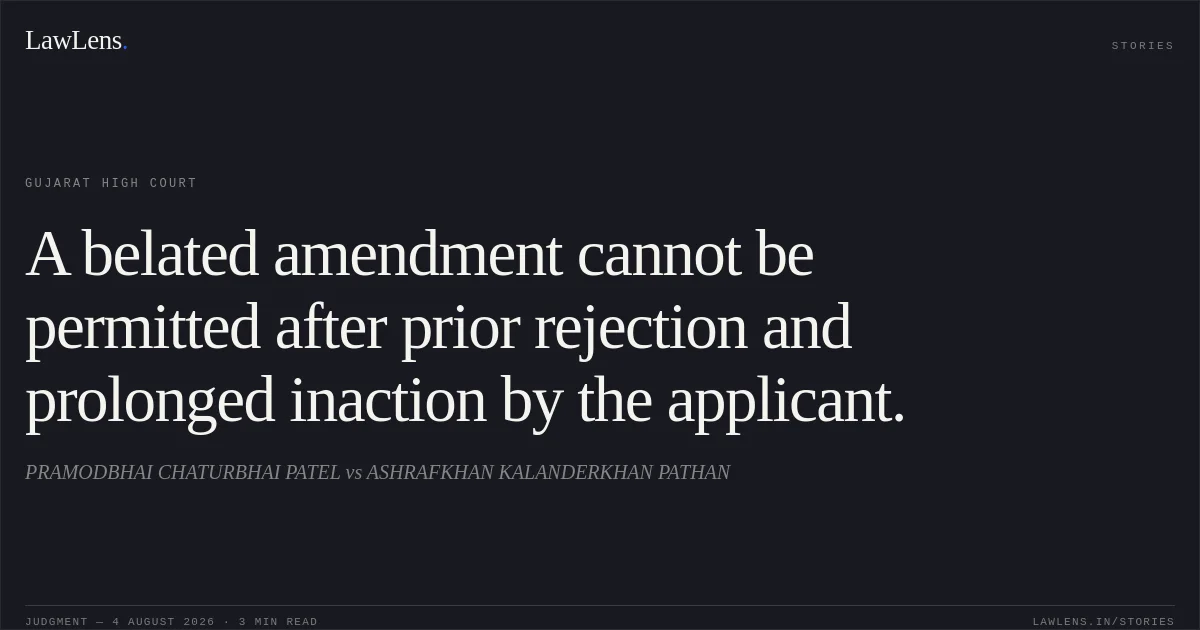
The High Court held that no substantive amendment had been granted under Exhibit 42; in any event, the petitioners’ prolonged inaction, failure to challenge the earlier orders, lack of due diligence, and suppression of the Exhibit 62 proceedings disentitled them to relief.
The Trial Court had correctly rejected Exhibit 331, and its decision did not warrant supervisory interference under Article 227.
Source reference: paras. 13–14The Special Civil Application was accordingly rejected, with no order as to costs.
Source reference: para. 14Acts & Sections Cited
1 provisions across 1 statute referred to in this judgment. Each provision opens on LawLens.
Code of Civil Procedure, 19081
Original Court PDF
PRAMODBHAI CHATURBHAI PATELvsASHRAFKHAN KALANDERKHAN PATHAN
Click to open original judgment
Original judgment, available to read, download and summarize on LawLens.in