01Facts
The petitioner was appointed as a Time Keeper, a Work-Charged and Contingency Paid Employee in the Water Resources Department, on 22 December 1971 and served continuously for approximately 38 years and 7 months before retiring.
¶ 2He was granted the pay scales of Rs. 445–635 from 1 April 1982, Rs. 825–1220 from 1 January 1986, and Rs. 2750–4400 from 1 January 1996. He claimed entitlement to the higher corresponding scales of Rs. 515–800, Rs. 950–1530, and Rs. 3050–4590, together with consequential benefits.
¶ 2The petitioner relied on the judgment in A.L. Thakur v. State of Madhya Pradesh, W.P. No. 16054 of 2003, dated 27 June 2012, which granted similar benefits to identically situated employees; that decision was affirmed by the Division Bench in W.A. No. 478 of 2013.
¶ 3After his representation dated 8 September 2019 was not acted upon, he filed the present writ petition seeking revised pay scales, arrears, interest, and other consequential benefits.
¶ 4The State opposed the petition, referring to the pending review proceedings concerning similar orders and raising delay and laches, since the petitioner had approached the Court approximately eight years after retirement.
¶ 5–8The Court noted that Review Petition No. 281 of 2020, concerning the same controversy, had been dismissed on 23 February 2023.
¶ 1002Issues
i.1. Whether the petitioner, being a Time Keeper in the Work-Charged and Contingency Establishment, was entitled to the higher pay scales granted to similarly situated employees in A.L. Thakur and connected cases?
¶ 2–3, 12ii.2. Whether the petitioner’s delay in approaching the Court after retirement disentitled him to arrears and other monetary benefits, despite the recurring nature of pay and pension claims?
¶ 8, 13–25iii.3. Whether the petitioner could nevertheless be granted notional pay fixation and consequential revision of pensionary benefits?
¶ 25–2703Law Applied
The Court exercised its discretionary jurisdiction under Article 226 of the Constitution, applying the principle of parity and equal treatment for similarly situated employees, as recognised in A.L. Thakur v. State of Madhya Pradesh and affirmed in connected appellate proceedings.
¶ 3, 12It relied on Article 7 of the Schedule to the Limitation Act, 1963, under which claims for wages are ordinarily recoverable within three years from the date they become due.
¶ 15The Court further applied the doctrine of delay and laches, relying on State of Orissa v. Mamata Mohanty, M.R. Gupta v. Union of India, Karnataka Power Corporation Ltd. v. K. Thangappan, Shiv Dass v. Union of India, U.P. Jal Nigam v. Jaswant Singh, Jagdish Lal v. State of Haryana, NDMC v. Pan Singh, and related authorities.
¶ 13–24These decisions establish that a continuing or recurring cause of action may justify correction of an erroneous pay fixation prospectively or notionally, but unexplained delay ordinarily bars recovery of stale arrears and may restrict relief under Article 226.
¶ 13–2404Reasoning
The Court found that the petitioner’s appointment, status as a Time Keeper in the Work-Charged and Contingency Establishment, service history, and lower pay fixation were materially identical to those of the employees who had succeeded in A.L. Thakur and related cases.
¶ 11–12Since those decisions had been affirmed and the State’s review petition had been dismissed, there was no sufficient basis to deny the petitioner parity in pay fixation.
¶ 10–12However, the petitioner had retired approximately eight years before filing the writ petition and had not satisfactorily explained the delay.
¶ 8Applying the distinction in M.R. Gupta between correction of an ongoing wrong and recovery of time-barred arrears, the Court held that the recurring nature of pay or pension did not entitle a retired employee to recover arrears for the entire historical period.
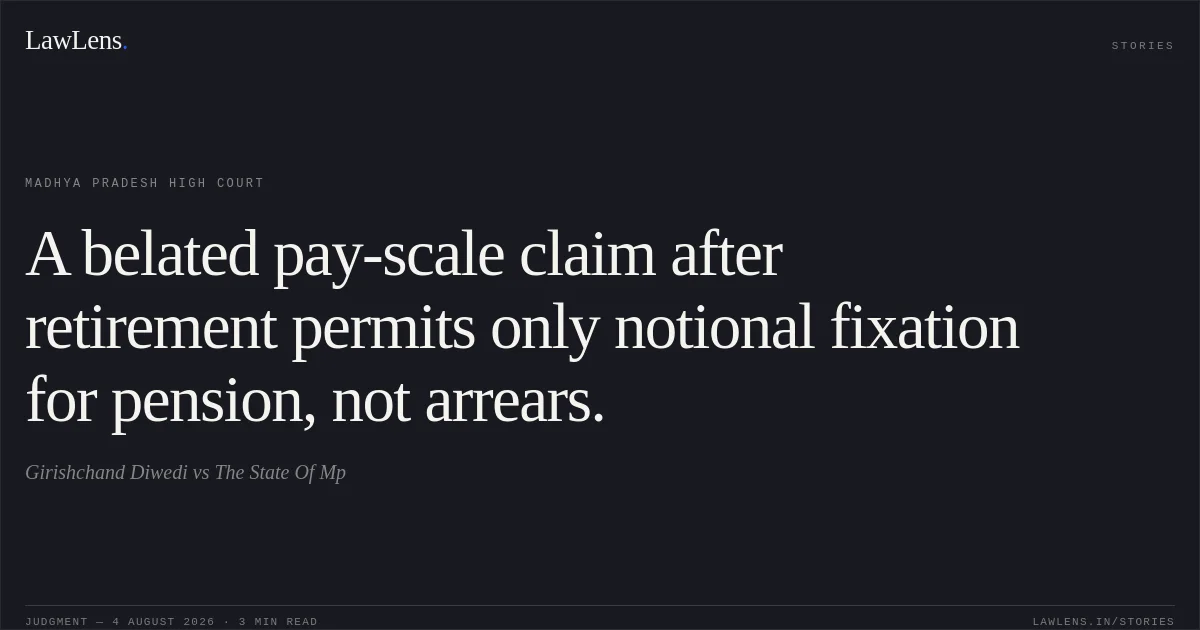
¶ 16–17, 25The appropriate relief was therefore limited to notional fixation for determining pensionary benefits.
¶ 16–17, 2505Holding
The petition was partly allowed.
¶ 25–26The Court held that the petitioner was entitled to the benefit of the higher pay scales applicable to similarly situated employees, but only by way of notional pay fixation for pensionary purposes.
¶ 25–26He was not granted arrears of salary or other monetary benefits for the period preceding retirement, owing to delay, laches, and the limitation applicable to stale monetary claims.
¶ 25–26The respondents were directed to re-fix the petitioner’s pay notionally and revise his pensionary benefits in accordance with law.
¶ 27The petition was accordingly disposed of.
¶ 28Original Court PDF
Girishchand DiwedivsThe State Of Mp
Click to open original judgment
Original judgment, available to read, download and summarize on LawLens.in