Facts
The first respondent was appointed as a Lecturer in 1982 and promoted to Senior Grade in 1990.
Source reference: para. 2He obtained an M.Phil. in 1993 and a Ph.D. in 1998.
Source reference: para. 2The College initially proposed his placement as Lecturer (Selection Grade) from 25.10.1995, but the University approved it only from 25.10.1997, granting one year’s relaxation for the M.Phil.
Source reference: para. 2He retired on 31.05.2001.
Source reference: para. 2.2–2.6In 2017, he sought promotion from 25.10.1994, relying on a 1990 Government Order allowing service relaxation for research degrees.
Source reference: paras. 2.2–2.6Following a direction to consider his representation, the University rejected it in 2018.
Source reference: paras. 2.2–2.6The Single Judge allowed his writ petition and directed promotion from 25.10.1994; the University appealed.
Source reference: paras. 2.2–2.6Issues
Whether the respondent’s claim for retrospective promotion, first pursued by representation in 2017 after his retirement in 2001, was barred by delay and laches.
Source reference: paras. 4, 6, 22Whether the claim could be treated as a continuing cause of action, or revived by the Court’s earlier direction to consider the representation and the University’s subsequent decision.
Source reference: paras. 4, 22Law Applied
Although Article 226 prescribes no limitation period, a service claim must be brought within a reasonable time; courts may refuse relief where a claimant sleeps on the claim and seeks to unsettle settled service matters.
Source reference: no citationP.S. Sadasivaswamy v. State of Tamil Nadu explains that delayed challenges to promotion should ordinarily be rejected, while C. Jacob v. Director of Geology and Mining and Union of India v. M.K. Sarkar establish that a direction to consider a stale representation, or its rejection, does not revive a dead claim or create a fresh cause of action.
Source reference: paras. 8–12Under Union of India v. Tarsem Singh, a continuing wrong may permit relief despite delay, but claims involving promotion or rights affecting others may be barred where reopening would unsettle settled rights.
Source reference: para. 21A continuing wrong requires a continuing breach of an obligation, not merely the continuing effects of a completed act.
Source reference: paras. 19–20Reasoning
The Court held that the respondent’s promotion had been approved from 25.10.1997 and that he neither challenged that decision contemporaneously nor raised the claim before retiring in 2001.
Source reference: para. 22His first relevant representation was made in 2017, more than sixteen years after retirement.
Source reference: para. 22The prior direction to consider the representation did not determine the merits or revive the stale claim; nor did the University’s decision on it create a fresh cause of action.
Source reference: paras. 8–9, 22The Court rejected the continuing-cause argument because the promotion claim was not shown to have remained a subsisting cause of action throughout the intervening period.
Source reference: para. 22It therefore found that the Single Judge had erred in granting relief without properly addressing delay and laches.
Source reference: para. 22Holding
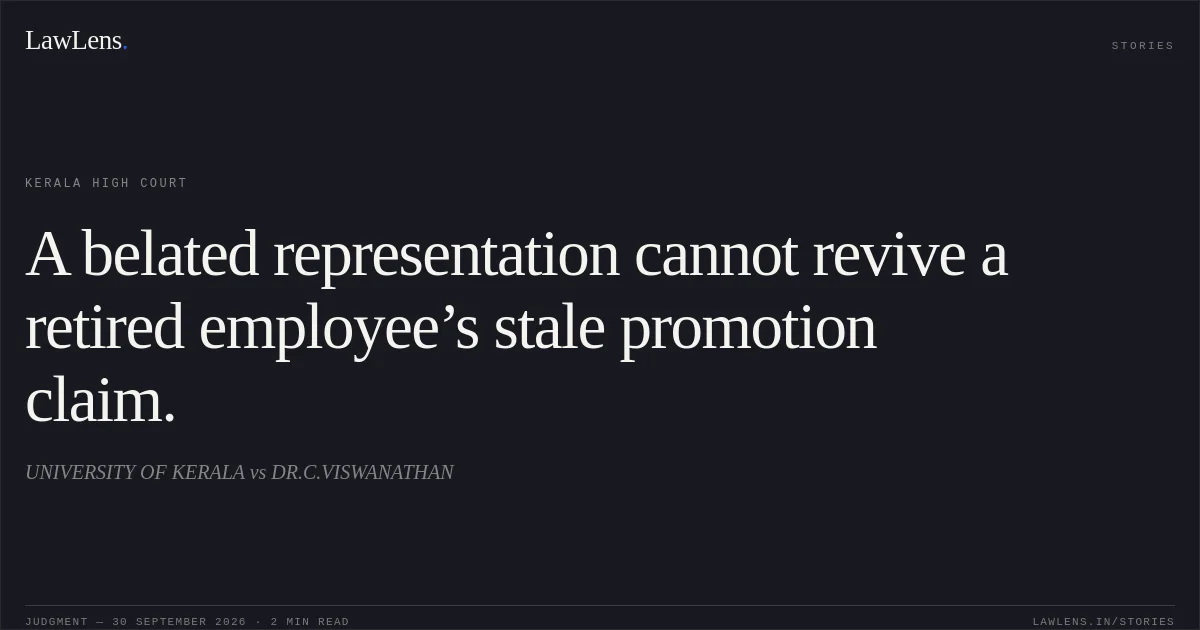
The Division Bench held that the respondent was not entitled to the relief sought because his retrospective-promotion claim was stale and could not be revived by a belated representation or the order passed on it.
The writ appeal was allowed, the Single Judge’s judgment was set aside, and the writ petition was dismissed.
Source reference: para. 22Acts & Sections Cited
5 provisions across 2 statutes referred to in this judgment. Each provision opens on LawLens.
Administrative Tribunals Act, 19853
Limitation Act, 19632
Original Court PDF
UNIVERSITY OF KERALAvsDR.C.VISWANATHAN
Click to open original judgment
Original judgment, available to read, download and summarize on LawLens.in