Facts
The petitioner sought quashing of FIR No. 0292/2025, registered under Section 69 of the Bharatiya Nyaya Sanhita, 2023 (BNS), at P.S. Neb Sarai.
Source reference: p.1The parties had been introduced for an arranged marriage and became engaged on 1 April 2025. They had a physical relationship on 14 June 2025, after which the petitioner refused to marry the complainant; she lodged the complaint on 9 July 2025.
Source reference: p.2During the proceedings, the parties settled their differences. The complainant stated that she did not wish to pursue the case and had settled voluntarily, without coercion or pressure.
Source reference: p.2Issues
Whether the circumstances disclosed a false promise to marry, made without intention to fulfil it, so as to attract Section 69 BNS.
Source reference: pp.2–3Whether the FIR and consequential proceedings should be quashed in light of the parties’ settlement and the circumstances of the relationship.
Source reference: pp.2, 5Law Applied
Section 69 BNS addresses sexual intercourse obtained by deceitful means, including a promise to marry made without any intention of fulfilling it.
Source reference: p.2Relying on Pramod Suryabhan Pawar v. State of Maharashtra, (2019) 9 SCC 608, the Court reiterated that a false promise requires proof that, when making it, the accused had no intention of keeping it, and that the promise was directly relevant to the complainant’s decision to engage in the sexual act; a later failure to fulfil a genuine promise is distinct from a false promise.
Source reference: pp.3–4The Court also relied on Dhruvaram Murlidhar Sonar v. State of Maharashtra, (2019) 18 SCC 191, which distinguishes a false promise made to induce sexual relations from a consensual relationship followed by a breach of promise.
Source reference: pp.4–5Reasoning
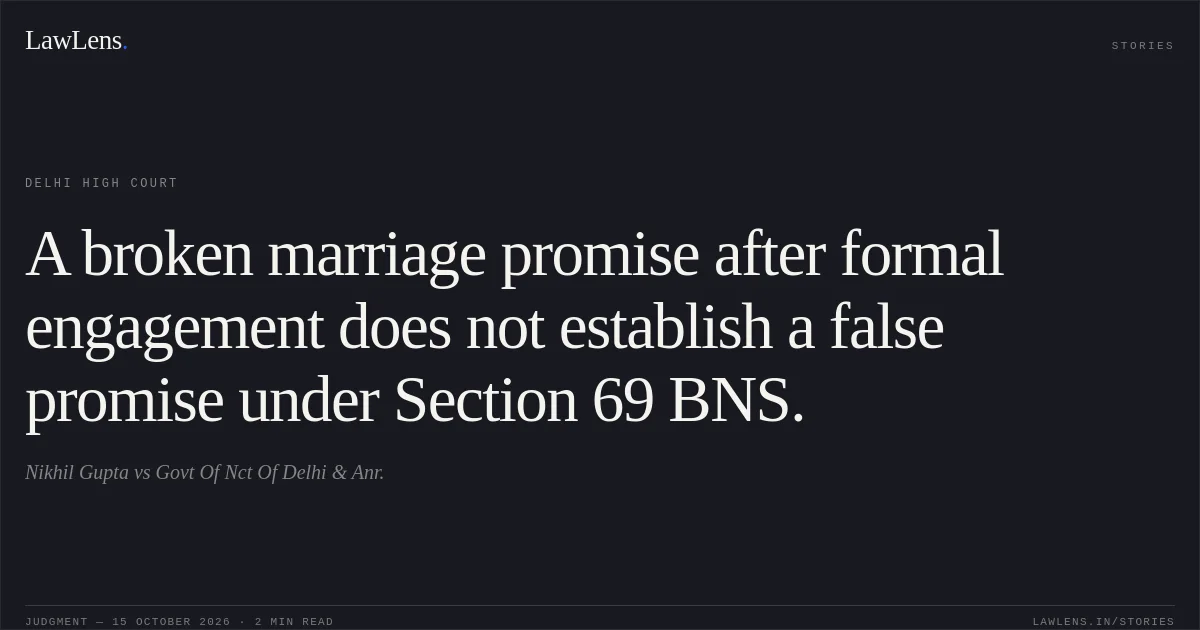
The Court considered that the parties’ physical relationship occurred after a formal engagement, which, in the circumstances of this case, negated an inference that the petitioner had made a false promise at the outset.
Source reference: pp.2–3The complainant attributed the relationship’s breakdown to differences arising after the engagement, and her affidavit described the FIR as arising from family disputes and quarrels.
Source reference: pp.2–3Applying the distinction between a false promise and a subsequent breach of promise, the Court found that the material indicated, at most, a breach of promise rather than an initially dishonest promise to marry.
Source reference: pp.3–5It also took account of the complainant’s voluntary settlement and her decision not to pursue the case.
Source reference: pp.2, 5Holding
The Court allowed the joint request and quashed FIR No. 0292/2025 and all proceedings emanating from it, finding that their continuation would be an exercise in futility.
The petition and pending application were disposed of.
Source reference: p.5The petitioner was directed to pay Rs. 20,000 to the Delhi High Court Legal Services Committee within four weeks and to file proof of payment in the Registry.
Source reference: p.5Acts & Sections Cited
4 provisions across 2 statutes referred to in this judgment. Each provision opens on LawLens.
Bharatiya Nyaya Sanhita, 20231
Indian Penal Code, 18603
Original Court PDF
Nikhil GuptavsGovt Of Nct Of Delhi & Anr.
Click to open original judgment
Original judgment, available to read, download and summarize on LawLens.in