Facts
The Respondent, proprietor of M/s G.G. Enterprises, supplied coating powder and scrap to the Appellant-company on credit during their commercial dealings from 2015 onwards. After adjusting payments, including the last payment of ₹1,04,040 made on 30 October 2018, the Respondent claimed ₹36,35,584 as outstanding.
Source reference: p.2; para. 3(C)–(D)Following a legal demand notice and unsuccessful pre-institution mediation, the Respondent instituted a commercial recovery suit before the Delhi Commercial Court.
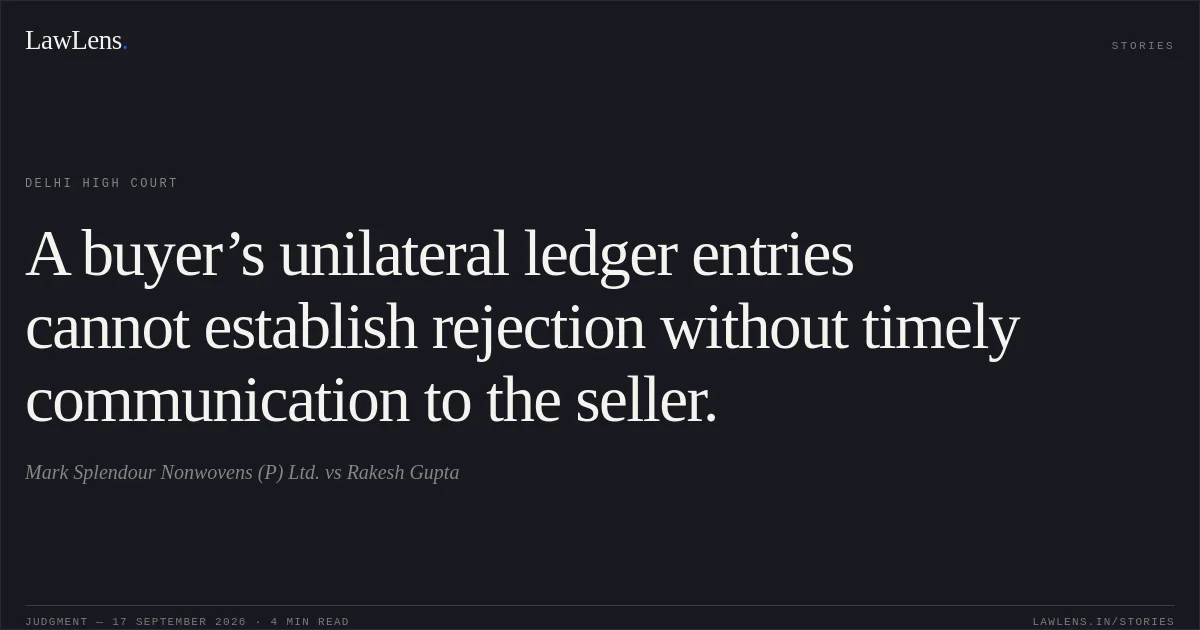
Source reference: p.3; para. 3(E)The Appellant disputed liability, contending that goods worth ₹34,15,742 had been rejected because they were not accompanied by requisite Test Reports and did not conform to agreed specifications. It relied principally on its own ledger and a summary of allegedly rejected bills.
Source reference: p.3–4; para. 3(G)–(J)The Commercial Court held that Delhi had jurisdiction, rejected the defence of rejection of goods, and decreed ₹36,35,584 with pre-suit interest at 18% per annum and pendente lite and future interest at 12% per annum.
Source reference: p.1–2; paras. 1–2The Appellant preferred the present first appeal under Section 13 of the Commercial Courts Act, 2015.
Source reference: p.1; para. 1Issues
Whether the Delhi Commercial Court possessed territorial jurisdiction to entertain and try the recovery suit, notwithstanding that negotiations and delivery of goods occurred at Bhiwadi?
Source reference: p.7; para. 6(A)Whether the Appellant established that goods worth ₹34,15,742 had been validly rejected for want of Test Reports and non-conformity with agreed specifications?
Source reference: p.7; para. 6(B)Law Applied
The Court applied Section 20(c) of the Code of Civil Procedure, 1908, under which a suit may be instituted where the cause of action arises wholly or in part; in contractual disputes, the place of contracting, performance, delivery, and payment may constitute relevant connecting factors.
Source reference: p.8–9; paras. 11–12Relying on A.B.C. Laminart Pvt. Ltd. v. A.P. Agencies, Salem, (1989) 2 SCC 163, the Court held that part of the cause of action may arise where payment is expressly or impliedly payable, and that parties may choose one among several otherwise competent forums.
Source reference: p.8–9; para. 12It also applied the principle in Satyapal v. Slick Auto Accessories Pvt. Ltd., RSA No. 40/2013, decided on 5 March 2014, that where no place of payment is agreed, the debtor must ordinarily seek the creditor.
Source reference: p.10; para. 18Under Section 42 of the Sale of Goods Act, 1930, a buyer is deemed to have accepted goods if, after delivery, it retains them beyond a reasonable time without intimating the seller of rejection.
Source reference: p.15; para. 41The burden of proving the alleged rejection and the contractual conditions relied upon lay on the Appellant.
Source reference: p.12–13; paras. 29–30Reasoning
The Court held that Bhiwadi was not the exclusive forum merely because the Respondent had initially visited the Appellant there, negotiations occurred there, and the goods were received there. The evidence also showed that the goods were supplied from the Respondent’s Delhi establishment.
Source reference: p.9–10; paras. 13–15No agreed place of payment at Bhiwadi was proved; consequently, payment was ordinarily performable at the creditor’s place of business in Delhi, giving rise to part of the cause of action under Section 20(c) CPC.
Source reference: p.10–11; paras. 16–21The invoices additionally contained a Delhi jurisdiction clause, which could validly reinforce the parties’ choice because Delhi independently possessed jurisdiction.
Source reference: p.11; paras. 23–25On the merits, the Appellant failed to prove that Test Reports were an agreed mandatory contractual condition: the purchase orders allegedly containing that condition were not produced, and the Respondent maintained that orders were placed orally.
Source reference: p.13–14; paras. 31–34The Appellant also failed to establish the precise specifications, the non-conformity of any identified consignment, or timely communication of rejection. Its authorised representative admitted that no rejection letter was sent and that the goods were never returned; the alleged oral communication through Rajpal was unsupported because Rajpal was not examined.
Source reference: p.14–15; paras. 35–40The Appellant’s unilateral ledger entries could not, without corroboration, prove either actual rejection or communication of rejection.
Source reference: p.15; para. 40Retention of the goods without reliable contemporaneous notice attracted the principle embodied in Section 42 of the Sale of Goods Act.
Source reference: p.15–16; paras. 41–44The Appellant also produced no reliable evidence of substitute purchases or consequential loss.
Source reference: p.16; para. 43Holding
The Court answered both issues against the Appellant.
It held that the Delhi Commercial Court possessed territorial jurisdiction because a material part of the cause of action, including the obligation to make payment, arose in Delhi; the jurisdiction clause validly supported Delhi as the chosen forum.
Source reference: p.11–12; paras. 25–27It further held that the Appellant failed to prove any agreed Test Report requirement, non-conformity, valid rejection, or timely communication of rejection.
Source reference: p.16–17; paras. 44–49The appeal was dismissed and the decree for ₹36,35,584, together with the interest awarded by the Commercial Court, was affirmed.
Source reference: p.17–18; paras. 51–52The amount deposited by the Appellant, with accrued interest, was directed to be released to the Respondent and adjusted against the decree; any balance was to be paid within four weeks, with no order as to costs in the appeal.
Source reference: p.18; paras. 53–55Acts & Sections Cited
3 provisions across 3 statutes referred to in this judgment. Each provision opens on LawLens.
Commercial Courts Act, 20151
Code of Civil Procedure, 19081
Sale of Goods Act, 19301
Original Court PDF
Mark Splendour Nonwovens (P) Ltd.vsRakesh Gupta
Click to open original judgment
Original judgment, available to read, download and summarize on LawLens.in