Facts
The Government assigned 23.02 hectares of land for housing sites for Tamil Nadu Secretariat staff and a co-operative housing society was formed for that purpose.
Source reference: p.2Alleged irregularities arose concerning allotment of plots to ineligible persons, including relatives of directors, and their admission as associate members in violation of the society’s bye-laws.
Source reference: p.2A criminal case was registered against the respondent under Sections 120-B, 409, 420, 467, 468 and 471 IPC and Section 13(2) read with Section 13(1)(d) of the Prevention of Corruption Act, 1988.
Source reference: p.2Although the Trial Court acquitted the respondent on 26 October 2016, the State’s criminal appeal remained pending.
Source reference: p.2The respondent, then serving as Under Secretary to the Government, was placed under suspension and issued a departmental charge memo dated 27 June 2012.
Source reference: p.3The Enquiry Officer submitted a report dated 17 August 2017 holding that the charges were not proved.
Source reference: p.3The Disciplinary Authority disagreed with that finding, recorded reasons for the disagreement, and issued a show-cause notice dated 5 February 2018, giving the respondent an opportunity to submit his explanation.
Source reference: p.3The respondent filed three writ petitions challenging the charge memo, subsequent disciplinary proceedings, and the show-cause notice, while also seeking a declaration that he had deemed to have retired on superannuation on 30 June 2012.
Source reference: p.3The learned Single Judge allowed the writ petitions by a common order dated 9 June 2025, relying, inter alia, on the Enquiry Officer’s report and evidence in the criminal proceedings.
Source reference: pp.3–5The State preferred the present writ appeal.
Source reference: pp.3–5Issues
1. Whether a writ petition challenging a departmental charge memo is maintainable after completion of the enquiry and issuance of a show-cause notice by the Disciplinary Authority disagreeing with the Enquiry Officer’s findings
Source reference: pp.4–72. Whether the Disciplinary Authority was legally entitled to disagree with the Enquiry Officer’s finding that the charges were not proved, provided reasons and an opportunity of hearing were given to the delinquent officer
Source reference: pp.3, 5–73. Whether the High Court, in exercise of judicial review under Article 226, could examine the merits of the charges, disputed facts, and evidence relied upon in the departmental and criminal proceedings before conclusion of the disciplinary process
Source reference: pp.4–84. Whether the respondent’s acquittal in the criminal case and the pendency of the State’s criminal appeal constituted a bar to continuation of the departmental disciplinary proceedings
Source reference: pp.2, 7–85. Whether the pendency or outcome of contempt proceedings affected the maintainability or adjudication of the writ appeal
Source reference: p.7Law Applied
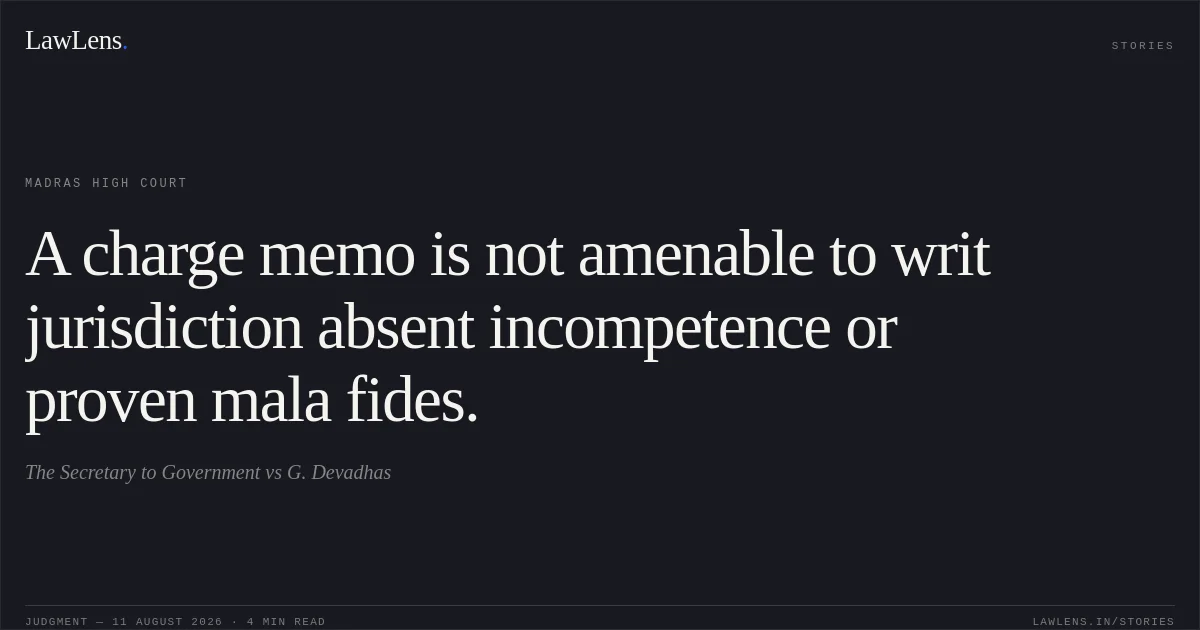
The Court applied the principle that a writ petition ordinarily is not maintainable against a charge memo unless it was issued by an incompetent authority or is vitiated by mala fides; where mala fides are alleged, the concerned authority must be impleaded in his or her personal capacity.
Source reference: pp.4–5Under Article 226, judicial review concerns the legality of the decision-making process, including compliance with the applicable Discipline and Appeal Rules and natural justice, and not the correctness of the decision on disputed facts or the merits of the charges.
Source reference: pp.4–5A Disciplinary Authority may accept or disagree with the Enquiry Officer’s findings, but when it disagrees, it must disclose its reasons and afford the delinquent officer an opportunity to respond.
Source reference: pp.3, 5–7Departmental disciplinary proceedings and criminal proceedings are distinct; the pendency or continuation of a criminal case or appeal does not, by itself, prevent the Disciplinary Authority from completing the departmental proceedings.
Source reference: pp.7–8The Court also held that contempt proceedings do not determine the merits or maintainability of an otherwise competent writ appeal.
Source reference: p.7Reasoning
The Court found that the respondent challenged the 2012 charge memo only after the enquiry had concluded and after the Disciplinary Authority had issued a reasoned show-cause notice proposing to disagree with the Enquiry Officer’s conclusions.
Source reference: p.5Since the Disciplinary Authority was empowered to take a different view and had furnished reasons while granting the respondent an opportunity to respond, there was no procedural violation warranting interference at the interlocutory stage.
Source reference: pp.5–7The learned Single Judge had impermissibly examined the allegations, the criminal-court evidence, and the Enquiry Officer’s conclusions, thereby adjudicating disputed facts instead of limiting review to the legality of the disciplinary process.
Source reference: pp.4–5, 7–8The Court further held that the respondent’s acquittal did not conclude or bar the departmental proceedings, particularly as the criminal appeal was pending and the two proceedings operated under distinct standards and procedures.
Source reference: pp.2, 7–8The respondent’s failure to submit an explanation to the show-cause notice also meant that the disciplinary process had not yet reached finality.
Source reference: p.6Holding
The Division Bench allowed the writ appeal and set aside the order dated 9 June 2025 in W.P. No. 26054 of 2012.
The respondent was granted two weeks from receipt of the judgment to submit his explanation to the Disciplinary Authority’s show-cause notice.
Source reference: p.8The Disciplinary Authority was directed to complete the departmental disciplinary proceedings and pass final orders on merits and in accordance with law as expeditiously as possible.
Source reference: p.8The Court expressly held that the pending criminal appeal was not a bar to concluding the departmental proceedings.
Source reference: p.8No costs were awarded, and the connected miscellaneous petition was closed.
Source reference: p.9Acts & Sections Cited
6 provisions across 2 statutes referred to in this judgment. Each provision opens on LawLens.
Indian Penal Code, 18605
Prevention of Corruption Act, 19881
Original Court PDF
The Secretary to GovernmentvsG. Devadhas
Click to open original judgment
Original judgment, available to read, download and summarize on LawLens.in