Facts
The Appellant was appointed as a Sales Clerk with the Delhi State Co-operative Union Ltd. in 1971.
Source reference: pp. 1–2, paras. 2.1–2.2An internal audit conducted between 1986 and 1989 allegedly revealed discrepancies in sales and collection entries.
Source reference: pp. 1–2, paras. 2.1–2.2A chargesheet dated 12.04.1989 alleged financial irregularities and failure to account for receipts.
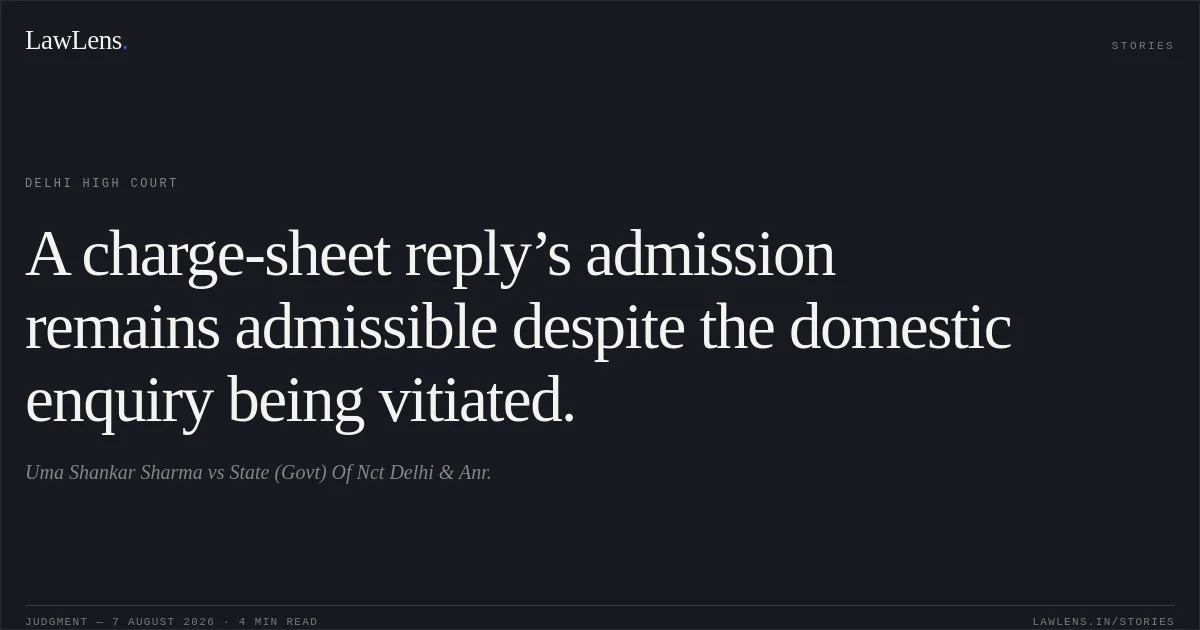
Source reference: pp. 1–2, paras. 2.1–2.2In his reply, the Appellant did not deny the existence of the discrepancies but attributed responsibility to one Mr. D.K. Sharma.
Source reference: pp. 1–2, paras. 2.1–2.2Following a domestic enquiry, the Enquiry Officer found the charges of misappropriation proved, and the Appellant’s services were terminated on 30.06.1989.
Source reference: p. 2, para. 2.3The Industrial Tribunal subsequently set aside the enquiry for violation of natural justice, while permitting the employer to lead evidence afresh.
Source reference: p. 2, para. 2.4Upon reconsideration, the Tribunal upheld the termination by award dated 05.07.2002.
Source reference: p. 3, paras. 2.5–2.6The learned Single Judge dismissed the Appellant’s writ petition challenging the award.
Source reference: p. 3, paras. 2.5–2.6The present LPA challenged both the Single Judge’s judgment dated 08.04.2026 and the Tribunal’s award.
Source reference: p. 3, paras. 2.5–2.6Issues
Whether the Appellant’s reply to the chargesheet, which acknowledged the existence of discrepancies, could be relied upon after the domestic enquiry had been set aside for violation of natural justice?
Source reference: pp. 7–8, paras. 6–8Whether the employer proved the charges through admissible and sufficient evidence, despite relying principally on the testimony of the Presenting Officer and not examining the auditors or Mr. D.K. Sharma?
Source reference: pp. 3–4, 6–8, paras. 3.1–3.5, 9–12Whether the punishment of termination was disproportionate to the proved misconduct, having regard to the Appellant’s length of service and alleged absence of financial loss?
Source reference: p. 5, para. 3.6; p. 9, para. 13Whether the Appellant was subjected to discriminatory treatment contrary to Article 14 of the Constitution because Mr. D.K. Sharma was allegedly treated more leniently?
Source reference: p. 5, para. 3.7; p. 9, para. 14Law Applied
Setting aside a domestic enquiry for breach of natural justice does not, by itself, nullify an independent admission made by the employee in a reply to the chargesheet; such an admission may be considered along with evidence subsequently led pursuant to permission granted by the Tribunal.
Source reference: p. 7, para. 7Relying on Jai Prakash Saini v. Managing Director, U.P. Cooperative Federation Ltd., 2026 SCC OnLine SC 505, the Court stated that documentary evidence ordinarily must be proved through a witness available for cross-examination where the charge is denied and the dismissal rests solely on documents; however, the Court treated that requirement as inapplicable where the employee had admitted the charge or the material discrepancy.
Source reference: p. 8, para. 8The Presenting Officer is not disqualified from proving documentary records merely because he conducted the presentation, particularly where he was also the employer’s Chief Executive Officer.
Source reference: p. 8, para. 9On proportionality, the Court held that proven misappropriation by an employee entrusted with cash strikes at the employer’s fundamental trust and may justify termination notwithstanding long service.
Source reference: p. 9, para. 13Under Article 14, parity cannot be claimed without establishing that the comparator was similarly situated and that misconduct was similarly proved.
Source reference: p. 9, para. 14The Court distinguished State of U.P. v. Ram Prakash Singh, Hardwari Lal v. State of U.P., G. Siva Prasad Rao v. Bank of India, and Jagdish Prasad Saxena v. State of Madhya Bharat, which concerned cases lacking supporting material or involving coerced and uncorroborated confessions.
Source reference: pp. 3–4, 8–9, paras. 3.2, 3.4, 11–12Reasoning
The Tribunal’s order invalidated the manner of conducting the domestic enquiry, not the Appellant’s separate written reply to the chargesheet.
Source reference: p. 7, para. 7Since the Appellant did not dispute the discrepancies themselves and only sought to shift responsibility to Mr. D.K. Sharma, the reply constituted relevant material that could be considered with the evidence led afresh.
Source reference: p. 7, para. 7The Presenting Officer, who was also the Chief Executive Officer, proved the statements of account, cash registers, and sale registers; those documents were exhibited and remained unrebutted on merits.
Source reference: p. 8, para. 9The non-examination of the auditors or Mr. D.K. Sharma did not warrant an adverse inference because the Appellant, being responsible for the accounts and collections, failed to substantiate his alternative explanation.
Source reference: p. 8, para. 10The Court found the case materially different from authorities where the charges rested on no evidence or on involuntary, uncorroborated confessions.
Source reference: pp. 8–9, paras. 11–12Given the nature of the proved financial misconduct and the position of trust occupied by the Appellant, termination was not shockingly disproportionate.
Source reference: p. 9, para. 13The Article 14 argument also failed because there was no material showing that misconduct had been proved against Mr. D.K. Sharma or that his circumstances were comparable to those of the Appellant.
Source reference: p. 9, para. 14Holding
The Delhi High Court held that the setting aside of the domestic enquiry did not render the Appellant’s independent admission inadmissible; the charges were sufficiently established through the admission and corroborating documentary evidence.
The Presenting Officer was competent to prove the records, and the non-examination of the auditors or Mr. D.K. Sharma did not undermine the findings of misconduct.
Source reference: pp. 7–9, paras. 7–14The punishment of termination was neither disproportionate nor discriminatory under Article 14.
Source reference: pp. 7–9, paras. 7–14Finding no perversity or evidentiary deficiency in the concurrent findings of the Industrial Tribunal and the learned Single Judge, the Court dismissed the LPA and upheld the judgment dated 08.04.2026 and award dated 05.07.2002.
Source reference: p. 10, paras. 15–16No order as to costs was made.
Source reference: p. 10, paras. 15–16Original Court PDF
Uma Shankar SharmavsState (Govt) Of Nct Delhi & Anr.
Click to open original judgment
Original judgment, available to read, download and summarize on LawLens.in