Facts
The petitions concerned competing claims over agricultural holdings in villages Rasauli, Jawania, Keshavpatti and Atawaria, District Allahabad (now Prayagraj), under consolidation proceedings.
Source reference: para. 1–4Ramji claimed to be the adopted son of Murlidhar through Murlidhar’s widow, Smt. Moti Rani, on the basis of an adoption deed dated 2 August 1960.
Source reference: para. 3Ram Kripal challenged Ramji’s recorded status and asserted that Murlidhar had died issueless and that Ramji’s name had been wrongly entered in the revenue records.
Source reference: para. 3In relation to Khata No. 96, the Consolidation Officer accepted Ramji’s adoption claim on 20 October 1973, and the Settlement Officer of Consolidation dismissed Ram Kripal’s appeal on 29 December 1973.
Source reference: para. 3Although the Deputy Director of Consolidation initially allowed Ram Kripal’s revision on 22 May 1974, that order was quashed by the High Court in Writ-B No. 3315 of 1974, with a direction to decide the revision afresh after considering the relevant evidence.
Source reference: para. 3, 13–14On remand, the Deputy Director dismissed the revision on 9 September 1983 and upheld Ramji’s status as Murlidhar’s adopted son.
Source reference: para. 3, 15–16In relation to Khata Nos. 123, 84, 364, 365, 98 and 108, the Consolidation Officer entered Ramji’s name as co-sharer; the Settlement Officer and Deputy Director of Consolidation affirmed that decision on 12 December 1984 and 8 April 1986, respectively.
Source reference: para. 4Ram Kripal therefore filed both writ petitions under Article 226 of the Constitution challenging the consolidation authorities’ orders.
Source reference: para. 3–6Issues
1. Whether the adoption deed dated 2 August 1960 validly established Ramji’s adoption by Smt. Moti Rani, despite the objections regarding non-compliance with the Hindu Adoption and Maintenance Act, 1956 and alleged defects in the deed?
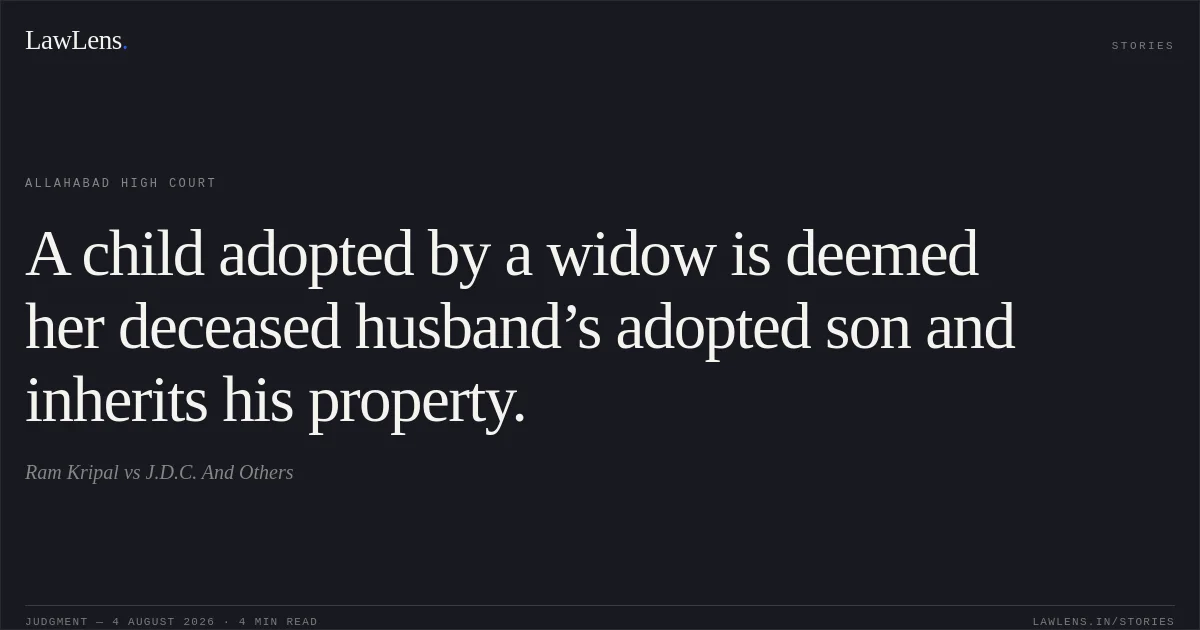
Source reference: para. 7, 12–162. Whether a child adopted by the widow after the death of her husband is to be treated, for purposes of inheritance, as the adopted son of the deceased husband and consequently entitled to succeed to his property?
Source reference: para. 15, 17–193. Whether the High Court should interfere under Article 226 with the concurrent factual findings of the Consolidation Officer, Settlement Officer of Consolidation and Deputy Director of Consolidation?
Source reference: para. 19–21Law Applied
The Court applied Sections 9A(2), 11(1) and 48 of the U.P. Consolidation of Holdings Act, 1953, governing objections, appeals and revisions in consolidation proceedings.
Source reference: para. 3–4It considered Sections 12, 14 and 16 of the Hindu Adoptions and Maintenance Act, 1956: Section 12 determines the legal consequences of adoption, Section 14 addresses the adoptive relationship, and Section 16 permits a presumption of validity from a registered adoption document, subject to rebuttal.
Source reference: para. 7, 15, 17–18Relying on Subhash Misir U/G of Sri Janardan Tewari v. Thagai Misir, 1966 RD 255, the Court held that a son adopted by a widow is deemed to be the son of her deceased husband and may inherit his property.
Source reference: para. 17It also relied on Sawan Ram v. Mst. Kalawanti, AIR 1967 SC 1761, which held that adoption by a widow does not prevent the adopted child from being treated as the adopted son of her deceased husband; the restrictions under Section 12 concern divesting rights already vested in others.
Source reference: para. 18Under Article 226, the High Court ordinarily does not reappraise concurrent findings of fact unless there is jurisdictional error, perversity or manifest illegality.
Source reference: para. 21Reasoning
The Court found that all three consolidation authorities had concurrently held that the adoption deed dated 2 August 1960 was duly proved and that Smt. Moti Rani had validly adopted Ramji.
Source reference: para. 10, 16, 20The revisional authority, while deciding the matter afresh pursuant to the earlier High Court judgment, considered the relevant oral and documentary evidence, including the adoption deed, witnesses to the adoption ceremony, revenue records and mutation proceedings.
Source reference: para. 13, 15–16Ram Kripal failed to produce reliable evidence rebutting the adoption, and the alleged defects in the deed were insufficient to displace the factual findings reached by the consolidation authorities.
Source reference: para. 15Applying Sections 12 and 14 of the Hindu Adoptions and Maintenance Act in light of Subhash Misir and Sawan Ram, the Court held that adoption by Moti Rani after Murlidhar’s death made Ramji the adopted son of Murlidhar for inheritance purposes.
Source reference: para. 17–20Accordingly, Ramji was entitled to succeed to Murlidhar’s share and to be recorded in the disputed holdings.
Source reference: para. 17–20Since the findings were concurrent, supported by evidence and involved no jurisdictional defect, the Court held that no interference under Article 226 was warranted.
Source reference: para. 21Holding
The High Court answered the issues in favour of Ramji.
It upheld the validity of the adoption deed dated 2 August 1960 and held that Ramji was the adopted son of both Smt. Moti Rani and her deceased husband, Murlidhar, with corresponding inheritance rights in Murlidhar’s property.
Source reference: para. 16, 19–20Both Writ-B No. 11407 of 1983 and Writ-B No. 6580 of 1986 were dismissed, and the impugned consolidation orders were left undisturbed.
Source reference: para. 22–23No order was made as to costs.
Source reference: para. 22–23Acts & Sections Cited
4 provisions across 1 statute referred to in this judgment. Each provision opens on LawLens.
Hindu Adoptions and Maintenance Act, 19564
Original Court PDF
Ram KripalvsJ.D.C. And Others
Click to open original judgment
Original judgment, available to read, download and summarize on LawLens.in