Facts
The petitioner’s father, Bindulal Singhad, an Assistant Teacher, died in service on 19 July 2019. He had two wives: Janibai, his first wife, and Rajubai, whom he married during the subsistence of the first marriage. The petitioner was born to Rajubai.
Source reference: para. 2–4He applied for compassionate appointment on 12 April 2023 and submitted affidavits from both wives and his three half-sisters confirming his relationship with the deceased employee.
Source reference: para. 2–4The District Education Officer rejected the application on 12 May 2023, holding that the petitioner was the son of the second wife and therefore did not qualify as a “dependent family member” under the compassionate appointment policy dated 29 September 2014.
Source reference: para. 4The State additionally contended that the second marriage violated Rule 22 of the M.P. Civil Services (Conduct) Rules, 1965, and that there was insufficient proof of the petitioner’s relationship with the deceased employee.
Source reference: para. 4, 6Issues
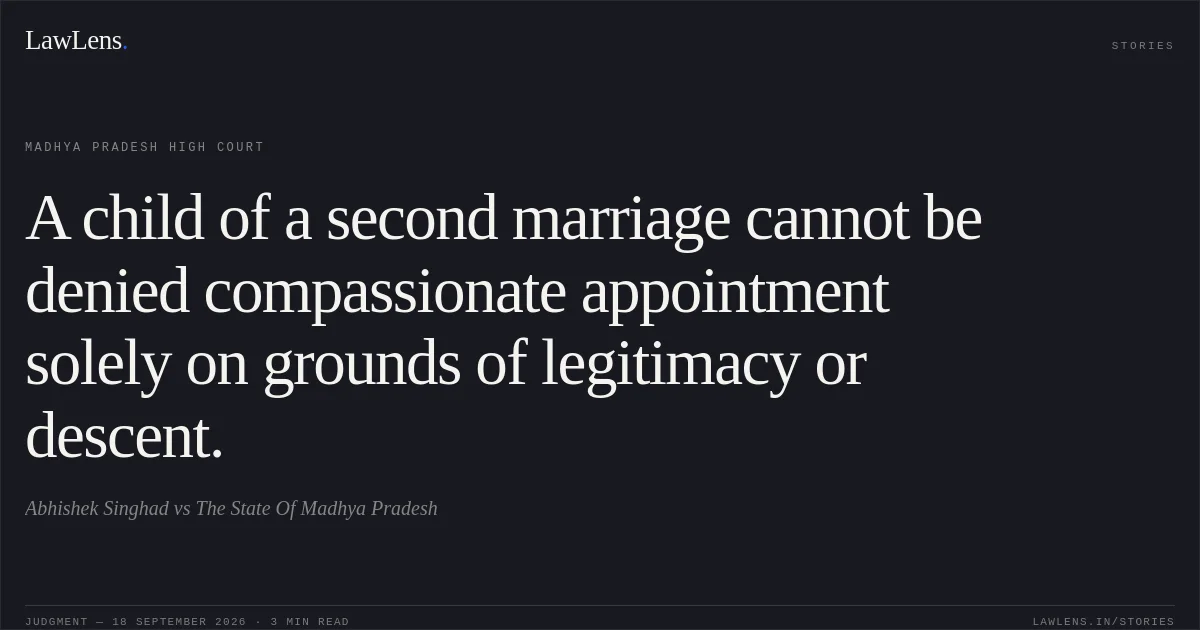
Whether the petitioner could be denied consideration for compassionate appointment merely because he was born from the deceased employee’s second marriage, contracted during the subsistence of the first marriage.
Source reference: para. 9–10Whether the respondents had sufficient basis to dispute the petitioner’s status as the son of the deceased employee in light of the affidavits and documentary evidence on record.
Source reference: para. 8Whether the rejection of the petitioner’s application on the ground of legitimacy or descent violated Articles 14 and 16(2) of the Constitution.
Source reference: para. 9–10Law Applied
The Court applied Section 16 of the Hindu Marriage Act, 1955, under which children born from a void marriage are treated as legitimate; Articles 14 and 16(2) of the Constitution, which prohibit arbitrary discrimination and discrimination in public employment on grounds including descent; and the compassionate appointment policy dated 29 September 2014.
Source reference: para. 9–10It relied principally on Union of India v. V.R. Tripathi, (2019) 14 SCC 646, which held that children born from a second marriage cannot be excluded from compassionate appointment merely because the marriage was contracted during the subsistence of an earlier marriage, and on Mukesh Kumar v. Union of India, (2022) 14 SCC 161, which held that “descent” includes familial origin, the validity of the parents’ marriage, and the child’s legitimacy.
Source reference: para. 9–10Such exclusion is arbitrary, disproportionate, and violative of Articles 14 and 16(2).
Source reference: para. 9–10Rule 22 of the M.P. Civil Services (Conduct) Rules, 1965, concerning marriage during the subsistence of an existing marriage, could not be used to deny the child’s independent claim for consideration.
Source reference: para. 6, 8Reasoning
The Court found that the State’s objections were internally inconsistent: it simultaneously alleged that the second marriage was impermissible and that there was no proof of the marriage or the petitioner’s relationship with the deceased employee.
Source reference: para. 8The affidavits of Janibai, Rajubai, and the petitioner’s three sisters consistently acknowledged that the petitioner was Bindulal Singhad’s son. His ration card, PAN card, caste certificate, bank passbook, Aadhaar card, voter list, and school records also recorded Bindulal Singhad as his father.
Source reference: para. 8Since these documents were not disputed and the respondents had conducted no meaningful enquiry, the Court accepted the petitioner’s relationship with the deceased employee.
Source reference: para. 8Applying V.R. Tripathi and Mukesh Kumar, the Court held that the petitioner could not be excluded from compassionate appointment solely because he was born from the second marriage.
Source reference: para. 9–11A policy that distinguishes between children on the basis of legitimacy, the status of the mother, or familial descent bears no reasonable nexus to the object of compassionate appointment and violates Articles 14 and 16(2).
Source reference: para. 9–11Holding
The Court quashed the rejection order dated 12 May 2023 and held that the petitioner could not be denied consideration for compassionate appointment on the ground that he was the son of the deceased employee’s second wife or on the ground of alleged illegitimacy.
The respondents were directed to reconsider and scrutinise the petitioner’s application on its own merits in accordance with the applicable policy and to pass an appropriate order within three months from communication of the judgment.
Source reference: para. 11–12The writ petition was accordingly allowed.
Source reference: para. 11–12Acts & Sections Cited
1 provisions across 1 statute referred to in this judgment. Each provision opens on LawLens.
Hindu Marriage Act, 19551
Original Court PDF
Abhishek SinghadvsThe State Of Madhya Pradesh
Click to open original judgment
Original judgment, available to read, download and summarize on LawLens.in