Facts
The complainant alleged that her father, petitioner no. 1, had gifted certain land to her mother in 1972, and that after her mother’s death in 2012 he and other petitioners transferred portions of that land to third parties.
Source reference: pp. 2–4She claimed possession through her mother and alleged that the petitioners also abused and threatened her when she visited the land on 20 September 2015.
Source reference: pp. 2–4The Magistrate directed issuance of summons after finding a prima facie case under Section 420 IPC.
Source reference: pp. 2–4Before filing the complaint, the complainant had instituted a title suit seeking, among other reliefs, a declaration concerning possession and the validity of the sale deeds.
Source reference: pp. 10–11The petitioners sought quashing under Section 482 CrPC, arguing that the dispute was civil and that the complaint did not disclose cheating.
Source reference: pp. 4–6Issues
Whether the complaint and supporting material disclosed the essential ingredients of cheating under Sections 415 and 420 IPC
Source reference: pp. 12–14, paras 25–27Whether continuation of the criminal proceeding, arising from the parties’ dispute over title, possession and transfers of land, amounted to an abuse of process warranting quashing under Section 482 CrPC
Source reference: pp. 14–16, paras 28–32Law Applied
Section 420 IPC requires the ingredients of cheating under Section 415 IPC, including fraudulent or dishonest inducement and, for the property-related offence, dishonest inducement to deliver property or to make, alter or destroy valuable security
Source reference: pp. 12–14, paras 25–27Under Section 482 CrPC, the High Court may intervene to prevent abuse of process or secure the ends of justice; a civil dispute may have a criminal dimension, but proceedings should be quashed where the dispute is in substance civil and the complaint merely gives it a criminal cloak.
Source reference: no citationThe Court relied on Prof. R. K. Vijayasarathy v. Sudha Seetharam, A. M. Mohan v. State, Mohammed Ibrahim v. State of Bihar, and Sarabjit Kaur v. State of Punjab on the ingredients of cheating
Source reference: p. 13, para 26and on R. Nagender Yadav v. State of Telangana concerning the exercise of Section 482 jurisdiction in civil disputes presented as criminal cases
Source reference: pp. 14–15, para 28Reasoning
The Court found no allegation that the complainant had been deceived or dishonestly induced to deliver property, nor that any such inducement occurred when the petitioners executed the disputed transfers; therefore, the essential ingredients of Sections 415 and 420 IPC were not made out.
Source reference: p. 14, para 27It considered the dispute to concern competing claims to title, possession and the effect of registered deeds, already placed before the civil court through the earlier title suit.
Source reference: pp. 10–11, 14–16, paras 21, 23, 28The Court also relied on the complainant’s failure to produce the alleged gift deed when asked and on the fact that a person named in the complaint as involved in the 2015 occurrence had died in 2012, treating these circumstances as supporting its conclusion that the complaint was unreliable and the prosecution vexatious.
Source reference: pp. 10–12, paras 20, 22It concluded that the Magistrate had issued process mechanically without properly examining whether the allegations constituted the offence.
Source reference: p. 16, para 30Holding
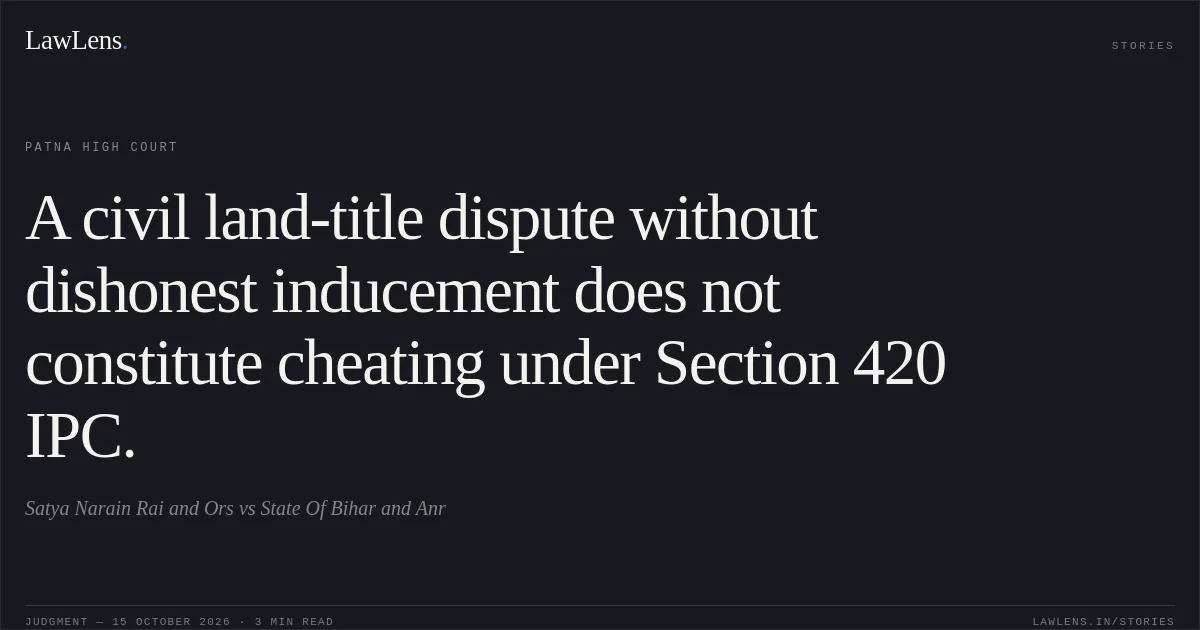
The Court held that the complaint did not disclose an offence under Section 420 IPC and that the criminal proceeding was an abuse of process in the context of the parties’ civil dispute over land.
It allowed the application, quashed the order dated 3 March 2016 and the consequential criminal proceedings against the petitioners, and disposed of any pending interlocutory applications.
Source reference: p. 16, paras 33–35Acts & Sections Cited
9 provisions across 3 statutes referred to in this judgment. Each provision opens on LawLens.
Code of Criminal Procedure, 19731
Indian Penal Code, 18607
Arms Act, 19591
Original Court PDF
Satya Narain Rai and OrsvsState Of Bihar and Anr
Click to open original judgment
Original judgment, available to read, download and summarize on LawLens.in