01Facts
The appellant sought probate of a registered Will dated 27 February 2001.
¶ 2After the testator’s death, the probate proceeding became contentious and was tried as Testamentary Suit No. 1 of 2007. The trial court refused probate, prompting this appeal.
¶ 2–3, 7–9The attesting witness initially gave a different date for execution but, on re-examination, clarified that the Will was executed on 27 February 2001, the date of registration. He also testified that the testator signed the Will and requested the attesting witnesses to sign it.
¶ 10–11During the appeal, the appellant also relied on a settlement in a partition suit between the parties.
¶ 502Issues
i.Whether the attesting witness’s evidence, including his clarification on re-examination, proved due execution and attestation of the Will despite the initial discrepancy about its date.
¶ 10–11ii.Whether the appellant was entitled to a grant of probate, notwithstanding the trial court’s refusal.
¶ 3, 11–1203Law Applied
The judgment did not cite a specific statutory provision or precedent. It referred to the Indian Succession Act, 1925 in recording the respondents’ submission that probate proceedings do not determine title to immovable property.
¶ 6The Court applied the principle that due execution of a Will may be established through the testimony of an attesting witness who proves the testator’s execution and the witnesses’ attestation.
¶ 10–1104Reasoning
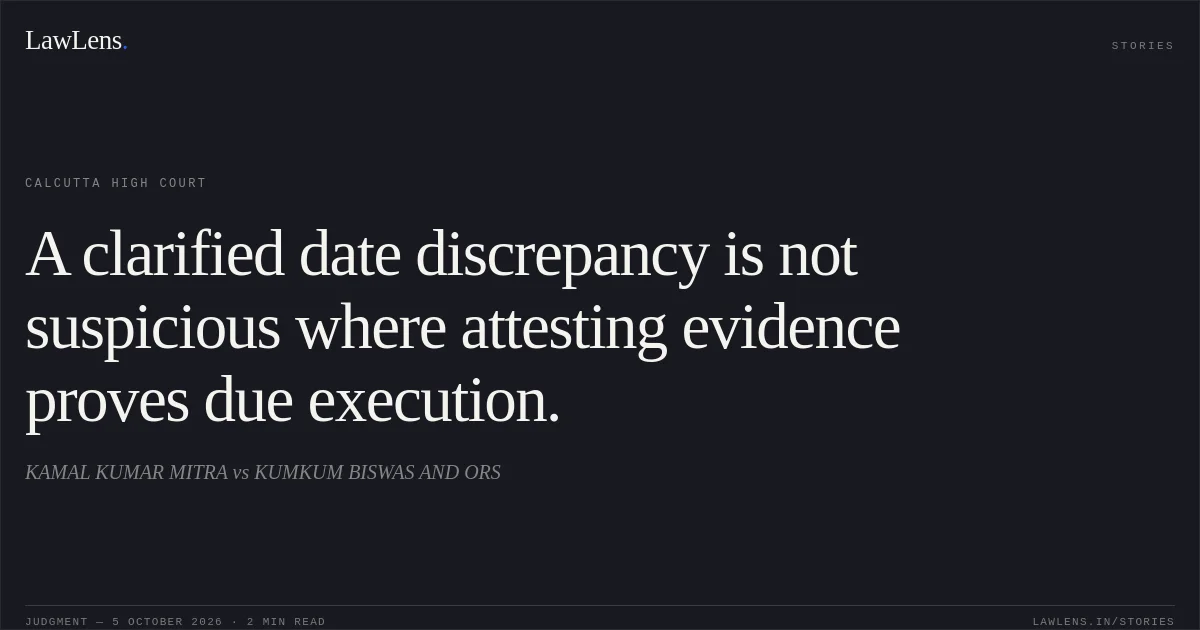
The Court accepted the attesting witness’s re-examination evidence that the Will was executed on 27 February 2001, the same date it was registered. The registration officer’s evidence corroborated that the Will was presented for registration on that date.
¶ 11The witness also established that the testator signed the Will first and that the attesting witnesses signed at the testator’s request and in his presence. The Court therefore found due execution proved and held that the initial discrepancy about the date did not constitute a suspicious circumstance.
¶ 1105Holding
The Court allowed the appeal and granted probate of the registered Will dated 27 February 2001.
¶ 12–13APD/6/2026 was allowed without an order as to costs.
¶ 13Original Court PDF
KAMAL KUMAR MITRAvsKUMKUM BISWAS AND ORS
Click to open original judgment
Original judgment, available to read, download and summarize on LawLens.in