Facts
The appellants sought the revocation of a probate previously granted by a District Delegate in 1989 regarding a non-contentious proceeding
Source reference: p. 2, para. 1They filed a revocation application (Misc. Judicial Case No. 15 of 2020) before the District Judge at Coochbehar, claiming they were unaware of the original probate proceedings and thus could not object at that time
Source reference: p. 4, para. 15On 16th December 2021, the District Judge returned the application, ruling that the proper forum for revocation was the District Delegate (the Additional District Judge) who originally granted the probate
Source reference: p. 2, para. 2The appellants challenged this order, arguing that once revocation is sought, the matter becomes "contentious," stripping the District Delegate of jurisdiction
Source reference: p. 2, para. 3-4Issues
1. Whether a District Delegate has the power and jurisdiction to adjudicate an application for the revocation of a probate granted by it
Source reference: p. 3, para. 102. Whether the District Judge is the appropriate forum to decide contentious issues relating to the revocation of probate
Source reference: p. 2, para. 5; p. 5, para. 25Law Applied
The court applied Section 264(1) of the Succession Act, 1925, which vests the District Judge with the jurisdiction to grant and revoke probates in all cases
Source reference: p. 3, para. 11Section 265 limits the District Delegate’s authority to granting probate only in "non-contentious" cases
Source reference: p. 3, para. 12-13Under Section 288, if a case becomes contentious, the Delegate must return the application for presentation before the District Judge
Source reference: p. 5, para. 20The court relied on Kailash Chandra v. Nanda Kumar (AIR 1944 Cal 385), establishing that revocation applications are contentious by nature and Mrs. Sara Moiz Khyrullah v. Sri Dilip Kumar Singh (2016 1 CalHCN 16), which clarified that the power to revoke is not conferred upon District Delegates
Source reference: p. 3, para. 5, 8; p. 4, para. 17; p. 5, para. 21Reasoning
The Court reasoned that while a District Delegate may grant probate in an initial non-contentious stage, they lack the legal mandate to handle "contentious" matters
Source reference: p. 3, para. 14An application for revocation is inherently contentious because it challenges the validity of a grant; therefore, treating it as within the Delegate's jurisdiction would lead to the "anomalous result" of a Delegate pronouncing a will spurious—an act they are expressly barred from doing in a grant proceeding under Section 286
Source reference: p. 4, para. 18-19The Court noted that what cannot be done directly (deciding a contested grant) cannot be done indirectly (deciding a revocation)
Source reference: p. 4, para. 19Consequently, even if the Delegate issued the original grant, only the District Judge holds the statutory authority to adjudicate the revocation
Source reference: p. 5, para. 22, 25Holding
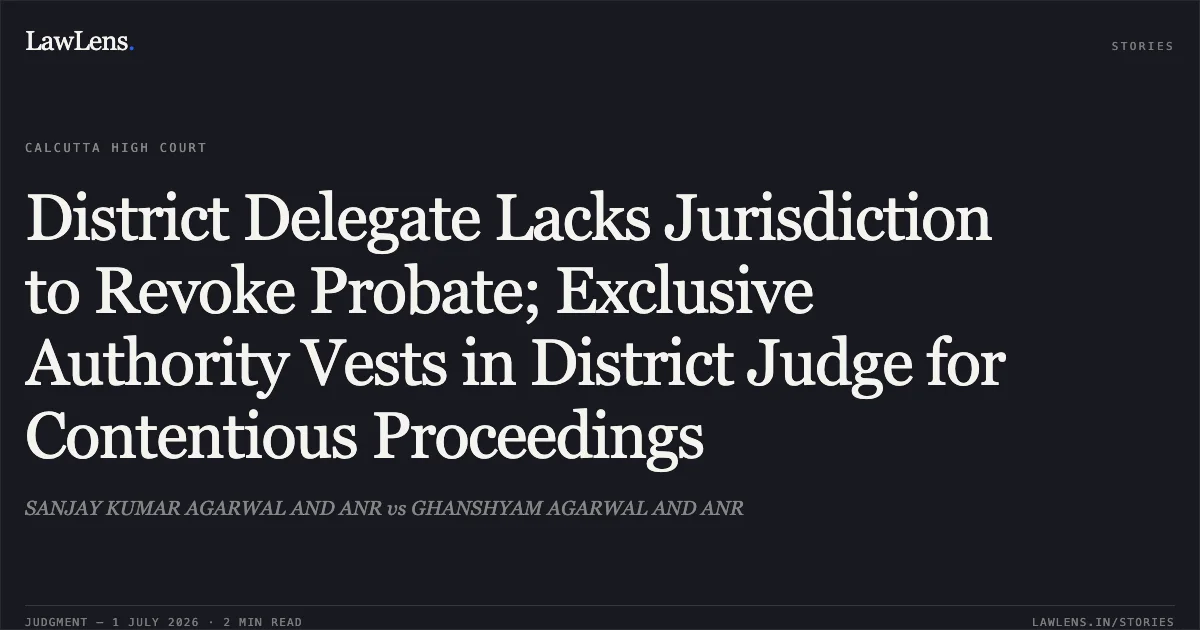
The Court answered that the District Delegate has no jurisdiction to revoke probate; such power rests solely with the District Judge
The High Court set aside the District Judge’s order dated 16th December 2021 as erroneous and contrary to law, directed the District Judge to adjudicate the revocation application on its merits and to dispose of the matter as expeditiously as possible
Source reference: p. 6, para. 26, 27-28The appeal (FAT 15 of 2026) and the application for condonation of delay (CAN 1 of 2026) were allowed
Source reference: p. 2, para. 5; p. 6, para. 29Acts & Sections Cited
5 provisions across 1 statute referred to in this judgment. Each provision opens on LawLens.
Indian Succession Act, 19255
Original Court PDF
SANJAY KUMAR AGARWAL AND ANRvsGHANSHYAM AGARWAL AND ANR
Click to open original judgment
Original judgment, available to read, download and summarize on LawLens.in