Facts
Respondent Nos. 1 and 2 instituted a suit under Section 229-B of the Uttarakhand Zamindari Abolition and Land Reforms Act, 1950, claiming bhumidhari rights with transferable rights over agricultural land allegedly purchased by their predecessors-in-interest approximately 20–22 years earlier.
Source reference: para. 2The plaint did not specify the date or nature of the alleged purchase document, nor did it refer to any agreement or contract for sale.
Source reference: para. 2–3The petitioners, who were recorded as bhumidhars with non-transferable rights, denied the alleged sale and asserted that the respondents were merely bataidars/sharecroppers.
Source reference: para. 4–5The Assistant Collector decreed the suit on the basis of photocopies of two unregistered contracts for sale dated 13 July 1989 and 23 May 1990.
Source reference: para. 7The Commissioner dismissed the petitioners’ first appeal cursorily, and the Board of Revenue dismissed their second appeal.
Source reference: para. 12–13The petitioners therefore invoked the High Court’s supervisory jurisdiction under Article 227 of the Constitution.
Source reference: no citationIssues
Whether the courts below could decree a suit under Section 229-B of the Z.A. Act on the basis of contracts for sale that were neither pleaded in the plaint nor made the subject of any framed issue?
Source reference: para. 14–16, 30, 39, 43–45Whether possession obtained pursuant to a contract for sale could be treated as adverse possession from the date of entry, without specific pleadings and proof regarding the date and circumstances on which possession became hostile to the true owner?
Source reference: para. 18, 34–42, 49–53Whether mere long possession and the failure to institute ejectment proceedings under Section 209 of the Z.A. Act were sufficient to confer bhumidhari rights under Section 210 of that Act?
Source reference: para. 28, 34–40Whether the findings and orders of the revenue authorities disclosed such a grave legal error or dereliction of duty as to warrant interference under Article 227 of the Constitution?
Source reference: para. 58–60Law Applied
The Court applied Sections 341, 229-B, 209 and 210 of the Uttarakhand Z.A. Act, together with Sections 54 and 53-A of the Transfer of Property Act, 1882, and the principles governing adverse possession.
Source reference: no citationUnder Section 54, a contract for sale does not itself create any interest in or charge on immovable property and does not transfer ownership.
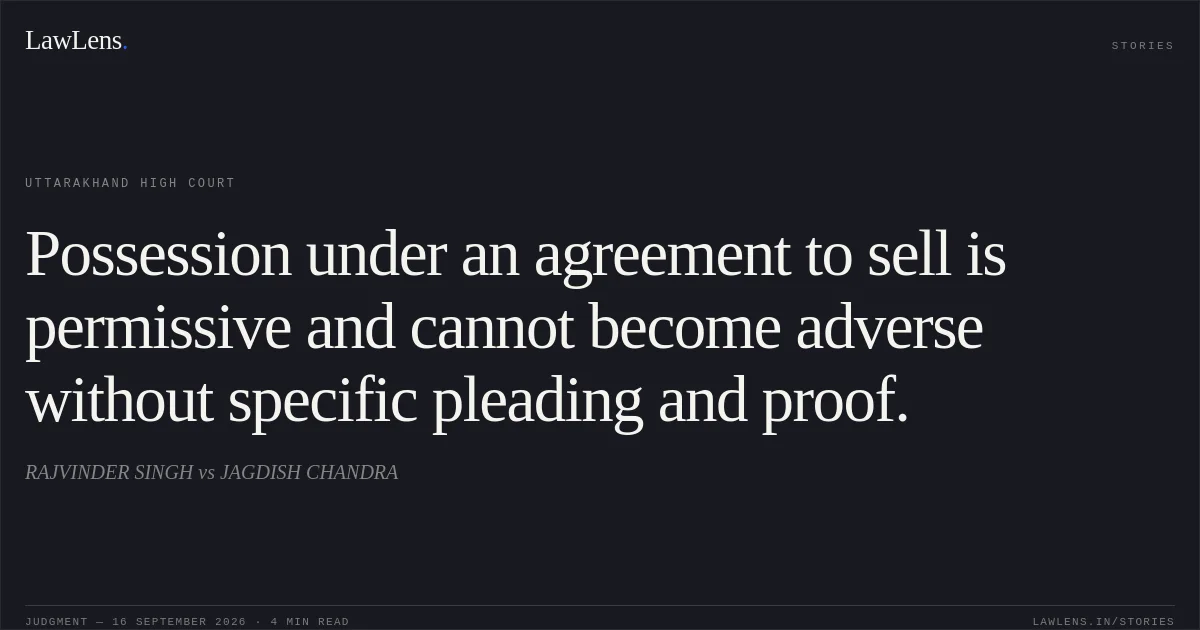
Source reference: para. 32, 49Possession under an executory contract for sale is ordinarily permissive and cannot become adverse unless hostile title is expressly asserted and proved to the knowledge of the true owner for the statutory period.
Source reference: para. 50–52Adverse possession must be specifically pleaded and proved, including the date on which possession became adverse, its continuity, publicity, openness and hostile character; mere long possession is insufficient.
Source reference: para. 35–38, 40–42The Court relied on S.M. Karim v. Mst. Bibi Sakina, P.T. Munichikkanna Reddy v. Revamma, Narasamma v. A. Krishnappa, State Bank of Travancore v. Aravindan Kunju Panicker, Bhura Mogiya v. Satish Pagariya, Achal Reddy v. Ramakrishna Reddiar, and Karnataka Board of Wakf v. Government of India.
Source reference: no citationIt further held that civil proceedings must be decided on the pleadings and issues framed, as recognised in Ponnayal alias Lakshmi v. Karuppannan and Maria Margarida Sequeira Fernandes v. Erasmo Jack de Sequeira.
Source reference: para. 43–48Under Article 227, the High Court may intervene where subordinate courts commit grave dereliction of duty, violate fundamental principles of law, or record perverse findings unsupported by evidence.
Source reference: para. 58–59Reasoning
The High Court held that the revenue authorities impermissibly travelled beyond the pleadings and issues.
Source reference: no citationThe plaint merely alleged that the land had been purchased 20–22 years earlier and alternatively claimed adverse possession; it contained no pleading regarding any contract for sale, its date, terms or legal effect.
Source reference: para. 2–3, 30No issue was framed concerning the alleged contracts dated 13 July 1989 and 23 May 1990, yet the Assistant Collector relied upon them to conclude that possession was adverse from inception.
Source reference: para. 7, 39This reasoning was legally unsustainable because a contract for sale does not convey title, and possession under such a contract is permissive rather than hostile.
Source reference: para. 32, 49–52The respondents also failed to plead or prove when their possession allegedly became adverse, or any overt act communicating hostile title to the petitioners.
Source reference: no citationTheir witnesses merely stated that they had seen the respondents cultivating the land, which did not establish adverse possession.
Source reference: para. 33The failure to bring an ejectment action under Section 209 could not, by itself, confer rights where the initial possession was permissive.
Source reference: para. 40The Commissioner and Board of Revenue further failed to properly examine these legal deficiencies and disposed of the appeals largely on the basis of prolonged possession.
Source reference: para. 54–56These errors constituted a grave departure from settled principles of pleadings, evidence and adverse possession, justifying interference under Article 227.
Source reference: para. 58–60Holding
The High Court held that the respondents could not be declared bhumidhars with transferable rights merely on the basis of unpleaded and untried contracts for sale, nor could their possession be treated as adverse from the date of entry.
Mere long possession or non-filing of an ejectment suit under Section 209 of the Z.A. Act did not establish adverse title.
Source reference: para. 40, 49–53The judgments and orders of the Assistant Collector, Commissioner and Board of Revenue were set aside.
Source reference: para. 61The writ petition was allowed, and the matter was remanded to the Assistant Collector, First Class, Haldwani, for fresh adjudication in accordance with law.
Source reference: para. 62–63Acts & Sections Cited
4 provisions across 4 statutes referred to in this judgment. Each provision opens on LawLens.
Registration Act, 19081
Transfer of Property Act, 18821
Limitation Act, 19631
Code of Civil Procedure, 19081
Original Court PDF
RAJVINDER SINGHvsJAGDISH CHANDRA
Click to open original judgment
Original judgment, available to read, download and summarize on LawLens.in