Facts
The petitioners were tenants in portions of the subject property. Eviction proceedings were earlier initiated under the Tamil Nadu Buildings (Lease and Rent Control) Act, 1960 by all the co-owners, but those proceedings were subsequently dismissed as not pressed. The tenants thereafter continued in occupation under the co-owners
Source reference: para. 4; p. 3; para. 11; pp. 6–7Subsequently, K.M. Mohammed Noordeen, one of several co-owners, issued notices alleging that the tenants had failed to execute tenancy agreements as required under Section 4(2) of the Tamil Nadu Regulation of Rights and Responsibilities of Landlords and Tenants Act, 2017 (“TNRRRLT Act”). He then filed eviction petitions under Section 21(2)(a) of that Act, claiming himself to be the absolute owner. The other co-owners were neither joined nor shown to have consented to the proceedings
Source reference: paras. 3–4, 10–12; pp. 2–7The Rent Court ordered eviction. The Rent Tribunal dismissed the tenants’ appeals and affirmed the eviction orders. The tenants challenged those concurrent findings under Article 227 of the Constitution, contending that the petitions were not maintainable when filed by only one co-owner in the circumstances of the case
Source reference: paras. 3–5; pp. 2–3Issues
Whether one co-owner could maintain eviction proceedings under Section 21(2)(a) of the TNRRRLT Act on the allegation that the tenants had failed to enter into a tenancy agreement, despite the existence of other co-owners who were not parties to the proceedings?
Source reference: paras. 8–12; pp. 4–7Whether the earlier order permitting the tenants to raise the maintainability objection during trial precluded them from challenging the eviction orders in revision?
Source reference: para. 13; p. 7Whether the concurrent orders of the Rent Court and Rent Tribunal warranted interference under Article 227 of the Constitution?
Source reference: para. 14; p. 8Law Applied
The Court applied Section 21(2)(a) of the TNRRRLT Act, which permits recovery of possession on the statutory ground alleged by the landlord, and Section 4(2), concerning the requirement of entering into a tenancy agreement
Source reference: paras. 3, 10; pp. 2, 6It recognised the general rent-control principle that a co-owner may ordinarily maintain eviction proceedings on behalf of the other co-owners. However, that principle is fact-sensitive and cannot automatically apply where the relief sought, or the manner in which it is sought, may affect the rights of the other co-owners
Source reference: paras. 8–10; pp. 4–6The Court relied on Manharlal J. Parekh v. V.L. Narayanan, (2008) 3 CTC 516, which held that, where eviction on the ground of demolition and reconstruction could adversely affect the rights of other co-owners, the proceeding could not be maintained without their consent
Source reference: para. 9; pp. 5–6The Court also exercised its supervisory jurisdiction under Article 227 to correct perverse or legally erroneous findings by subordinate courts
Source reference: para. 14; p. 8Reasoning
Although a co-owner may ordinarily represent the interests of all co-owners in rent-control proceedings, the present case involved a specific statutory ground based on the alleged failure to execute a tenancy agreement. Noordeen asserted that he alone was the absolute owner and claimed that the tenants had been inducted by him, despite the earlier proceedings having been instituted by all co-owners and despite the absence of any consent, release, or transfer of interest in his favour
Source reference: paras. 10–12; pp. 6–7The Court found that the earlier proceedings demonstrated that the tenants’ occupation was under all the co-owners, not exclusively under Noordeen. In those circumstances, Noordeen could not, while suppressing the earlier proceedings and denying the co-owners’ interests, unilaterally invoke Section 21(2)(a) as the alleged absolute landlord
Source reference: paras. 11–12; pp. 6–7The prior order concerning the tenants’ interlocutory applications did not operate as res judicata because it expressly preserved their right to raise maintainability during trial; the passing reference to the general co-owner principle was not a final adjudication of the present objection
Source reference: para. 13; p. 7The subordinate courts therefore committed a serious legal error in ordering eviction, justifying interference under Article 227
Source reference: para. 14; p. 8Holding
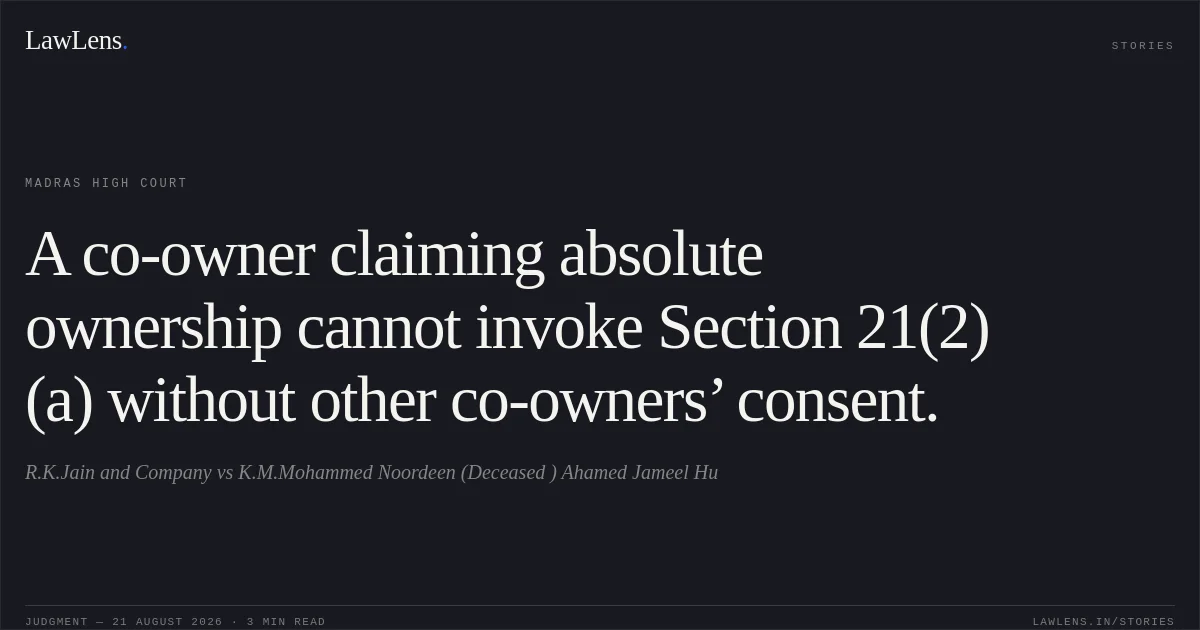
The High Court held that, on the facts of the case, a single co-owner who incorrectly claimed to be the absolute owner could not maintain eviction proceedings under Section 21(2)(a) of the TNRRRLT Act without joining or obtaining the consent of the other co-owners
The Civil Revision Petitions were allowed, and the orders of the Rent Court and Rent Tribunal directing recovery of possession were set aside
Source reference: para. 15; pp. 8–9The Court clarified that the landlords were at liberty to file fresh eviction applications by including the other co-owners and approaching the Rent Court afresh. The connected miscellaneous petitions were closed, with no order as to costs
Source reference: para. 15; p. 9Acts & Sections Cited
4 provisions across 2 statutes referred to in this judgment. Linked provisions open on LawLens.
Tamil Nadu Regulation of Rights and Responsibilities of Landlords and Tenants Act, 20172
Tamil Nadu Buildings (Lease and Rent Control) Act, 19602
Original Court PDF
R.K.Jain and CompanyvsK.M.Mohammed Noordeen (Deceased ) Ahamed Jameel Hu
Click to open original judgment
Original judgment, available to read, download and summarize on LawLens.in