Facts
The respondent sued for possession, alleging that the appellant had been permitted to occupy the ground and first floors of the property from June 2010 on payment of ₹7,000 per month, and had failed to vacate after notice.
Source reference: p. 2–3The appellant denied any tenancy, claimed ownership under a Will dated 29 March 2010, and alternatively asserted that he occupied the property as a caretaker.
Source reference: p. 3–5, 12–13The trial court dismissed the suit, finding that the respondent had not proved the tenancy or his asserted Will.
Source reference: p. 6–7On first appeal, the District Judge found that neither party had proved their respective Will, but held that the respondent had inherited an interest as a co-owner and decreed possession; it denied occupation charges for want of proof.
Source reference: p. 7–8The appellant challenged that decree in this second appeal.
Source reference: p. 8–10Issues
1. Whether the respondent, despite failing to prove the Will relied upon, had locus standi as a legal heir and co-owner to seek possession.
Source reference: p. 11–122. Whether the appellant established an independent right to remain in possession through his Will or caretaker claim.
Source reference: p. 12–153. Whether the possession decree could stand despite the absence of a landlord–tenant relationship and an issue specifically framed on the Wills.
Source reference: p. 15–164. Whether the appeal raised a substantial question of law under Section 100 CPC.
Source reference: p. 17Law Applied
Section 100 CPC limits a regular second appeal to cases involving a substantial question of law.
Source reference: p. 1, 17Under the Hindu Succession Act, 1956, property devolves upon the deceased’s legal heirs where no effective testamentary disposition is established; a legal-heir co-owner may maintain a possession claim against a person unable to establish a superior or independent right.
Source reference: p. 11–12, 15–16A Will must be duly proved, and where suspicious circumstances arise, the propounder must satisfactorily explain them; proof of execution and attestation alone may not suffice.
Source reference: p. 13–15The judgment also treated the notice to vacate as terminating any permissive occupation.
Source reference: p. 15Reasoning
The Court accepted that the respondent had failed to prove his Will, but found that this did not defeat his claim: the deceased owner was survived by the respondent, his son, and the children of a predeceased daughter, giving the respondent an inherited co-ownership interest.
Source reference: p. 11–12The appellant, in turn, failed to establish his claimed Will: although attestation evidence was offered, the circumstances surrounding the Will—including its execution shortly after the property’s purchase, the lack of evidence supporting the alleged caregiving or financial contribution, and the exclusion of the deceased’s natural heirs—remained unexplained.
Source reference: p. 13–15The Court held that the Wills were relevant to the parties’ competing claims of right even though no separate issue had been framed on them.
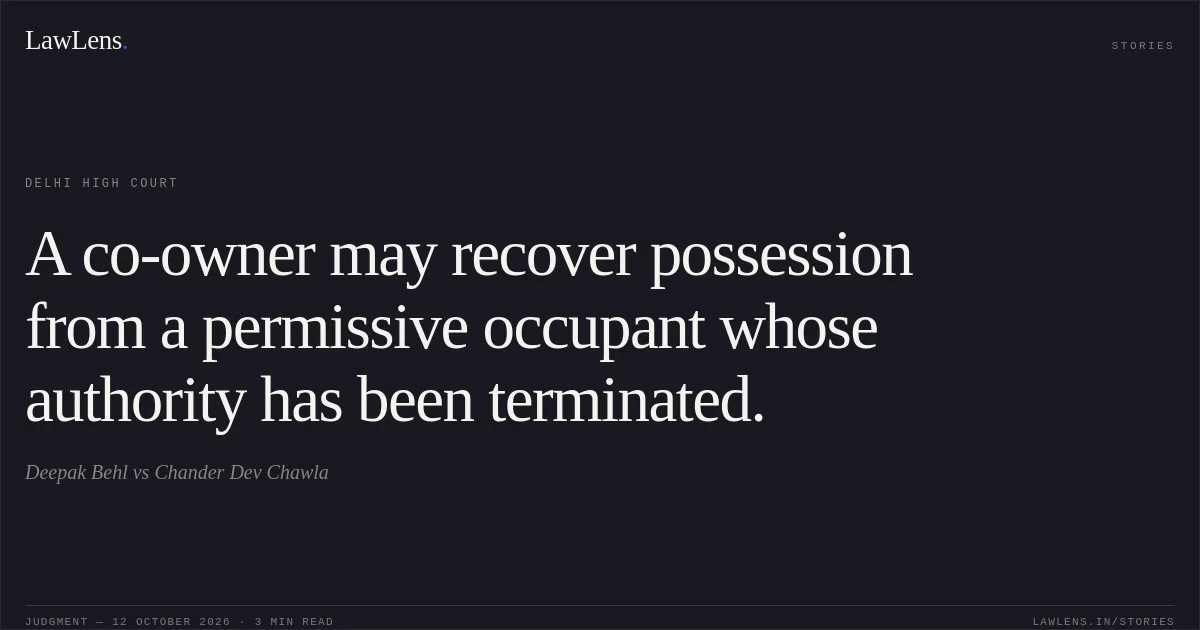
Source reference: p. 15–16Because the appellant established no independent right to possession, the absence of a landlord–tenant relationship did not bar the respondent, as co-owner, from obtaining possession.
Source reference: p. 16The respondent had not, however, proved his claim for mesne profits.
Source reference: p. 16Holding
The Court held that no substantial question of law arose and dismissed the regular second appeal.
It upheld the decree for possession, directing the appellant to deliver peaceful vacant possession within three months; failing that, he was directed to pay ₹10,000 per month for unauthorised occupation.
Source reference: p. 17The claim for user and occupation charges before that period remained denied for want of evidence.
Source reference: p. 16–17Acts & Sections Cited
2 provisions across 2 statutes referred to in this judgment. Each provision opens on LawLens.
Code of Civil Procedure, 19081
Transfer of Property Act, 18821
Original Court PDF
Deepak BehlvsChander Dev Chawla
Click to open original judgment
Original judgment, available to read, download and summarize on LawLens.in