01Facts
The plaintiff/respondent no. 1 instituted a partition suit concerning the disputed property and obtained a temporary injunction restraining alteration of the nature and character of the suit property by Order No. 7 dated 8 June 2026 of the Civil Judge, Senior Division, Second Court, Contai, Purba Medinipur.
¶ 2 · ¶ 31Defendant no. 5/appellant challenged the injunction, contending that Aparna Das, the alleged vendor/exchanger in favour of the plaintiff, had transferred a specifically demarcated portion and that the property was therefore not joint.
¶ 3–5, 24The appellant also claimed to have invested substantial sums and obtained a sanctioned building plan for construction on his allegedly demarcated portion, although construction had not commenced.
¶ 3–5, 24The plaintiff alleged that the proposed construction would destroy or encroach upon a common passage adjoining the property received through the exchange deed.
¶ 9–10, 25The appellant further disputed the exchange deed as fraudulent, while the plaintiff contended that this implicitly acknowledged the deed’s existence and raised a triable issue.
¶ 11–1202Issues
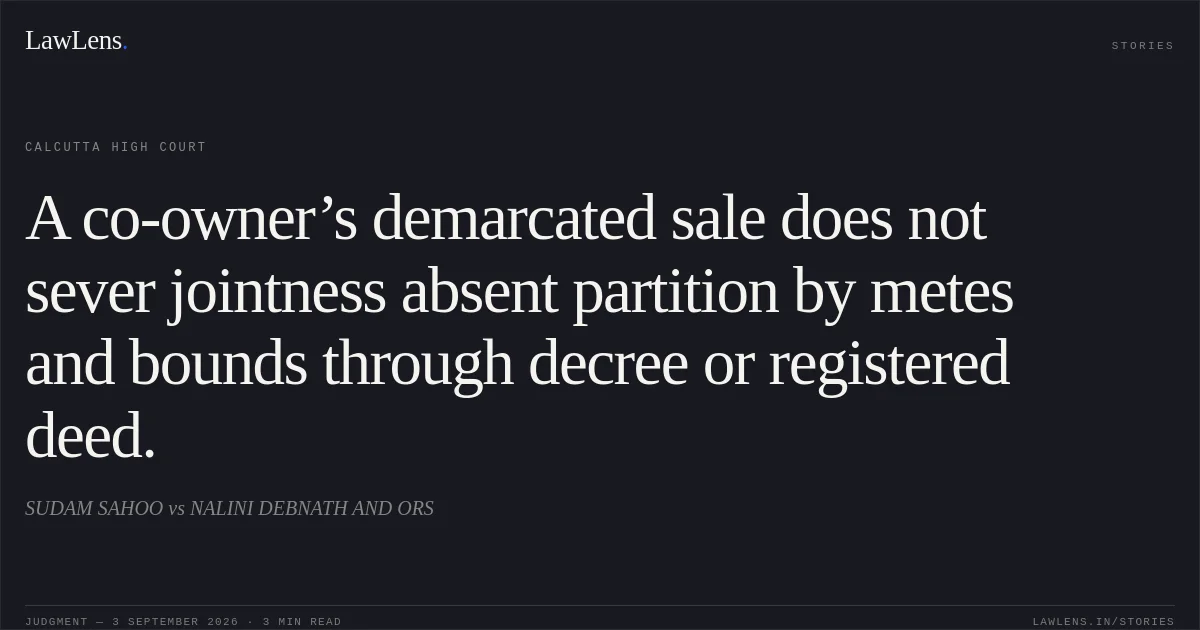
i.1. Whether the transfer or exchange by a co-owner of a demarcated portion of jointly owned property, without partition by metes and bounds, severed the jointness of the property under Section 14 of the West Bengal Land Reforms Act, 1955.
¶ 13, 18–23ii.2. Whether the plaintiff established a prima facie case, balance of convenience, and likelihood of irreparable injury warranting temporary injunction against the appellant’s proposed construction.
¶ 6, 25–29iii.3. Whether the Trial Court’s failure to expressly articulate the three tests for temporary injunction justified appellate interference.
¶ 26–3003Law Applied
The Court applied Section 14 of the West Bengal Land Reforms Act, 1955, holding that jointness is not disturbed unless the property is partitioned by metes and bounds through a competent court’s partition decree or a registered deed of partition, even where a co-owner has transferred a demarcated portion.
¶ 18It distinguished Sm. Labanya Bala Debi v. Sm. Parul Bala Debi, 77 CWN 272, and Sk. Samser Ali v. Serina Bibi, 2012 (2) CHN 694, where a single original owner had transferred specified portions of the property; such cases did not involve a co-owner transferring part of jointly held property.
¶ 14–20Temporary injunction requires consideration of a prima facie case, balance of convenience and inconvenience, and likelihood of irreparable injury.
¶ 6, 28–29An appellate court may supply additional reasons where it agrees with the Trial Court’s conclusion, despite the Trial Court not expressing each test in precise terms.
¶ 26Provisions in the judgment · 1 · Linked ones open on LawLens
west bengal land reforms act, 1955 Section 14
04Reasoning
The Court held that the plaintiff had made a prima facie case that Aparna Das was herself a co-owner of the entire property and that her exchange of a demarcated portion did not, at the interlocutory stage, sever the property’s joint character in the absence of partition by metes and bounds.
¶ 21–23The appellant’s allegation that the exchange deed was fraudulent raised a matter requiring evidence at trial and could not conclusively defeat the injunction application.
¶ 11–12, 23Since construction had not commenced, and the proposed construction allegedly threatened a common passage, the balance of convenience favoured preservation of the existing state of the property.
¶ 24–25Construction could cause irreversible consequences and prejudice the plaintiff’s rights if the partition suit ultimately succeeded, thereby satisfying the requirement of irreparable injury.
¶ 29Although the Trial Court had not expressly stated the three injunction tests in exact terms, its reasoned consideration of the parties’ contentions and materials justified affirmance.
¶ 26–2805Holding
The appeal was dismissed on contest against respondent no. 1, and the temporary injunction granted by the Trial Court was affirmed.
¶ 31The Court held that the alleged demarcated transfer by a co-owner did not, at the interlocutory stage, establish severance of the jointly owned property under Section 14 of the 1955 Act, and that the plaintiff satisfied the requirements for temporary injunction.
¶ 18, 28–30CAN 1 of 2026 was disposed of accordingly.
The Trial Court was requested to endeavour to dispose of the partition suit expeditiously, preferably within one year from communication of the order; there was no order as to costs.
¶ 32–34Original Court PDF
SUDAM SAHOOvsNALINI DEBNATH AND ORS
Click to open original judgment
Original judgment, available to read, download and summarize on LawLens.in