Facts
The suit property was a dwelling house originally owned by Hiralal and inherited by his three sons—Bhogiram, Mohanlal and Rajaram. Rajaram died unmarried and issueless. Motilal, predecessor of the present appellants, claimed that the portion allotted to Rajaram devolved upon him and that the respondents were interfering with his possession over a specific part of that property.
Source reference: para. 2–4During the suit, the appellants also sought mandatory injunction alleging that the respondents had raised construction over the disputed portion.
Source reference: para. 4The respondents denied that Rajaram’s share had been partitioned between the branches of Bhogiram and Mohanlal and contended that no party could claim any specific portion in the absence of partition.
Source reference: para. 5The trial court and first appellate court concurrently found that no partition of Rajaram’s share had taken place and dismissed the suit. The present appeal under Section 100 of the Code of Civil Procedure challenged those findings and the dismissal of the suit.
Source reference: para. 1, 6Issues
Whether, in the absence of partition of Rajaram’s share, the respondents had any right to raise construction over a specific portion of the suit property, and whether the appellants were consequently entitled to injunction?
Source reference: para. 7, 9Whether mandatory injunction could be granted for removal of the construction when the construction was not proved to have been raised during the pendency of the suit?
Source reference: para. 9–11Whether the High Court could pass a decree for partition in the present second appeal despite the absence of a specific partition claim and the non-joinder of necessary parties?
Source reference: para. 12Law Applied
The Court exercised jurisdiction under Section 100 CPC, which permits interference in a second appeal only on a substantial question of law.
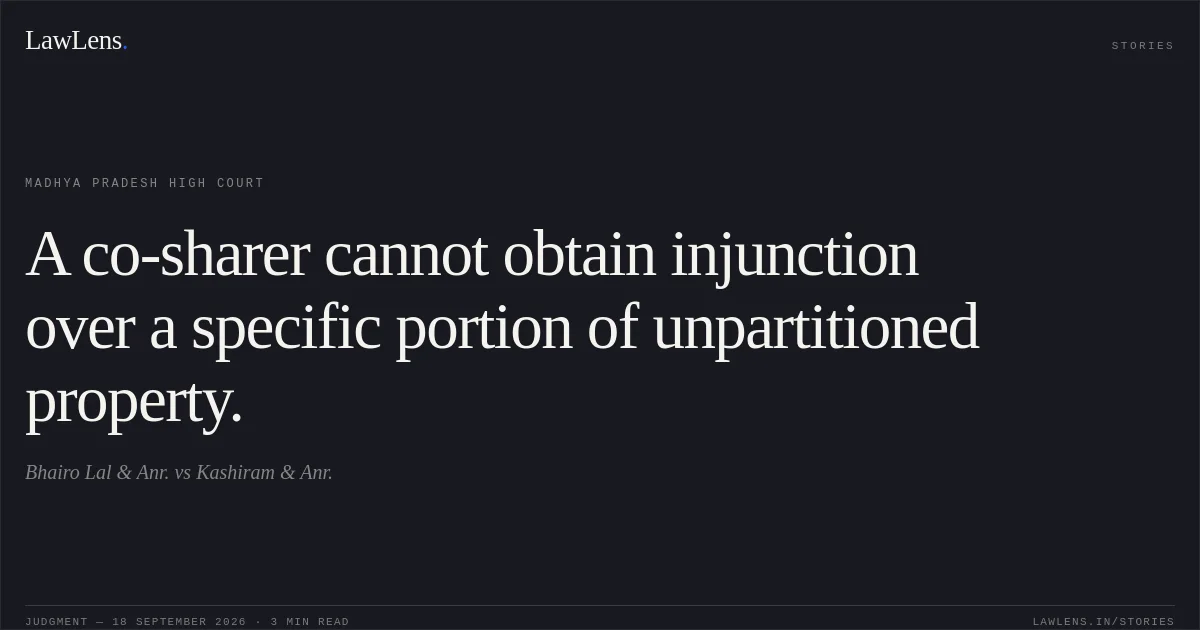
Source reference: para. 1, 7A co-sharer or heir cannot claim exclusive entitlement to, or raise construction over, a specific and unpartitioned portion of jointly inherited property; the parties must first obtain partition before asserting exclusive rights over any defined part.
Source reference: para. 8–10However, an injunction is preventive in nature and cannot ordinarily be granted to restrain an act that was completed before institution of the suit; nor would mandatory removal be ordered merely because construction exists on jointly held property when its timing and the parties’ ultimate shares remain unresolved.
Source reference: para. 9–11A partition decree cannot be passed in proceedings seeking only injunction, particularly where the specific area for partition is not established and all affected parties have not been impleaded.
Source reference: para. 12Reasoning
The concurrent finding that Rajaram’s share had not been partitioned was not shown to suffer from any legal or factual defect.
Source reference: para. 8Accordingly, the respondents could not claim a right to construct over any particular portion as against the other co-sharers; partition was legally necessary before exclusive possession of a defined area could be asserted.
Source reference: para. 9Nevertheless, the appellants failed to prove that the construction was raised during the pendency of the suit. Since the respondents’ case was that the construction pre-dated the suit, a prohibitory injunction could not operate retrospectively, and mandatory removal was not justified before determination of the parties’ respective shares through partition.
Source reference: para. 9–10The High Court also declined to convert the injunction suit into a partition proceeding because the precise area was not ascertainable from the record, Halkeram—another legal heir of Bhogiram—was not a party, and no relief of partition had been claimed.
Source reference: para. 12Holding
The substantial question of law was answered against the appellants.
The Court held that although the respondents had no exclusive right to construct over a specific unpartitioned portion of Rajaram’s share, neither permanent nor mandatory injunction could be granted because the construction was not proved to have been made during the pendency of the suit.
Source reference: para. 11The parties were left at liberty to seek partition, after which the question of removal could be considered if the construction fell within the appellants’ allotted share.
Source reference: para. 10The judgments and decrees of the courts below were affirmed, and the second appeal was dismissed.
Source reference: para. 13Acts & Sections Cited
1 provisions across 1 statute referred to in this judgment. Each provision opens on LawLens.
Code of Civil Procedure, 19081
Original Court PDF
Bhairo Lal & Anr.vsKashiram & Anr.
Click to open original judgment
Original judgment, available to read, download and summarize on LawLens.in